EPA Discussed Chromium Cleanup at Old Navco Road Factory in 2008
Archived WKRG coverage reported that the EPA planned cleanup and follow-up sampling at the former American Wheel and Bumper Factory in Mobile.
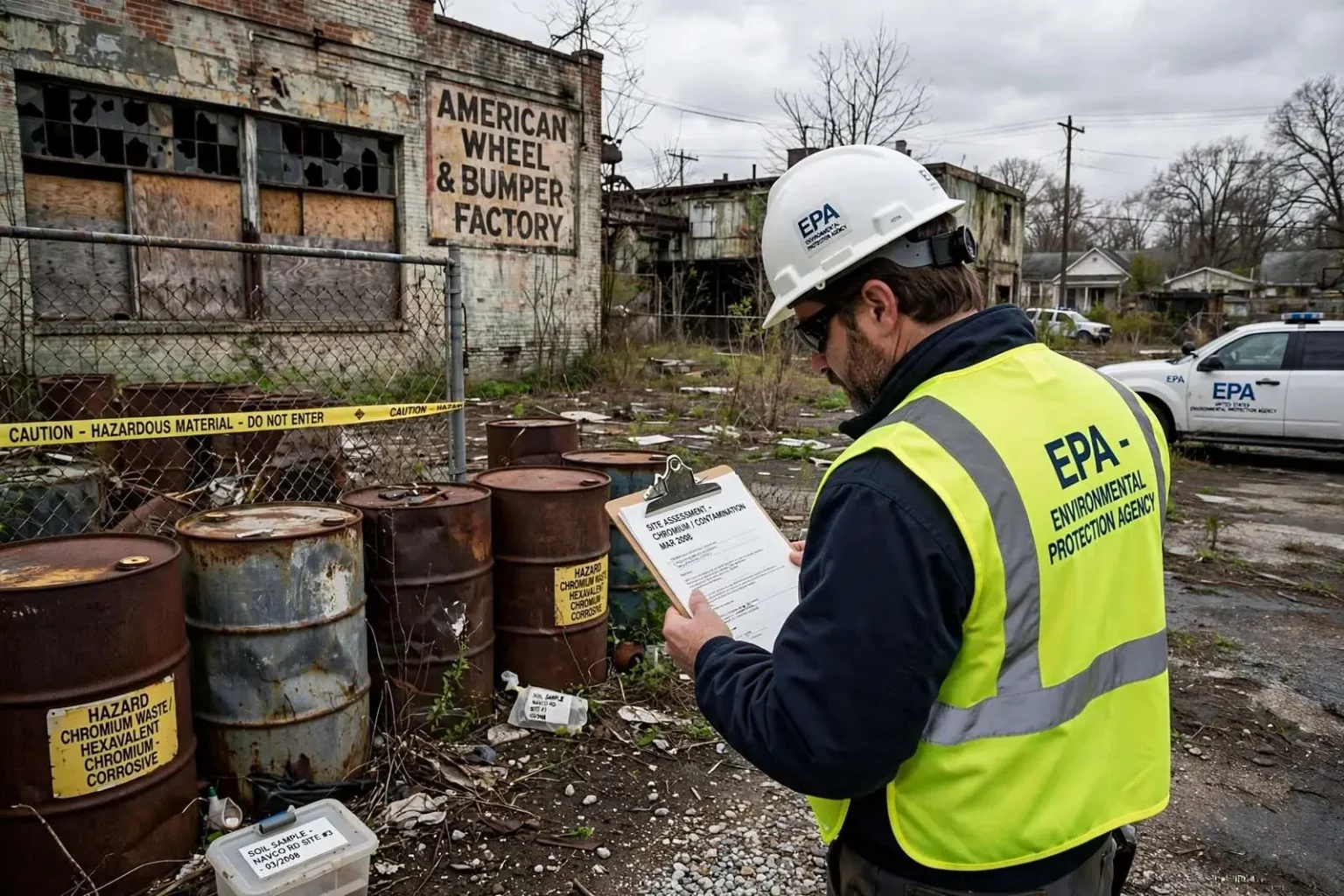
In March 2008, the Environmental Protection Agency told Mobile residents that chromium had been found in the ground around the former American Wheel and Bumper Factory on Navco Road, according to an archived local news report. The announcement focused attention on one of the aging industrial parcels scattered through Mobile’s western neighborhoods, where mid-century manufacturing plants once operated along corridors like Navco Road and then closed, leaving their properties to sit idle. For people who had lived near the factory for years, the news turned a quiet question into an urgent one: what had the site left behind, and how soon would it be cleaned up?
The factory, which had been closed for years, had manufactured car wheels and bumpers, and chromium had been used in that manufacturing process. Chromium plating and chromium-based treatments were widely used in the automotive industry because the metal resists corrosion, hardens surfaces, and gives finished parts a bright, durable finish. Facilities that handled chromium compounds on an industrial scale typically kept the material in drums, tanks, and vats, and spills, leaks, or improper disposal during a plant’s working life could leave residue in the soil long after the machinery was shut down and the workers went home.
What made the March 2008 report notable was not simply that chromium was present, but that the report said chromium-filled barrels and other hazardous materials remained on the site even after the factory had been closed for years. Drums left standing on an abandoned property can corrode over time, and rainwater moving through a site can carry contaminants deeper into the ground or toward neighboring land. Federal and state environmental agencies treat leftover chemical containers at an idle industrial property as a priority, because the condition of those containers determines how urgent a cleanup needs to be.
Why chromium in soil matters
Chromium occurs in several chemical forms, and they are not equally hazardous. Trivalent chromium is a naturally occurring element that, in small amounts, is even considered an essential trace nutrient for humans. Hexavalent chromium, by contrast, is the industrial form most often associated with plating operations, and health authorities have long recognized it as a serious concern when people are exposed to it through inhaled dust or, in some circumstances, through contaminated soil and water. That distinction is why environmental agencies respond carefully to any report of chromium at a former industrial site, and why soil sampling typically plays a central role in deciding what kind of cleanup is required.
Exposure risks around a site like this depend on how the contamination is situated. Chromium locked in soil several feet below the surface poses a different kind of concern than drums of liquid material sitting in the open, where containers could leak or where trespassers might come into direct contact with them. Agencies evaluating an abandoned plant generally begin by mapping where materials are stored, testing the soil around and beneath them, and checking whether anything has migrated off the property. Those early steps shape everything that follows, from the protective equipment crews wear to the way excavated soil is transported and disposed.
The Navco Road corridor runs through a part of Mobile where residential streets sit close to old commercial and industrial tracts, a pattern common across the city’s older neighborhoods. When a plant closes, the property often changes hands, sits vacant, or falls into disuse while homes continue to line the nearby blocks. That proximity is what turns an environmental finding at an idle factory into a neighborhood issue, and it is why residents in the area paid close attention when the EPA outlined its plans in 2008.
According to the archived report, the EPA said cleanup was expected to begin within a month of the March 2008 announcement, and that follow-up soil samples would be taken to confirm conditions after the initial work. A timetable framed in weeks rather than months or years signaled that the agency viewed the site as a removal action rather than a long-term study project. In environmental practice, a removal action is the fast-track path used when hazardous materials at a property need to be secured, containerized, or hauled away without waiting for a full, multi-year remedial investigation to run its course.
A typical cleanup of this kind follows a recognizable sequence. Crews first stabilize the site, often fencing it and controlling access. Then workers in protective gear open, characterize, and repack drums of chemical material, separating what can be safely managed from what requires licensed hazardous waste disposal. Contaminated soil identified by sampling is excavated and trucked to a permitted facility, and the holes are backfilled with clean material. Follow-up soil samples, like those the EPA said would be taken at the Navco Road site, are the verification step: new laboratory results show whether remaining concentrations meet the agency’s cleanup goals or whether more material has to be removed. Residents usually see the work as a series of unremarkable sights, including trucks, backhoes, and crews in white suits, but each stage is documented and reported back to the agency overseeing the project.
For the neighbors, the most meaningful part of any such announcement is often the promise of continued communication. Environmental cleanups are technical, and the agencies running them answer to laboratories and regulations that can seem remote from a front porch. That is where local organizations step in, translating timelines and test results into plain terms and pressing officials for answers about what the findings mean for the blocks around the site.
The River Park Community Action Group’s role
The report noted that the River Park Community Action Group welcomed the EPA’s response and planned another meeting with the agency for an update. Community action groups like this one are a familiar feature of Mobile neighborhoods that grew up around industry. They organize meetings, collect residents’ questions, and maintain a line of contact with city, state, and federal officials so that a cleanup does not quietly lose momentum once the initial announcement fades from the news.
The decision to schedule a follow-up meeting with the EPA reflected that approach. A first announcement tells residents what was found and what is planned; a second meeting is where they learn what the crews actually encountered, how much material was removed, and what the follow-up sampling showed. For a group representing people who live near the site, showing up consistently matters as much as the outcome of any single test, because ongoing attention is what keeps a property’s condition in front of the officials responsible for it.
Neighborhood organizations in similar situations across the Gulf Coast have historically served several functions at once. They document community concerns in a form agencies can respond to, they circulate accurate information in place of rumor, and they give individual residents a collective voice that is harder to disregard. In the case of the former American Wheel and Bumper Factory, the group’s reaction, as reported, was notably constructive: rather than opposing the agency, it welcomed the response and worked to stay engaged through the next round of updates.
The Navco Road episode fit into a much larger pattern across Mobile and the wider Gulf Coast, where decades of manufacturing, shipbuilding, and metalworking left behind properties that required environmental attention after their operators moved on. Cities in the region have grappled with how to return such parcels to productive use, a challenge that comes with its own vocabulary of brownfields, site assessments, and cleanup grants. Every former plant that is evaluated and cleaned becomes a case study in the same process the EPA described for the Navco Road site: identify what remains, remove the hazard, sample to confirm, and keep the surrounding community informed.
For residents of neighborhoods near old industrial tracts, the practical lessons from episodes like the 2008 chromium finding are consistent. Property next to a former manufacturing site does not automatically pose a risk, but it does warrant attention when reports surface about materials left on the property. Residents can follow the public record of agency actions, attend community meetings like those the River Park Community Action Group organized, and ask direct questions about whether contamination has been confirmed off-site. Environmental agencies generally make sampling results and cleanup milestones available to the public, and community groups that track those documents give their neighborhoods an early picture of what is happening.
What a chromium cleanup typically involves
Although each site is different, cleanups involving chromium generally draw on a familiar toolkit. Excavation and off-site disposal is the most direct approach, removing affected soil entirely. Stabilization treatments can chemically convert chromium into a less mobile, less hazardous form so it cannot move through the ground. Where contamination is deeper or more widespread, monitoring wells and long-term sampling plans may be used to track conditions over time. The choice among these methods depends on the amount of material involved, its chemical form, the depth of the soil affected, and how the property will be used afterward, whether as green space, commercial land, or something else entirely.
That is why the promise of follow-up soil samples carried real weight in the 2008 report. Initial samples establish where contamination exists; verification samples establish whether the cleanup actually achieved its goal. The gap between those two sets of numbers is where communities learn whether a site is genuinely resolved or whether additional rounds of work lie ahead.
The March 2008 announcement about the former American Wheel and Bumper Factory, as preserved in the archived report, captured a moment when a long-idle property moved back into active status. The EPA identified chromium in the ground, committed to starting cleanup within a month, and promised verification sampling, while a neighborhood organization prepared to press for updates. It was a snapshot of the ordinary machinery of environmental response at work in a Mobile neighborhood.
This is a historical account of the site’s reported conditions and cleanup plans at that time, not a current environmental advisory. Conditions at the property, along with any agency actions, may have changed substantially in the years since the report was published. Residents with questions about environmental conditions near their homes should consult current information from federal and state environmental agencies rather than relying on this archived account, which reflects only what was reported in March 2008 about the Navco Road site and the plans in place at that time.