Aerospace facilities in Mobile, AlabamaMobile's aerospace sector.

Historical report, published from archived local news coverage.

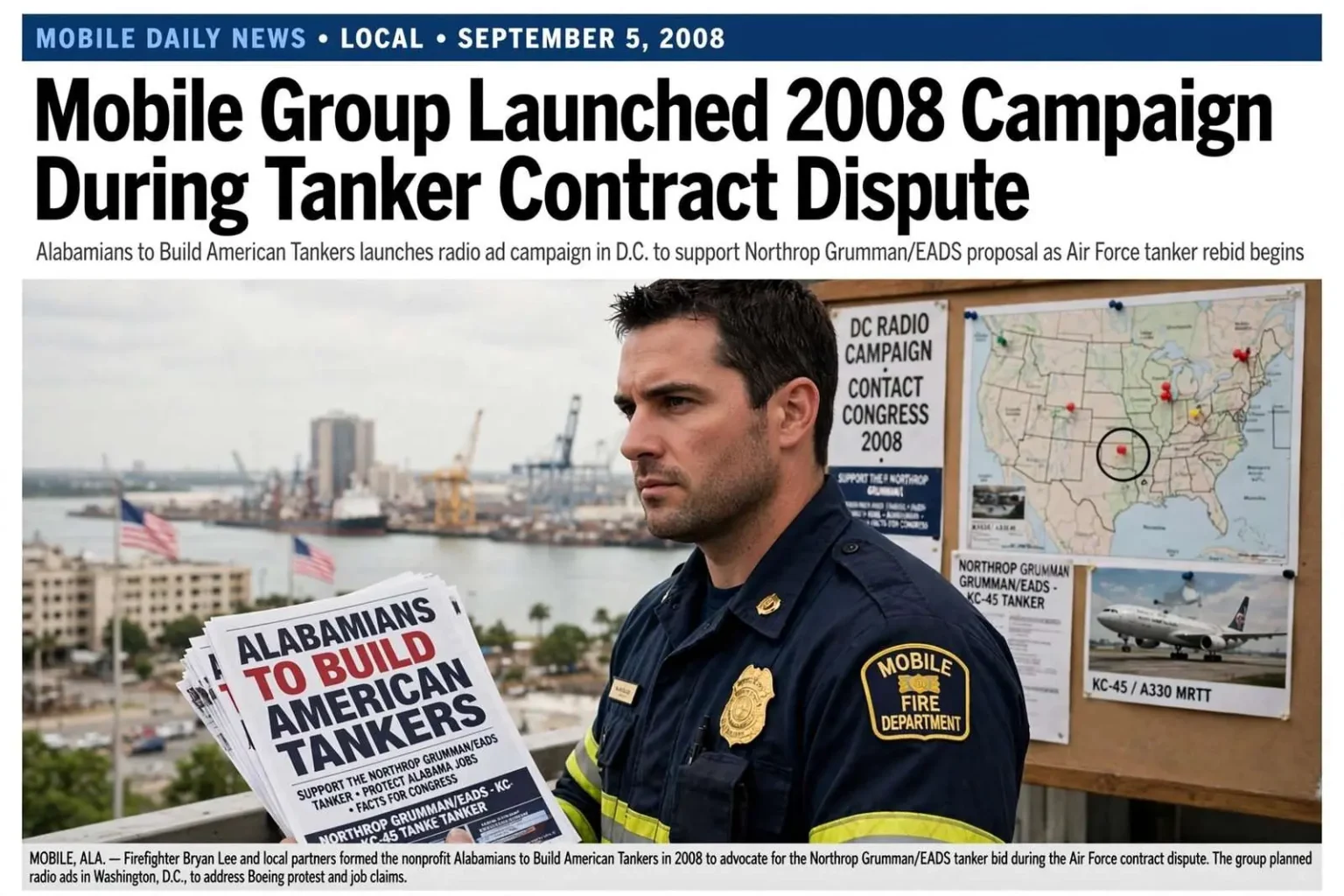
As the Air Force tanker-contract dispute continued in 2008, a Mobile-based group launched an advertising campaign to support the Northrop Grumman/EADS proposal, according to an archived local news report. The fight over who would build the military’s next generation of aerial refueling tankers had already become one of the most consequential industrial contests in Mobile’s history, and the city’s residents, officials, and business community followed every turn of it with unusual intensity — for good reason, since the winning bid promised thousands of jobs at a time when the region was working to diversify its economy.

Mobile firefighter Bryan Lee and several local partners formed the nonprofit Alabamians to Build American Tankers to enter the public debate directly. Lee told the station the group wanted to counter claims that a Northrop/EADS win would cost American jobs and to educate Congress about concerns it had raised about Boeing’s past record. The group planned radio advertising in the Washington, D.C., area as the renewed bidding process began, taking a locally rooted argument to the audience that mattered most — the lawmakers and opinion leaders who would shape the contract’s fate.

The stakes behind the ad campaign

The tanker contract at issue in 2008 involved replacing the Air Force’s aging fleet of KC-135 Stratotankers, aircraft that had been refueling American and allied fighters and bombers since the 1950s. The program’s size — a fleet replacement ultimately valued in the tens of billions of dollars — made it one of the largest defense acquisitions in history, and both competing proposals carried enormous weight for the communities attached to them. For Mobile, the Northrop Grumman/EADS proposal included plans to assemble the tankers at Brookley Field, the former Air Force base on the Mobile Bay waterfront that the city had spent decades trying to redevelop into an industrial and aerospace site.

That local stake explains why a firefighter, a profession with no direct tie to aerospace, would organize a nonprofit around a defense procurement. The prospect of assembly work at Brookley represented not just jobs at the plant but a foothold in an industry — commercial and military aircraft manufacturing — that the Gulf Coast had long sought. A win would have validated the city’s long courtship of aerospace employers and rippled through suppliers, ports, and schools training technical workers. A loss would have left Brookley waiting for its next tenant, as it had for years after the base closed.

See also  Bayside Academy Launches Mobile App for Daphne Families

The argument over “American jobs”

The central public controversy, and the one Lee’s group formed to answer, concerned where the tankers would actually be built and what “American jobs” meant in a globalized defense industry. Critics of the Northrop Grumman/EADS bid argued that the European parentage of EADS, the parent company of Airbus, made the proposal an outsourcing of American defense work. Supporters countered with the specifics of the plan: assembly at Brookley Field in Mobile, an American workforce, and American suppliers, with the work distributed across both continents in the manner of every major modern aircraft program.

Lee’s group framed its mission as education rather than attack — informing Congress about the concerns it had raised regarding Boeing’s past record on the tanker program and pushing back on the job-loss narrative. The archived report is careful, as this account is, to attribute those statements and allegations to the group and its organizers; a historical report does not determine the accuracy of their claims or the contract’s later outcome. But the structure of the argument reflected the era’s politics: the decision would be made not only on technical merit evaluated by the Air Force, but in the court of congressional and public opinion, where advertising on Washington radio stations was a recognized tool of advocacy.

How the dispute reached the rebid

The campaign took shape at a specific procedural moment. Northrop Grumman and EADS had originally won the competition — the Air Force selected their proposal over Boeing’s in early 2008 — and had planned to assemble the tankers at Brookley Field. Boeing protested the award to the Government Accountability Office, the congressional watchdog agency that reviews federal contract protests, and the GAO sustained key elements of the protest, recommending that the Air Force rebid the program. It was that recommendation, and the renewed bidding process that followed, that the Alabamians to Build American Tankers campaign was organized around, with its radio advertising planned as the new bidding began.

The GAO’s recommendation transformed the contest from a settled decision back into an open fight, and it set off months of maneuvering — by the companies, by the Air Force, and by the congressional delegations of the states that stood to gain or lose. Alabama’s officials had celebrated the original award as a generational economic victory; Washington State and Kansas officials, home to Boeing’s commercial and defense operations, had attacked it just as fiercely. The renewed bidding kept every one of those constituencies engaged, and it was in that atmosphere that a Mobile nonprofit bought radio time in the nation’s capital.

See also  Mobile, Baldwin County Turnout Matched Expectations in Alabama Primary Runoff, State Officials Say

Grassroots defense advocacy, Mobile-style

The episode is a study in how defense procurement battles reach down into local communities. Alabamians to Build American Tankers was not a corporate front in the shape described by the archived report but a locally organized nonprofit, founded by a Mobile firefighter and several local partners, that attempted to give the city’s hopes a voice in Washington. Grassroots advocacy of this kind — locals organizing around a federal contract decision — has a long history in Gulf Coast communities, from shipyard towns to launch-complex counties on the Space Coast, because federal procurement decisions concentrate their effects geographically.

A radio advertising campaign in the Washington, D.C., area was the chosen instrument, aimed at an audience of policymakers, staffers, and journalists rather than Alabama voters. The group’s two stated goals — countering the American-jobs argument against the Northrop/EADS bid, and educating Congress about Boeing’s record on the tanker program — tracked the two fronts on which the public fight was being waged: the economics of the bid and the reliability of the competitor.

The statements and allegations in this account are attributed to the group and its organizers. This historical report does not determine the accuracy of their claims or the contract’s later outcome, which unfolded over subsequent years and multiple rounds of competition.

Brookley Field and Mobile’s aerospace ambitions

Understanding why a firefighter organized a tanker nonprofit requires understanding what Brookley Field meant to Mobile. The base, closed in the 1960s, occupies a large waterfront site on Mobile Bay just south of downtown, and for decades its redevelopment was the city’s signature economic development project. The site became the Mobile Aeroplex at Brookley, hosting aviation maintenance, repair, and overhaul businesses and other industry, and city leaders consistently pursued aircraft manufacturing as the anchor the site needed. The Northrop Grumman/EADS tanker plan was the closest the community had come to landing it.

The stakes explain the breadth of the local coalition behind the bid — elected officials, the port authority, business groups, and private citizens like Lee. Whatever the merits of any argument in the dispute, the archived report captures a moment when a Gulf Coast city organized itself around the largest industrial prize it had ever pursued, and took its case to Washington by radio.

See also  Cracks Found in Hulls of Austal-Built Navy Ships, Including Mobile's USS Coronado

The tanker wars in context

The 2008 dispute was only one chapter in what became a decade-long saga. The aerial refueling fleet replacement had been contested repeatedly through the 2000s, with earlier leasing arrangements scrapped amid scandal, the 2008 award reversed after the GAO protest, and further rounds of competition and legal challenge to follow. Each restart reset the clock on the Air Force’s plans and kept the host communities in a state of suspended animation — hopeful in Mobile, defensive in Washington State, and litigious everywhere in between.

For Mobile specifically, the repeated reversals taught a civic lesson about the volatility of defense procurement. A single award decision could put thousands of assembly jobs on the table, and a single protest could take them off again, regardless of the quality of local preparation or the intensity of local support. That volatility is precisely what groups like Alabamians to Build American Tankers were responding to: if the decision would be remade in the political arena, then the political arena was where a city’s advocates needed to operate.

The archived report of the group’s founding and advertising plan preserves a snapshot of that advocacy at work — a firefighter with a nonprofit, local partners with a stake in the outcome, radio spots planned for the capital as the bidding reopened, and an argument built around American jobs assembled in Alabama. It stands as a record of how the Gulf Coast pursued, and contested for, its place in the aerospace industry during one of the most-watched defense competitions in modern history.

As with all historical reports on this site, the figures, statements, and characterizations above come from the archived local coverage of the period and are presented as they were reported at the time, not as verified present-day claims.