Mobile, Baldwin County Turnout Matched Expectations in Alabama Primary Runoff, State Officials Say
Alabama's Secretary of State says primary runoff turnout in Mobile and Baldwin counties matched expectations, while Mobile County's probate judge reports a smooth election despite some poll worker growing pains with a new voter registration system.
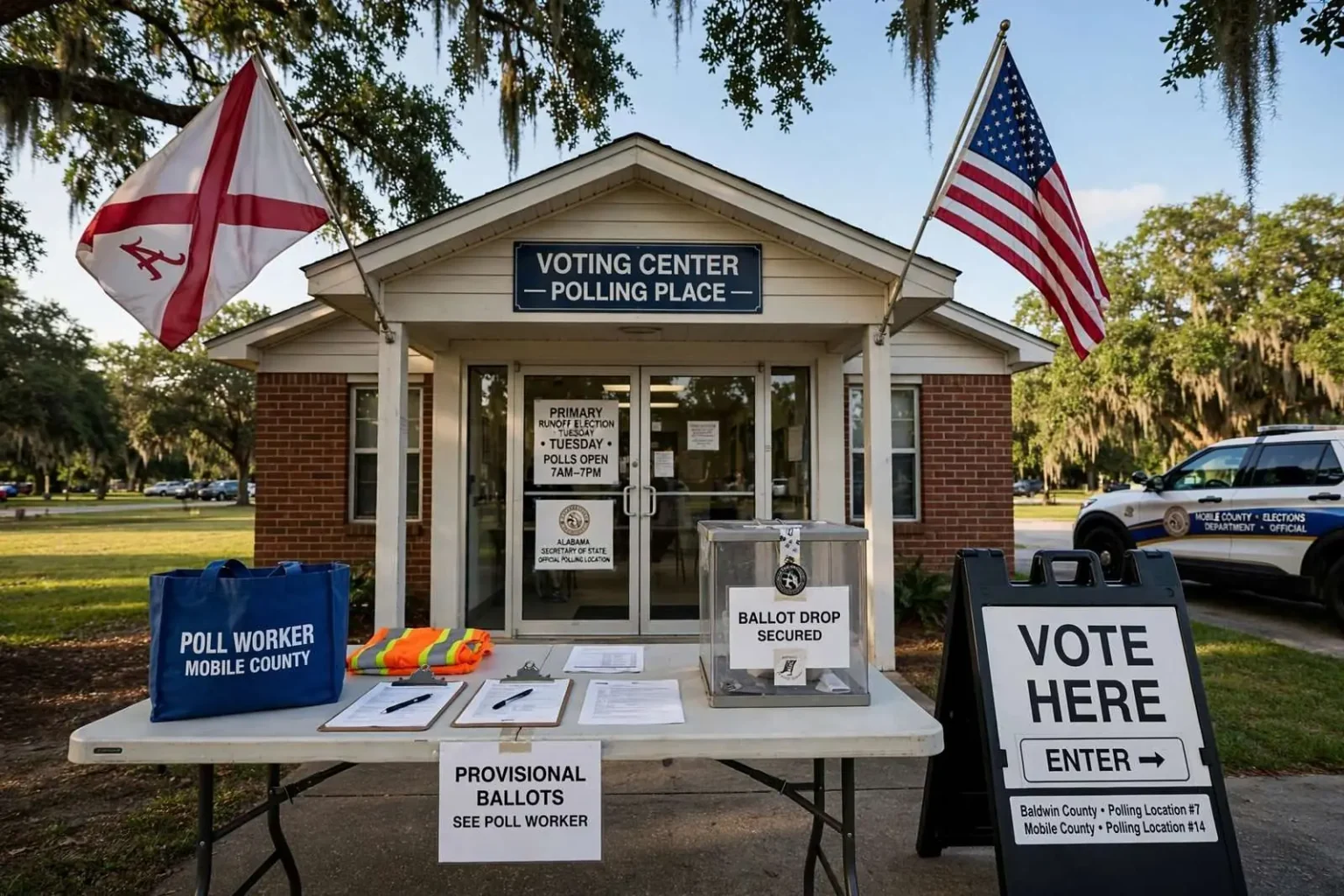
Alabama’s primary runoff election went off with only minor hiccups this week, and voter turnout across the state landed squarely within what election officials had projected, according to figures released by the Alabama Secretary of State’s office.
Statewide turnout for Tuesday’s runoff came in at 12.7 percent, with just under 464,600 ballots cast out of roughly 3.65 million registered voters across Alabama. Secretary of State John Merrill said his office had projected turnout somewhere between 10 and 15 percent heading into the runoff, and the final numbers landed right in that range.
The projection was not guesswork. Runoff elections in Alabama historically draw a small fraction of the electorate that a general election brings out, and the office’s models have learned to account for it: fewer contested races, a narrower electorate of committed partisans, and a summer calendar that works against high participation. A 12.7 percent figure would be alarming in November and entirely routine in a runoff.
Locally, Mobile County saw a lighter turnout than the state as a whole. Out of 308,710 registered voters in the county, 25,914 ballots were cast, for a turnout rate of 8.4 percent. Baldwin County outpaced both Mobile County and the statewide average, with 22,373 of its 184,341 registered voters turning out, a rate of 12.1 percent.
The gap between the two Gulf Coast counties follows a familiar pattern. Baldwin County’s electorate — older, faster-growing, and reliably Republican in its primary participation — has frequently outvoted Mobile County in percentage terms in recent cycles. Mobile County’s raw registration total remains far larger, but its turnout in low-profile contests tends to lag, particularly in precincts where no local race headed the ballot.
Late openings, court orders and a first for the office
Merrill said the election ran smoothly from an operational standpoint, though he acknowledged a handful of polling places in Montgomery and Birmingham did not open on time Tuesday morning. One Birmingham polling location did not open its doors until 8:30 a.m., roughly an hour and a half after polls were supposed to open at 7 a.m.
Merrill’s office secured court orders in both cities allowing the affected polling places to stay open later in the day to make up for the lost time, and he said no complaints were filed regarding how those situations were handled.
Still, he noted the delays were unusual: polling locations opening late has not happened during his nearly eight years as Secretary of State.
The court-order remedy is the standard tool for such failures. When a precinct cannot open on time, state law and judicial practice allow affected voting hours to be extended, so that no voter who arrived at the scheduled opening is effectively denied a ballot. Extending hours requires balancing election security with fairness, and the fact that no complaints followed the extensions suggests the process worked as intended — even if the underlying failure was a first for the office in nearly a decade.
Merrill also said his office has not received any reports of cross-over voting, voter fraud or other irregularities connected to the runoff. Any challenges to the results are expected to follow next Tuesday’s certification, once outstanding provisional ballots have been counted.
Provisional ballots are the system’s safety valve for voters whose eligibility cannot be confirmed at the polls — registration questions, wrong-precinct issues, identification disputes. They are counted only after officials verify each voter’s qualifications, which is why results cannot be finalized until the certification date. Challenges filed after certification face a high bar, and the absence of irregularity reports suggests the field for such challenges is narrow.
Mobile County’s adjustments
In Mobile County, Probate Judge Don Davis said the runoff proceeded smoothly on the local level as well. He noted that Tuesday’s election was only the third to be run under the county’s newer electronic voter registration system, and said poll workers are still adjusting to the technology.
Davis pointed out that the average age of poll workers in the county falls between 70 and 75 years old, which he said contributes to a learning curve when new systems are introduced.
The observation gets at a structural challenge facing election offices everywhere. Poll workers are the backbone of any election — they open and close precincts, verify voters, operate machines and resolve problems on the spot — and the work is overwhelmingly done by volunteers, many of them retired. The same reliability that makes retired workers attractive creates friction when a jurisdiction changes its technology: workers who have run elections for decades with paper rolls and physical books must now navigate electronic check-in systems that were designed with, at most, a few days of training behind them.
Three elections into the new system, the learning curve Davis described is trending the expected direction. Each cycle adds practice, refines the training materials, and surfaces the edge cases — the voter at the wrong precinct, the connectivity hiccup, the name entered slightly wrong — that no manual anticipates until workers meet them live.
Davis said his office dealt with two medical situations involving poll workers on election day. One poll worker fainted prior to the opening of polls, and an election inspector working in Mount Vernon became ill during the day and required care. A county office worker had to be sent out to oversee that Mount Vernon polling location while the situation was addressed.
Mount Vernon, the small town in the county’s northeastern corner, sits far enough from the election center that an onsite staffing gap cannot be quickly filled from headquarters — which is why the contingency involved dispatching a county office worker to supervise the precinct rather than replacing the inspector outright. The episode illustrated both the fragility of an all-volunteer poll workforce and the value of a contingency plan: the precinct stayed open, and the election proceeded.
Looking toward November
With the runoff behind them, Davis said preparations are already underway for the November general election. He said one of his office’s top priorities in the coming months will be filling vacancies among election inspector positions across the county, several of which remain open ahead of the fall election cycle.
Residents interested in serving as election inspectors for the November general election can contact the Mobile County election center at 251-574-6082 for more information on open positions and how to apply.
The recruitment push comes at a moment when the general election will demand more from every precinct than the runoff did. Turnout in a general election runs multiples higher, ballots are longer, and the stakes of a smooth opening are proportionally greater. Inspectors — the poll workers who lead each precinct — are the positions hardest to fill, because the role carries the most responsibility and requires the most training.
The two medical incidents of election day, minor as they proved, sharpened the point for county officials. A workforce averaging 70 to 75 years of age brings experience that no training class can replicate, but it also brings the realities of age, and the county’s inspector vacancies compound that arithmetic. Opening the pipeline to younger and mid-career volunteers has been a recurring recommendation of election administrators nationally, and the November cycle gives Mobile County’s recruitment call a concrete deadline.
For now, the runoff’s numbers told a story officials had already written: low turnout, few surprises, a learning curve still being climbed — and a November election already on the calendar, with the county seeking the poll workers who will run it.
What the turnout numbers mean
Runoff turnout figures reward careful reading. A 12.7 percent statewide rate means the nominees in the contests on Tuesday’s ballot were chosen by roughly one voter in eight — but it also means those voters were disproportionately the parties’ most engaged, the ones who show up in June and July as reliably as in November. Candidates who survive a low-turnout runoff have typically won the endorsement of their party’s activist core, which is exactly the constituency a general election campaign builds upon.
The county-level contrasts tell their own story about the state’s electoral geography. Mobile County, with by far the larger registration base of the two Gulf Coast counties, contributed more raw ballots than Baldwin despite its lower rate — 25,914 votes to Baldwin’s 22,373. In a statewide race, those raw numbers are what matter, and they explain why both counties’ precincts receive attention from campaigns that might otherwise write off a sleepy summer runoff.
For the campaigns that won on Tuesday, the certification next Tuesday closes the books on the runoff and opens the general election campaign. For the ones that lost, the provisional ballot count offers a faint hope that history rarely rewards — margins in runoff contests are rarely narrow enough for a handful of provisional ballots to matter, but the counting must be completed before the result is official.
The relative smoothness of the day, meanwhile, gave both parties something they value more than any individual result: a demonstration that the machinery of the election — machines, poll books, poll workers, courts, and the county election centers that coordinate them — functioned under the usual summer conditions. The November general will test that machinery at several times the scale, and the work of recruiting and training the people who operate it starts the day after certification.