Historical report, published from archived local news coverage.
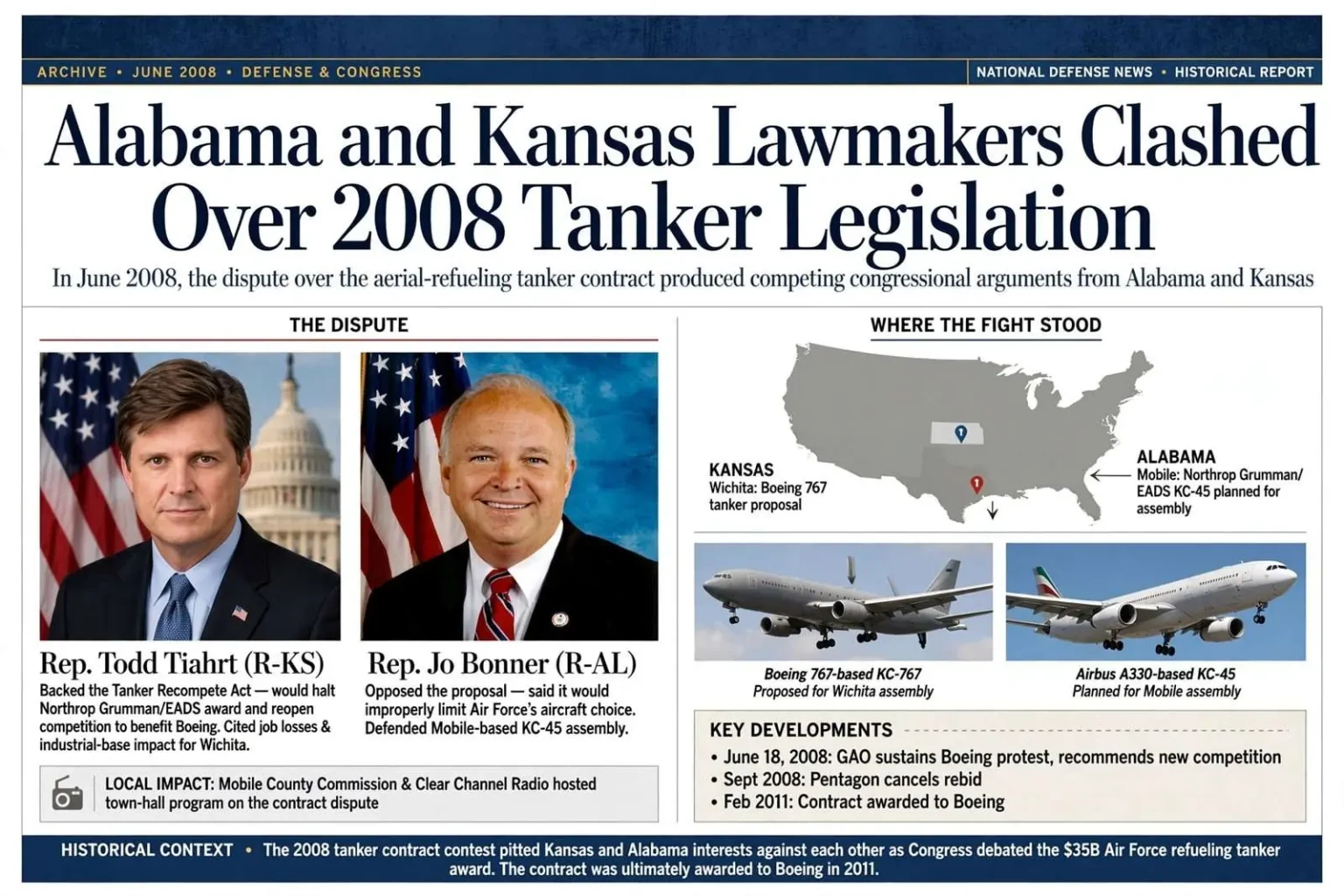
In June 2008, the dispute over the aerial-refueling tanker contract produced competing congressional arguments from Alabama and Kansas, according to an archived local news report. The clash was the latest round in a years-long procurement fight that pitted the two states — and the two aerospace giants courting their workforces — against each other, with billions of dollars and thousands of jobs hanging on the outcome. At stake was the U.S. Air Force’s effort to replace its aging fleet of KC-135 aerial refuelers, a program so large that it ranked among the biggest defense contracts in American history.
Kansas Rep. Todd Tiahrt backed the proposed Tanker Recompete Act, which he said would stop the existing Northrop Grumman/EADS award, potentially award the contract to Boeing, or require a new competition based on the original requirements. He also cited concerns about industrial-base and job impacts. Tiahrt’s district included Wichita, a city whose economy had been built on aircraft manufacturing and whose aerospace workers had watched the tanker work flow toward the Gulf Coast when the Air Force selected the Northrop Grumman/EADS team earlier in the year.
Alabama Rep. Jo Bonner rejected the proposal, arguing that it would improperly limit the Air Force’s choice of aircraft. From Mobile’s perspective, the issue was straightforward: the Air Force had run a competition, evaluated the bids, and picked the Northrop Grumman/EADS bid — a tanker based on the Airbus A330 airframe, to be assembled in Mobile if the award stood. Legislation engineered to reopen that decision, Bonner argued, would upend a process the Air Force had conducted at great expense and with enormous national consequences.
The disagreement captured the politics of the tanker war in miniature. For Kansas and Washington state, where Boeing had long employed tens of thousands, the Northrop win threatened a signature industry. For Alabama, the tanker represented the largest economic development prize in the state’s history — a commercial-scale aircraft assembly operation at Mobile’s Brookley Aeroplex that promised thousands of direct and indirect jobs across the Gulf Coast.
Mobilizing Public Opinion in Mobile
The station also reported that the Mobile County Commission and Clear Channel radio were promoting a local tanker-discussion program about the contract dispute. The effort reflected how deeply the tanker issue had penetrated civic life in Mobile — this was not an abstract defense procurement story, but a topic debated on the radio, at civic club meetings and across dinner tables throughout the area.
Community mobilization around the tanker contract had grown steadily since the February award. Business leaders organized support efforts, local officials traveled to Washington to make Mobile’s case, and residents wrote letters and phoned congressional offices in both parties. The county commission’s partnership with a major radio broadcaster to host a discussion program was another layer of that campaign, aimed at keeping the community informed and engaged while the contract’s fate was argued in the capital.
For Gulf Coast residents, the program offered a chance to understand the competing claims in detail — the job projections, the tanker specifications, the legislative maneuvering — from people involved in the effort. Local media across Alabama treated the tanker fight as the state’s most consequential economic story, and the discussion program joined a broader effort by civic institutions to make sure residents grasped what was at stake and how decisions made hundreds of miles away could reshape the region.
What the Rival Tankers Meant
The competing bids represented more than two aircraft. The Northrop Grumman/EADS tanker, based on the wide-body Airbus A330, offered more fuel capacity, cargo volume and passenger space than Boeing’s smaller 767-based proposal, and the Air Force’s evaluation had scored it accordingly. Boeing argued that its tanker was less expensive and lower-risk, built on a proven military airframe already serving the Air Force and Navy in airlift and refueling roles. Those technical arguments became the backbone of the political fight, with each side’s congressional champions repeating them in hearing rooms and press releases.
The industrial footprint was equally contested. A Northrop Grumman/EADS win meant final assembly in Mobile, with work spread among suppliers in multiple states; a Boeing win would have anchored the new tanker line in Washington state, with Wichita performing modification work. Kansas’s fear that the award hollowed out the nation’s existing tanker industrial base drove the Tanker Recompete Act’s argument about industrial security, while Alabama countered that the A330-based fleet would create a second, competing source for large aircraft assembly on American soil — a diversification supporters called vital to the nation’s long-term aerospace capacity.
Both states had allies in Congress, and the fight echoed through the presidential campaign season that summer, when defense procurement became a talking point on the stump. Lawmakers whose investigations years earlier had forced the original tanker lease deal into open competition defended the process, while union leaders and manufacturing-state representatives lined up behind the recompete effort. The tanker had become a national story with local stakes on both ends.
The Fight Over the Contract
The Air Force had awarded the KC-X contract to the Northrop Grumman/EADS team in February 2008, selecting the larger Airbus-based tanker over Boeing’s proposal built around a 767 airframe. Boeing immediately protested the award to the Government Accountability Office, arguing that the competition had been conducted unfairly. The stakes were measured not only in dollars but in decades: refueling tankers are the aircraft that extend the reach of American fighter and bomber fleets, and the replacement program had been delayed repeatedly since the early 2000s.
That earlier history hung over the 2008 fight. An earlier tanker lease-and-purchase deal with Boeing had collapsed in scandal in 2003-2004 after procurement irregularities surfaced, sending the program back to open competition and souring both sides on the process. By the time the Air Force selected the Northrop Grumman/EADS tanker, members of Congress from the losing state were already primed to challenge the result in whatever forum was available — and the proposed Tanker Recompete Act was the legislative front of that challenge.
Mobile had its own reasons to believe the fight was far from over even after the initial award. The city had spent years positioning Brookley — the former Air Force base turned industrial airfield near downtown — as a site for aerospace work, and the tanker assembly plan promised to transform the area. Local officials understood that any congressional intervention, budget delay or renewed competition could push the decision back toward Boeing’s Washington-based work and leave Mobile’s plans on the drawing board.
The June 2008 debate also unfolded against a rapidly moving procedural backdrop. The GAO was weighing Boeing’s protest, with a ruling expected within weeks, and Congress was preparing annual defense authorization legislation where tanker amendments could surface. Each side lobbied accordingly, framing its argument in the language of fairness: Kansas lawmakers said the competition itself had been flawed, while Alabama’s delegation insisted that changing the rules after an award would damage the credibility of the entire procurement system.
What the Rival Tankers Meant
The competing bids represented more than two aircraft. The Northrop Grumman/EADS KC-45, based on the wide-body Airbus A330, offered more fuel capacity, cargo volume and passenger space than Boeing’s smaller 767-based proposal, and the Air Force’s evaluation had scored it accordingly. Boeing argued that its tanker was less expensive and lower-risk, built on a proven military airframe already serving the Air Force and Navy in airlift and refueling roles. Those technical arguments became the backbone of the political fight, with each side’s congressional champions repeating them in hearing rooms and press releases.
The industrial footprint was equally contested. A Northrop Grumman/EADS win meant final assembly in Mobile, with work spread among suppliers in multiple states; a Boeing win would have anchored the new tanker line in Washington state, with Wichita performing modification work. Kansas’s fear that the award hollowed out the nation’s existing tanker industrial base drove the Tanker Recompete Act’s argument about industrial security, while Alabama countered that the A330-based fleet would create a second, competing source for large aircraft assembly on American soil — a diversification supporters called vital to the nation’s long-term aerospace capacity.
Both states had allies in Congress, and the fight echoed through the presidential campaign season that summer, when defense procurement became a talking point on the stump. Arizona Sen. John McCain, whose staff investigations years earlier had forced the original tanker lease deal into open competition, defended the process against Boeing-backing legislators, while union leaders and manufacturing-state representatives lined up behind the recompete effort. The tanker had become a national story with local stakes on both ends.
A Snapshot, Not an Ending
This historical article reports the competing views at the time and does not address later legislative or procurement outcomes. The Tanker Recompete Act described in the archived coverage was a proposal in a moving fight — one that, whatever its immediate fate, demonstrated how a single defense contract could engage two states’ congressional delegations, two aerospace giants and thousands of workers in a contest that would stretch well beyond the summer of 2008.
What the June 2008 record preserves is the texture of the moment in Mobile: a community that had won the largest economic development bid in its history and was organizing to defend it, county leaders using every platform available to keep the public informed, and a congressman pressing Mobile’s case against legislation he saw as an attempt to reverse a fair result. For readers looking back, the coverage documents how completely the tanker issue occupied the Gulf Coast’s civic attention in that season — and how high the expectations ran at Brookley before the outcome of the GAO protest and the recompete fight was known.
The episode remains a defining chapter in Mobile’s economic history. Whatever came afterward, the summer of 2008 was when the region first truly imagined itself as an aerospace manufacturing city, with county government, radio broadcasters, business groups and ordinary residents all taking part in the fight to keep that vision alive. The archived coverage stands as a record of how the tanker war looked from the Gulf Coast while its outcome was still in doubt.