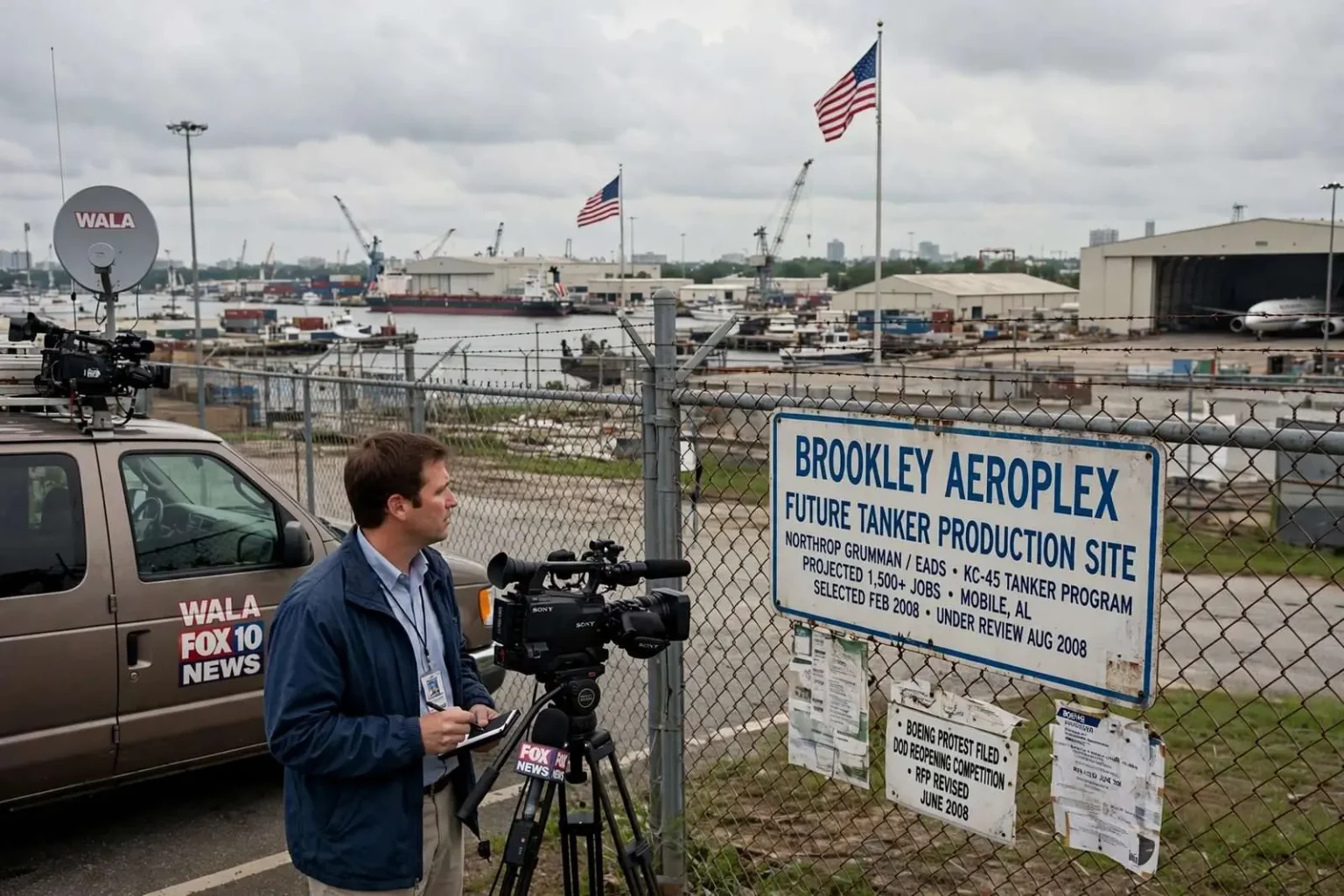
Aerospace facilities in Mobile, AlabamaAerospace facilities in Mobile.

Historical report, published from archived local news coverage.

In August 2008, reports that Boeing might leave the Air Force’s aerial-refueling tanker competition drew keen attention in Mobile, where the rival Northrop Grumman/EADS proposal was expected to have a major local economic impact. At stake was not just a multibillion-dollar Pentagon contract but the promise of a new aerospace manufacturing complex on the Gulf Coast, and local officials, business leaders and residents had been following every twist of the contest for months.

The competition centered on the Air Force’s KC-X program, a long-planned effort to begin replacing the service’s aging fleet of KC-135 Stratotankers, workhorse aircraft that had been refueling fighters and bombers since the late 1950s. Many of the tankers in the fleet were older than the pilots flying them, and Defense Department planners had warned for years that the fleet could not be sustained indefinitely. Finding a replacement had become one of the military’s most urgent procurement priorities.

The contest had already produced one of the most contentious procurement battles in recent memory. In February 2008, the Air Force selected the Northrop Grumman team, which had partnered with the European aerospace company EADS, the parent of Airbus, and proposed building its tankers at a facility in Mobile. Boeing, which had supplied virtually all of the Air Force’s tankers for decades, promptly filed a formal protest. In June 2008, the Government Accountability Office upheld a series of Boeing’s complaints about the evaluation, and the Defense Department effectively reopened the competition, requiring a new round of bidding under a revised request for proposals.

High stakes for Brookley

For Mobile, the stakes could hardly have been higher. The Northrop Grumman/EADS plan called for assembling the tanker at the Brookley Aeroplex, the former Air Force base on Mobile Bay that the city had spent years redeveloping as an industrial and aerospace site. Local economic development officials had argued that the tanker work would anchor a permanent manufacturing presence and spin off hundreds of supplier and maintenance jobs across the region, building on the engineering center EADS had already opened in Mobile.

The August 2008 reports landed at a delicate moment in that story. Mobile had spent much of the year celebrating the February award, only to watch the protest process put everything on hold. With the Pentagon drafting a new solicitation, the city was once again living with two possible futures, and the question of whether Boeing would stay in the contest shaped which future was more likely.

See also  Nearly Four Decades Later, Family and Detectives Still Seek Answers in 1981 Todd Acres Murder

Against that backdrop, word that Boeing might drop out of the re-bidding carried real consequences for both camps. If Boeing withdrew, Northrop Grumman and EADS would win by default, and Mobile’s long-awaited tanker plant would move ahead without another round of uncertainty. If Boeing stayed in, the competition would continue into the fall, with both companies spending heavily and Mobile remaining in a holding pattern.

In an archived local news interview, Boeing spokesperson Dan Beck did not give a definite answer on the company’s plans. He said a decision on its path forward would be premature, and that the company remained committed to competing under what it viewed as a fair process. The wording mattered: Boeing had argued since the June protest decision that the Pentagon’s draft solicitation still tilted toward larger, wider-bodied aircraft, the kind of plane Northrop Grumman and EADS had proposed, and company officials had suggested openly that they might not bid unless the terms changed.

The dispute over aircraft size was the heart of the re-competition. Boeing’s proposed tanker was based on its 767 airframe, a medium-sized aircraft, while the Northrop Grumman/EADS entry was derived from the Airbus A330, a larger wide-body plane with greater fuel capacity. The Air Force’s initial evaluation had weighed factors that rewarded the larger aircraft, and Boeing contended the new draft request for proposals did not correct that imbalance to its satisfaction. Any statement about staying in or dropping out was therefore tied directly to how the Pentagon worded the final solicitation.

A company still rebuilding trust

Boeing’s caution also reflected the company’s history with the tanker program. An earlier effort to lease and later purchase 767-based tankers had collapsed in scandal in the early 2000s, when a senior Air Force procurement official was prosecuted for giving preferential treatment to Boeing in exchange for a job with the company. The episode had left Boeing fighting to rebuild its standing in Washington, and company executives were acutely aware that a second failed bid, or an accusation that it had abandoned the program entirely, would carry its own costs.

For the Air Force, the renewed uncertainty was its own headache. The service had watched its first attempt at the competition collapse under protest and had promised Congress a fair, transparent re-bid that would finally deliver new tankers to a fleet flying well beyond its intended service life. Another withdrawal would mean a sole-source award, new scrutiny on Capitol Hill and fresh questions about whether the nation could buy a critical combat support aircraft without years of litigation.

See also  Mobile Artist Elizabet Elliott Staged Site-Specific 'Ballad of the Bear King' at the Blind Mule

Bonner: speculation is negotiating strategy

Locally, the speculation was received with a measure of skepticism. U.S. Rep. Jo Bonner, the Mobile-area Republican whose district included the Brookley site, told the station he did not believe Boeing would withdraw. In his view, the public talk of walking away was better understood as a negotiating strategy, an effort to pressure Defense Department officials into revising the draft request for proposals before it was finalized.

Bonner had been one of the most visible advocates for the Northrop Grumman/EADS bid since the team first identified Mobile as its preferred assembly location, and he had argued repeatedly that the Gulf Coast deserved a share of the nation’s aerospace manufacturing base. But he also understood the dynamics of the competition: a threatened exit was a card that could only be played while it remained plausible, and few observers in either camp expected the Chicago-based company to cede the entire tanker franchise without another fight.

Whatever their preferences, the companies themselves were still working the process. The station reported that Boeing and Northrop Grumman had met with Defense Department officials about the draft request for proposals, part of a formal period in which prospective bidders could question the government’s requirements and evaluation criteria before the solicitation was locked in. Those meetings were a routine but consequential step: the answers the companies received, and any changes the Pentagon made in response, would help determine whether the final competition was broad enough to hold both bids.

The meetings also gave both sides a chance to press their versions of the central dispute. Boeing officials argued that the requirements were still written around a larger aircraft than the mission required, while Northrop Grumman and EADS maintained that the Air Force had simply chosen the best-value tanker for the mission and that reopening the process had been an unnecessary concession to a losing bidder. Between the two positions sat a Pentagon acquisition office that had already watched its first attempt fall apart.

For Mobile readers, the maneuvers played out as a kind of civic drama. Local media tracked each company statement and Pentagon response, and commentary in the community split between confidence that the February award would ultimately hold and anxiety that the whole project could yet slip away. The tanker debate had become, for a season, the single most consequential economic question on the Gulf Coast.

See also  Tropical Storm Bertha Closures: Roads, Ramp and Cedar Point Pier Shut Down in South Alabama

Timeline pointed to a fast fall

Despite the uncertainty, the acquisition schedule remained aggressive. At the time, a final request for proposals was expected within days, bids were due in early October, and a decision was anticipated in December. Compressing a competition of that size into a few months reflected the Air Force’s desire to show Congress and the flying public that it could buy tankers without another multiyear delay, and it left bidders little room to maneuver, since any company that intended to compete would have to commit its engineering and pricing teams almost immediately after the final solicitation was issued.

For Mobile, the calendar cut both ways. A decision in December meant the city’s tanker question could be answered before the end of the year, either clearing the way for site work and hiring or closing the chapter on a bid that had already drawn national attention. In the meantime, economic development officials continued to promote the Brookley site for other aviation and industrial work, wary of pinning the community’s expectations entirely on a single contract that had already changed direction more than once.

The episode was also an early lesson in how costly and unpredictable major defense competitions had become. The tanker contest had generated protests, congressional interest, revised requirements and round-the-clock coverage in the cities where the work would be performed, and the companies on both sides had spent years and enormous sums pursuing a contract that had yet to be re-awarded. Communities like Mobile learned to track draft solicitations and protest rulings as closely as any defense reporter in Washington.

This is a historical account of the competition at that stage. It does not describe the later procurement outcome, which unfolded over subsequent years as the Air Force continued to rework its requirements and the companies reassessed their participation. What the August 2008 moment captured was the uncertainty of the re-bid itself: a defense giant hinting it might quit, a congressman calling the threat a bluff, and a Gulf Coast city watching the Pentagon’s calendar for word on a factory that had not yet been built.