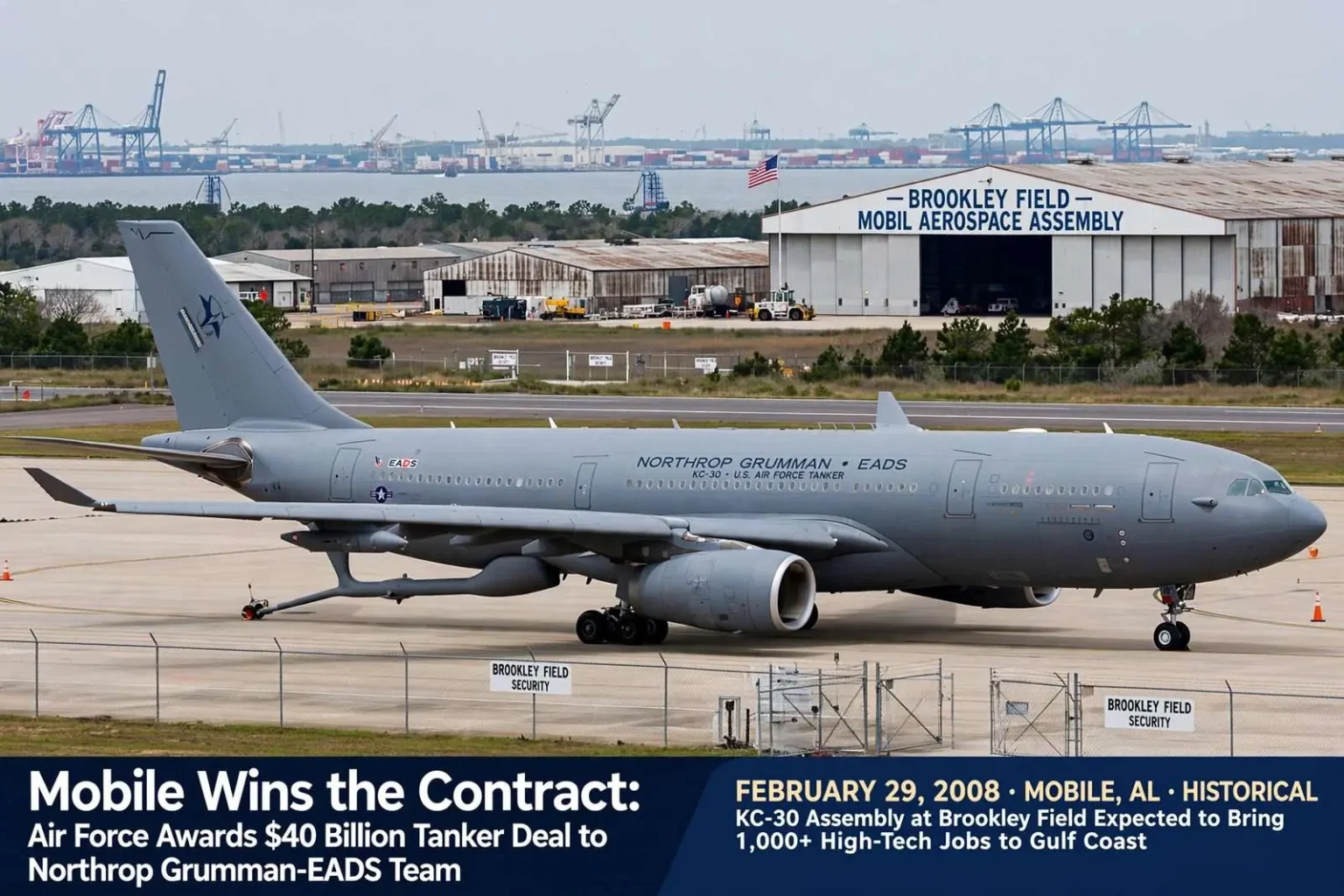
Historical report, published from archived news coverage. In late February 2008, Mobile held its breath as the United States Air Force weighed the largest aerial-refueling tanker competition in a generation, a contest that pitted Boeing against a partnership of Northrop Grumman and EADS and carried implications far beyond the defense industry. The Northrop-EADS proposal centered on the KC-30 tanker, and coverage at the time reported that a Mobile win could bring more than 1,000 high-tech jobs and an aerospace contract valued at about $40 billion to the city. Boeing’s competing entry was the KC-767. For a Gulf Coast city that had spent years courting heavy industry, the decision ranked among the most consequential in its modern history.
The stakes were clear to everyone watching. Mobile had positioned Brookley Field as the centerpiece of its industrial recruitment strategy, and local leaders had made no secret of their desire to land the tanker work. What followed was a decision that reshaped the way South Alabama thought about itself — a community long identified with shipbuilding, port operations and paper mills suddenly in position to join the ranks of America’s aerospace centers.
The Contest and What Was at Stake
The competition itself had been years in the making. The Air Force sought a replacement for its aging fleet of KC-135 tankers, workhorse aircraft that had been refueling American fighters and bombers since the 1950s. The Northrop Grumman-EADS team proposed the KC-30, a militarized version of the widely used Airbus A330 airframe, while Boeing offered the KC-767, derived from its 767 commercial airliner. Because the winning airframe would be built to American military specifications over decades of deliveries, the contract implied not only an assembly line but a durable industrial footprint — machining, wiring, interiors, testing and training work that would ripple through a regional economy for a generation.
For Mobile, the numbers reported at the time were staggering for a metropolitan area of its size: a contract valued at roughly $40 billion and more than 1,000 high-tech jobs concentrated at the assembly site. Local officials and business leaders anticipated a wave of related supplier contracts, construction work and long-term investment in the region’s growing aerospace sector — the kind of ripple effect that would shape Mobile’s economy for years after the announcement itself.
A City Holds Its Breath
Mayor Sam Jones captured the mood of the city in the final days before the announcement. He said a Mobile selection would be a tremendous day for the community, but he also framed the city’s ambition in broader terms, adding that Mobile remained committed to aircraft manufacturing even if the decision went the other way. The hedge was characteristic of a city that had learned, through hard experience with plant closures and defense-base realignments, that no single award could be the end of an economic strategy.
Both sides had indicated they could protest a loss, a process that could take as long as a year. That possibility weighed on the region through the winter, because defense-contracting protests were notorious for freezing work on a program while the losing bidder pressed its case before federal auditors. For Mobile, a protest would have meant prolonged uncertainty about whether the promised jobs would ever arrive, even after an announcement in the city’s favor.
The Decision Comes Down
The suspense ended on Feb. 29, 2008, when the Air Force awarded the contract to the Northrop Grumman/EADS partnership outright, rather than splitting the work with Boeing as many analysts had predicted going in. A split award had been widely forecast because it would have preserved competition and spread political benefits across multiple states and congressional districts. Instead, the Air Force chose a single winner, and the winner was the team that had promised to build the aircraft in Mobile.
The deal covered 179 tanker aircraft to be delivered over the following 10 to 15 years, with final assembly to take place at Mobile’s Brookley Field, the same site the city had spent years positioning for exactly this kind of industrial win. Deliveries on that scale meant sustained hiring, a permanent engineering presence and decades of maintenance and support work tied to a fleet the Air Force would rely on well into the middle of the century.
Rep. Jo Bonner, whose district includes Mobile, called the announcement the dawn of a new era for the city. “Today marks the dawn of a new era for Mobile, and I couldn’t be more proud of our city and our state than I am right now,” Bonner said immediately after the award was announced. “We are so very excited about having the opportunity to help the Air Force acquire the most modern and capable refueling tanker – a tanker assembled in America – by Americans.”
Bonner, along with Sens. Jeff Sessions and Richard Shelby, had lobbied heavily on behalf of Mobile’s bid in the months leading up to the decision. The delegation’s argument to Pentagon officials was consistent: Alabama offered a capable workforce, a cooperative business climate and a deepwater port within sight of the assembly floor. Sessions said the choice to build the KC-30 in Mobile amounted to a vote of confidence in Alabama’s workforce and a substantial investment in the state.
“The decision by Northrop Grumman/EADS to manufacture the KC-30 in Mobile was a clear endorsement of our state’s workforce, and today’s contract award represents a huge investment in our state,” Sessions said. “The assembly of over 170 tankers in Alabama solidifies our state’s growing reputation as a national leader in defense technology. From one end of the state to the other, Alabama workers are proudly providing our men and women in uniform with the best and most advanced defense technology available.”
Brookley Field: Built for Second Acts
There was a particular poetry in the selection of Brookley Field. The site had been one of the Army Air Forces’ largest depots during World War II, employing tens of thousands of workers who serviced and supplied aircraft during the war, before the base was ordered closed in the late 1960s. For decades afterward, the city worked to rebuild an industrial economy on the old airfield’s footprint along Mobile Bay, marketing the site’s runways, rail access and port proximity to manufacturers. Landing the tanker program there was, in the most literal sense, a restoration: heavy aviation work returning to ground that had been built for it.
The award also fit into a broader pattern across Alabama, a state that had quietly assembled one of the more diverse aerospace economies in the country. North Alabama’s Tennessee Valley was home to the Marshall Space Flight Center and Redstone Arsenal, anchoring rocket propulsion and missile defense work, while a corridor of auto plants in the center of the state had proven that global manufacturers could find skilled labor in Alabama towns. The tanker win extended that story south to the coast, and it validated the argument Mobile’s recruiters had been making for years.
What the Award Meant for South Alabama
The award ranked among the largest single economic-development wins in South Alabama history. Beyond the direct assembly jobs at Brookley, economists and local planners expected the work to pull a constellation of suppliers into the region: companies that fabricate composite structures, machine metal components, manufacture wiring harnesses and provide engineering services. Each supplier that opened a facility near an aircraft assembly line tended to stay for the life of the program, which in the case of a tanker fleet would span decades.
The timing mattered as well. Mobile’s port was in the midst of its own expansion, and city leaders had argued that the combination of a deepwater harbor, an intermodal rail network and an industrial airfield gave Mobile a logistical profile few sites in the country could match. The tanker award tested that argument at the highest level, and the result was a new template for how the city pitched itself: not as a low-cost alternative to established aerospace regions, but as a place where the physics of moving large aircraft parts by water and rail actually worked in the project’s favor.
As with any award of this size, the story did not end with the announcement. Boeing pursued its promised protest, and the tanker contest ultimately remained contentious for years as the Air Force reworked its acquisition strategy. But whatever the program’s later twists, the day the contract landed in Mobile marked a turning point for the region — proof that a Gulf Coast city could compete at the top of the defense industrial base and win, and a foundation on which Mobile continued to build its aerospace ambitions in the years that followed.
The human dimension of the award was just as significant as the industrial one. More than 1,000 high-tech positions meant engineering desks, avionics benches and quality-control labs filled with Alabama workers — jobs that in earlier decades had required young people from Mobile to leave the state to find. Community colleges and technical programs across the region suddenly had a focal point for aerospace training curricula, and local students could plausibly plan a career assembling aircraft a few miles from home. For families long tied to shipyards, chemical plants and seasonal port work, the tanker program represented the arrival of a new, higher-paying tier of the regional job market.