Mobile Family Chosen for Extreme Makeover: Home Edition in 2008
The Gaudet family of Mobile was selected for Extreme Makeover: Home Edition in February 2008 after their hurricane-damaged home and fire damage made life difficult for eight residents.
Originally reported February 2, 2008.
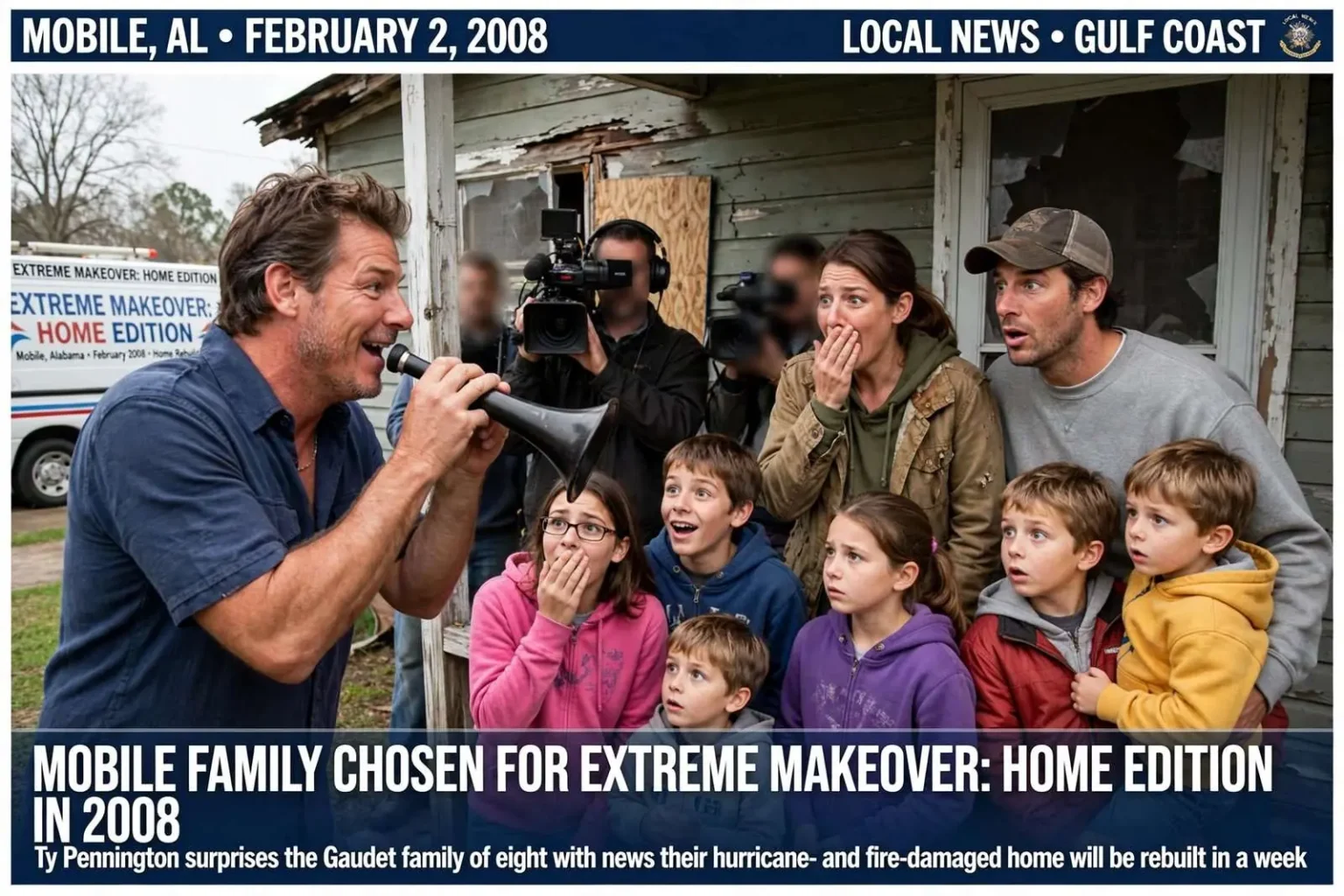
The Gaudet family of Mobile was selected for Extreme Makeover: Home Edition in February 2008, when host Ty Pennington surprised them with the news that their home would be rebuilt in a week. The family’s home had been deteriorating and had been damaged by Hurricane Katrina and a small house fire, and eight people lived in the residence, according to the report.
Lydia Gaudet said the family had hoped for the opportunity after being nominated among five Alabama families. A team of designers, volunteers and workers was expected to replace the old home, while the family traveled to Arizona for that Sunday’s Super Bowl. The report said the family would be able to see its new home the following week.
The Knock on the Door
Television’s most famous door knock arrived at the Gaudet household in early February 2008, when Ty Pennington and the production team of Extreme Makeover: Home Edition delivered the news that thousands of families apply for and very few receive: their aging, ailing house would be torn down and replaced by a new one, built in seven days, at no cost to them. The surprise moment — the show’s signature scene, with Pennington’s bullhorn-energy announcement and the family’s stunned reaction — was filmed on the spot and became the emotional centerpiece of the episode that followed.
The selection came after a process that begins with a nomination. The Gaudets were one of five Alabama families nominated for the show’s consideration, and Lydia Gaudet said the family had hoped for the opportunity — hope that, in this case, was answered. The show’s producers weigh hundreds of nominations each season, looking for families whose needs are real and whose stories will resonate with viewers, and the competition within a single state can be stiff when a disaster-prone Gulf Coast is involved.
What the producers found in the Gaudet home was a structure in serious decline. The house had been deteriorating over time, and its troubles were compounded by two distinct blows: damage from Hurricane Katrina, which had lashed the Gulf Coast in August 2005, and a small house fire that added its own harm. For a household of eight people, the accumulating damage was more than a renovation could realistically fix, which is precisely the situation the show’s format exists to address.
Eight Under One Roof
Eight people lived in the Gaudet residence — a number that matters both to the family’s story and to the design brief that the show’s builders would take on. Large households in cramped, deteriorating spaces face pressures that go beyond inconvenience: bedrooms that double as everything, wear that accelerates, and repairs that fall permanently behind need. A rebuild, as opposed to a patch, offered the family a home designed for its actual size rather than one it had been stretching to fit.
The Katrina connection placed the family within a broader Gulf Coast story. More than two years after the hurricane, households across the region were still working through the wreckage the storm left behind — some from direct wind and water damage, others from the cascading costs and disrupted lives that followed. Insurance settlements, contractor shortages and rising construction costs left many families in homes that were lived in but never made whole. The Gaudets’ deteriorating house, damaged by the storm and then nicked by fire, was a familiar Gulf Coast portrait of postponed repair.
The February 2008 timing also caught Mobile at a familiar moment on the cultural calendar. That Sunday, the Arizona gathering the family would join centered on the Super Bowl — and the show’s producers routinely paired the family’s send-off with a marquee event, whisking them out of town while the demolition and construction crews took over the property. For the Gaudets, a week that began with a television crew on the doorstep ended with a trip to Arizona and a brand-new house waiting back home.
A Week of Construction Theater
The Extreme Makeover: Home Edition model compressed an entire custom-home build into seven days, and it accomplished that feat through a combination of professional scheduling, industrial-scale volunteering and round-the-clock shifts. A team of designers associated with the show planned the home, but the physical work was performed by an army of local builders, contractors, suppliers and volunteers, coordinated by a builder-partner who took on the project as a civic undertaking as much as a business one.
For the host city, the arrival of the show was an event in itself. Neighbors cleared out, volunteers signed up by the hundreds, material suppliers donated what they could, and spectators gathered along the perimeters to watch the demolition and the race to rebuild. Local media covered the week’s progress daily. The show’s episodes traded on that community energy — the idea that a town could come together and do in a week what normally takes months — and Mobile’s turn in the spotlight gave local firms and tradespeople a chance to demonstrate exactly that.
The Gaudet family, meanwhile, spent the construction week in Arizona, attending that Sunday’s Super Bowl as the show’s guests. The trips that accompanied each rebuild served a practical purpose — the family could not be underfoot during demolition — but they also added to the emotional arc: one week containing a surprise, a vacation, a championship event and a new house, in place of the years of worry that a failing home had imposed.
The Reveal and What Followed
The report said the family would be able to see its new home the following week — the moment the show made famous as the “reveal,” with the bus pulled away and the finished house presented to the returning family. After a week in Arizona and a build that ran continuously back in Mobile, the Gaudets would return to a structure designed from scratch for their household of eight, replacing the storm-damaged, fire-scarred and deteriorating home they had left behind.
For the volunteers and builders involved, the reveal closed a week of extraordinary labor. The show’s builds were famously grueling — construction running through the night, subcontractors stacking on top of one another, inspections compressed into hours — and the finish line brought a sense of shared accomplishment to a temporary workforce that in many cases had never worked together before and would never again in quite the same combination.
The episode that aired later carried Mobile’s story to the show’s national audience, complete with the family’s history, the Katrina damage, the fire, and the community that turned out to rebuild. For the families who had been nominated alongside the Gaudets — the five Alabama households in the running that season — the broadcast was a reminder of how narrow the funnel was, and of how much of the show’s power rested on the one family chosen from among so many with genuine needs.
The Show’s Gulf Coast Chapter
Extreme Makeover: Home Edition built a substantial part of its post-Katrina legacy along the Gulf Coast, rebuilding homes for families whose houses had been wrecked by the 2005 storms and their long financial aftermath. The Gaudet selection in February 2008 fit that pattern: a Mobile household of eight, in a home weakened by the hurricane and further damaged by fire, chosen from five nominated Alabama families to receive a ground-up rebuild on television’s fastest construction schedule.
Looking back, the episode stands as a snapshot of that era — the show at the height of its popularity, a Gulf Coast still repairing itself years after the storm, and a Mobile family whose luck changed in a single morning when a television host delivered the news that Lydia Gaudet and her household had been hoping to hear. The deteriorating house is gone in the story’s ending; in its place, built in a week by a small city’s worth of volunteers, stood a home sized for the family that had been waiting for exactly this chance.
Originally reported February 2, 2008.
The Economics of a Free House
A rebuild of the kind the Gaudets received represented a substantial investment of materials and labor, and the show’s model depended on the generosity of the local construction economy. Builder-partners organized the projects at cost or below, suppliers donated flooring, framing, fixtures and appliances, and the volunteer labor that filled the site around the clock came free. The finished product was a custom home delivered to a family that had no realistic path to one on its own — the entire premise of the series, executed in a week.
For the winning family, the new house changed daily life in ways that went beyond square footage. Purpose-built bedrooms for eight residents, modern systems replacing failing ones, and construction up to current codes meant lower maintenance burdens and utility costs going forward. Households that had been pouring money into a losing battle against deterioration suddenly had that money available for everything else — a practical transformation that the show’s tearful reveals only gestured at.
The community’s return on the investment was less measurable but real. Episodes showcased the host city to a national audience, and the volunteer week left local firms and tradespeople with new relationships and a visible demonstration of what coordinated generosity could accomplish. Mobile’s turn with the Gaudet family put the city inside a television tradition that, for all its produced sentiment, ran on genuine local effort — hundreds of people showing up to build a house for neighbors they had never met.
Nominated Among Five
The detail that the Gaudets were nominated among five Alabama families is worth lingering on, because it frames both the family’s fortune and the need that surrounded them. Nominations to the show came from friends, neighbors, churches and community organizations, each making the case that a particular household deserved rescue from a home that had failed it. That five Alabama families were in contention in a single cycle says something about the housing struggles that persisted along the Gulf Coast well into 2008, more than two years after Katrina.
Lydia Gaudet’s comment that the family had hoped for the opportunity gives the selection its human weight. Hope in these situations is a fragile thing — families nominated for the show waited through uncertainty, knowing that the cameras might never come. When the knock finally arrived, it resolved months of anticipation in a single morning, and the surprise that Pennington delivered captured the moment the hope was answered.
The week that followed — demolition, construction, the trip to Arizona for the Super Bowl, and the reveal of the new home the next week — compressed into days a transformation that the family’s own resources could never have produced. It was, by any measure, a rare piece of good fortune landing on a Mobile household that had weathered a hurricane, a fire and years of slow decline, and it came with the whole city watching it happen.