Before the Tanker Verdict, Mobile Chased Rumors Across the World
With a $40 billion Air Force tanker decision imminent and an assembly line at stake for Brookley Field, an unsourced report in a foreign wire service set Mobile talking — and talk of a split contract gained ground.
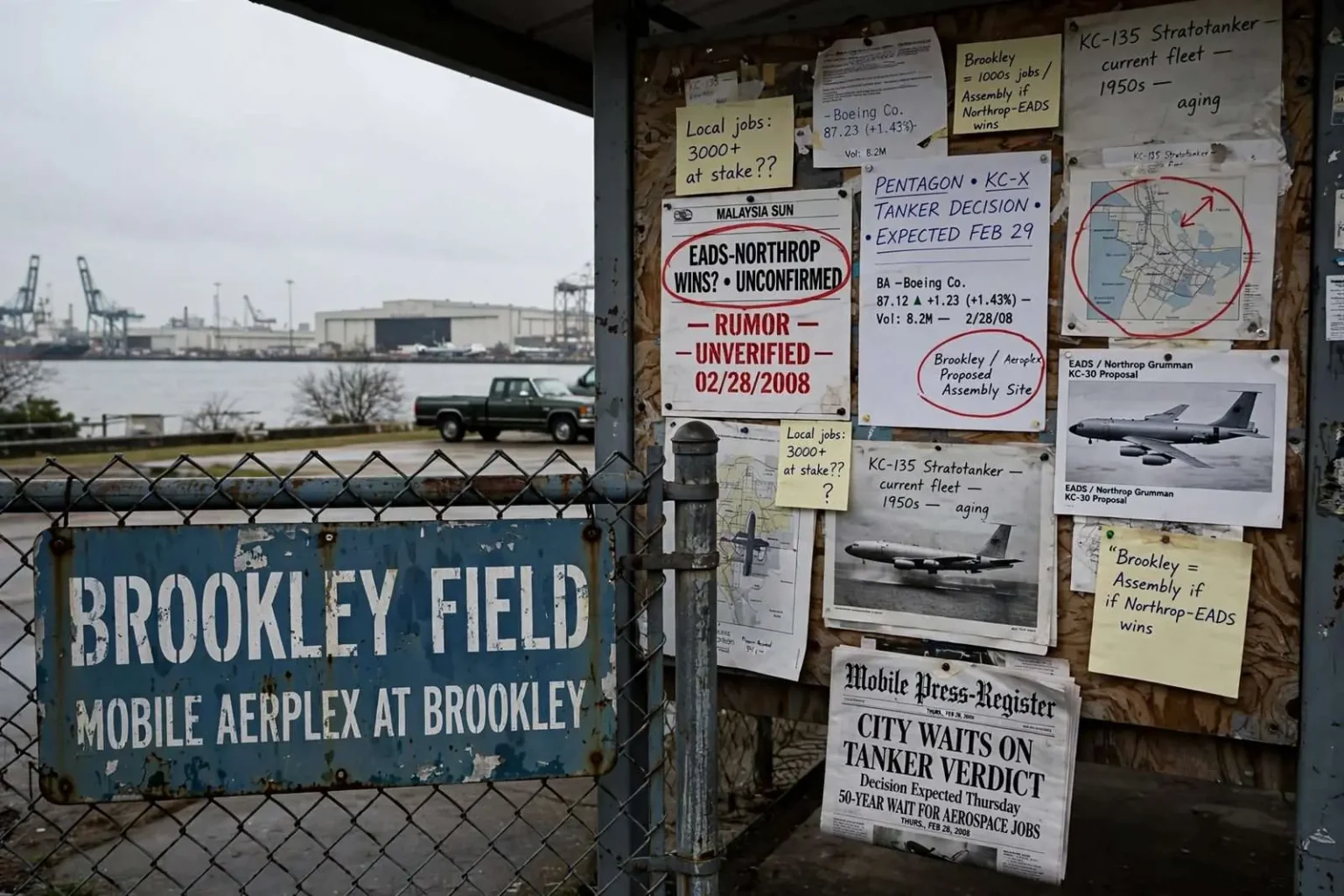
In the last days of February 2008, Mobile was waiting on a decision that would be made in Washington but felt entirely local. The U.S. Air Force was preparing to award a contract, valued at roughly $40 billion, to build a new generation of aerial refueling tankers — the aircraft that top off other military planes in mid-flight and make global deployments possible. The existing fleet of KC-135 Stratotankers had entered service in the late 1950s, during the Eisenhower administration, and the Air Force had spent years arguing that it could not be replaced soon enough. If the team of Northrop Grumman and EADS won, the aircraft would be assembled at Brookley Field on Mobile Bay. If Boeing won, they would be built in Everett, Washington. For one Alabama city, the distinction between those two outcomes was the difference between becoming a center of American aerospace manufacturing and watching one take shape on the other side of the country.
The waiting produced the kind of rumor traffic that only a high-stakes decision can generate. With the announcement expected at any hour, the normal channels of news — the Pentagon briefing room, the national wires, the morning paper — were supplanted by anything that moved: aggregator sites, stock tickers, word of mouth. In an era when procurement decisions leaked constantly but were confirmed slowly, the gap between rumor and fact was where an entire city’s anxiety lived.
A report from Malaysia
The Malaysia Sun, citing no sources whatsoever, reported that the EADS-Northrop Grumman partnership had won the contract. The claim could not be immediately confirmed in Mobile, and it was received locally with the appropriate mixture of hope and skepticism — a foreign wire aggregator with no visible reporting behind it was not the customary channel for Pentagon procurement news. Major defense awards are announced by the Department of Defense with a formal release, and anything arriving ahead of that release was, by definition, unverified.
The episode captured the strangeness of the moment. A city of 200,000 people was refreshing obscure news websites, watching Boeing’s stock ticker and trading calls with anyone who might have a line into the Air Force, because the outcome would determine whether thousands of aerospace manufacturing jobs landed on a decommissioned air base on its waterfront. Local reporters, business leaders and city officials all found themselves in the same position: unable to confirm anything, and unwilling to dismiss the possibility that someone, somewhere, already knew something.
The tanker competition, formally known as KC-X, had been years in the making. An earlier attempt to lease and then buy replacement tankers from Boeing had collapsed in scandal in the middle of the decade, and the rebid that followed drew the European company EADS — parent of Airbus — into partnership with Northrop Grumman, with assembly promised for Mobile. That history made the 2008 decision feel less like a single award and more like the resolution of a long argument about how American defense dollars should be spent and where American defense hardware should be built.
The split-contract theory
Meanwhile, talk of dividing the contract between Boeing and the Airbus-affiliated team had gained strength, despite earlier and emphatic statements from military and congressional leaders that the competition would remain winner-take-all. The idea had obvious political appeal. Splitting the award would give both Washington state and Alabama a share of the work and defuse a fight that had already consumed enormous congressional energy, with delegations from both states lobbying the Pentagon and pressing their cases through the appropriations process.
It also had obvious practical problems. Dividing the contract would likely require a virtual do-over of the request for proposals and delay delivery of aircraft the Air Force said it urgently needed, since the KC-135 fleet then in service dated to the Eisenhower administration and was aging toward obsolescence. A split award would also multiply the cost and complexity of training, spare parts and maintenance — precisely the expenses a single standard tanker fleet was meant to control. Defense officials had repeatedly warned that reopening the competition would push delivery of new tankers years further into the future.
What Mobile had at stake
Brookley Field had been a wound in Mobile’s civic memory since 1969, when the closure of Brookley Air Force Base cost the city thousands of jobs and, by some estimates, a tenth of its population. For decades afterward the base — redeveloped as the Mobile Aeroplex at Brookley — remained a vast piece of waterfront infrastructure: runways, hangars and deep-water access beside a major port, waiting for an industry big enough to fill it. Aerospace maintenance and modification firms had moved in over the years, but nothing on the scale of a tanker assembly line had ever materialized on the site.
The prospect of an Airbus-affiliated assembly line on the same runways was more than an economic development win; it was a restoration. City and county leaders had spent years courting the project, offering incentives and improvements at the Aeroplex, and the pitch they made was simple: a Gulf Coast workforce accustomed to industrial work, a port capable of shipping outsized aircraft sections anywhere in the world, and a site with room to expand. The tanker contract would test whether that pitch could actually land the biggest prize available.
The politics were correspondingly fierce
Alabama’s congressional delegation, led by Sens. Richard Shelby and Jeff Sessions, had pressed the case relentlessly, arguing that the Northrop Grumman-EADS aircraft offered more capability at a lower cost. Washington state’s delegation and organized labor pressed Boeing’s, arguing that a European-designed aircraft should not be built with American defense dollars. The fight had become a proxy for a larger argument about globalization, defense manufacturing and the meaning of “American-made” — a question with an audience far beyond the two states competing for the work.
Inside Mobile, the stakes were understood in personal terms. Suppliers, training programs and site preparations had been arranged on the assumption of a win. Real estate brokers, workforce developers and community college administrators all had plans that began the day the announcement came. A loss would not merely cost jobs; it would invalidate a decade’s worth of civic planning built around the assumption that the aerospace industry had finally chosen the city.
The answer arrives
The Air Force announced its decision on Feb. 29, 2008. The Northrop Grumman-EADS team won. The announcement set off one of the largest celebrations in the city’s modern history: within hours, crowds had gathered at Brookley, and by evening the name “Mobile” was attached to one of the biggest defense contracts in the country. The win promised thousands of aerospace manufacturing jobs at the former base, with additional work expected among suppliers across the region, and it validated the years of courting, incentives and site preparation that state and local officials had invested in the Aeroplex.
For a few days, the future seemed settled. The rumor from Malaysia had been wrong in its timing and right in its substance, and the city that had spent a week chasing whispers suddenly had nothing left to wait for.
The victory did not hold
Boeing filed a protest with the Government Accountability Office, the congressional watchdog agency that reviews contested federal awards, and the decision soon unraveled. In June 2008 the GAO sustained Boeing’s protest, finding significant errors in the Air Force’s evaluation — flaws in how the competing aircraft had been compared on capability, cost and risk. The finding forced the Air Force to cancel the award and begin the process again, and the celebration that had filled Brookley in February gave way to a second round of waiting that no one in Mobile had planned for.
The competition was recompeted under new rules and a new solicitation. In 2011, after Northrop Grumman declined to bid again in a contest it believed had been reshaped in Boeing’s favor, Boeing won with a new, larger tanker based on its 767 airframe — an aircraft that would eventually enter service as the KC-46 Pegasus. The Everett line, not Mobile’s, would build the next generation of American tankers.
The assembly line came anyway
The Mobile assembly line eventually came anyway — as a commercial Airbus A320 plant, opened in 2015 on the same Brookley ground, born of relationships forged during the tanker fight. The years of lobbying, site preparation, workforce training and political goodwill that the tanker battle produced had made Brookley a credible address for aerospace manufacturing, and when Airbus set out to build its first U.S. assembly plant, Mobile was the choice. The plant grew into one of the city’s largest employers, assembling A320-family aircraft and anchoring a supplier network that spread across the Gulf Coast.
None of that was knowable in late February 2008. There was only a rumor from Malaysia, a stock ticker, and a city holding its breath — and then, for one leap-day weekend, a victory that felt like the end of a fifty-year wait. It was not, in the end, the ending Mobile had planned for, but it was the beginning of something that outlasted the tanker award itself.