Federal Watchdog Finds ‘Significant’ Errors in Air Force Tanker Bid Scoring, Clouding Mobile Assembly Plant Plans
The GAO found the Air Force made significant math errors in scoring a $35 billion tanker contract, casting new doubt on plans for an aircraft assembly plant at Brookley Field in Mobile.
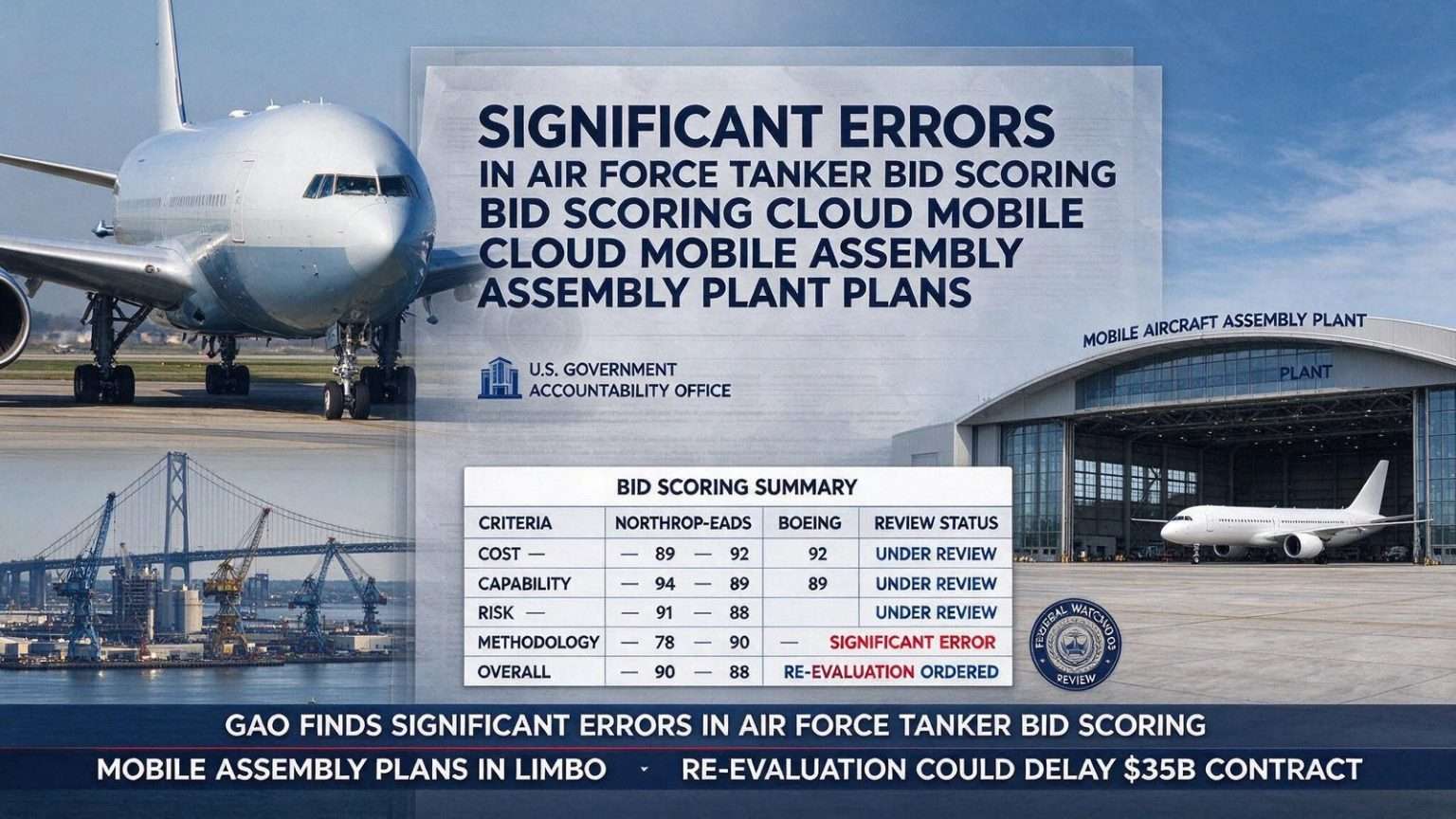
A federal government watchdog has concluded that the U.S. Air Force made “significant errors” when it evaluated competing bids for a massive aerial refueling tanker contract, a finding that throws fresh uncertainty over plans for an aircraft assembly plant that had been expected to bring jobs to the Mobile area. The Government Accountability Office’s ruling lands like an earthquake under a competition that South Alabama had treated as settled — and it means the fate of the Mobile project now rests with a contracting dispute playing out in Washington rather than with the award ceremony local officials had already begun planning around.
The U.S. Government Accountability Office (GAO), the federal agency tasked with auditing and investigating how government money is spent, backed up complaints raised by Boeing that the Air Force’s math and methodology were flawed when it scored the competing proposals for the multibillion-dollar tanker deal. Boeing had publicly argued the Air Force miscalculated key figures during the evaluation process, and the GAO’s review reached the same conclusion, going so far as to call the errors “significant.”
How the dispute began
The dispute traces back to February, when the Air Force awarded a $35 billion contract for a new generation of refueling tankers to a partnership between Northrop Grumman and the European aerospace company EADS, the parent of Airbus. That decision passed over Boeing, the longtime supplier of the Air Force’s aging refueling fleet, and set off a fierce protest. Boeing filed its formal challenge with the GAO within the protest window, arguing that the source selection had misjudged the relative merits of the two bids on cost, capability and risk.
Bid protests of this scale are extraordinary events in federal contracting. A $35 billion award — one of the largest in Defense Department history — would sustain production lines, suppliers and workforces for decades, which is why losing bidders exhaust every avenue of challenge. The GAO process is the first of those avenues: a fast-moving review in which the agency’s lawyers examine the evaluation record and rule on whether the buying agency followed the law and its own procedures. Its recommendations are not legally binding on the Air Force, but no service secretary disregards them lightly, because the alternative is congressional intervention and a procurement that never recovers public credibility.
Why Mobile is at the center
For Mobile, the stakes go well beyond a corporate rivalry between two aerospace giants. The Northrop Grumman-EADS team had proposed building a final assembly line for the tanker aircraft at Brookley Field in Mobile, a project local officials and business leaders hoped would deliver hundreds of aerospace manufacturing jobs and cement the region’s growing foothold in the aviation industry. A reversal of the contract award, or a new round of bidding, could delay or upend those plans.
Brookley, the former Air Force base on Mobile Bay south of downtown, had spent years rebuilding itself as an industrial aeroplex after the military left, filling its hangars and runways with aviation, shipbuilding and manufacturing tenants. A final tanker assembly line would have been the centerpiece of that transformation — the kind of anchor tenant that reshapes a community’s economy, draws suppliers to the region and gives local colleges and training programs a destination for their graduates. No other project on the city’s economic development horizon came close to its scale.
The proposal also fit the region’s industrial profile. Mobile’s shipyards had long demonstrated that the Gulf Coast could build large, complex machines to military standards, and civic leaders had spent a decade arguing that the same workforce, the same deep-water port and the same rail and highway connections that served shipbuilding could serve aircraft assembly. The Northrop-EADS bid was the first chance to prove that argument at scale.
What the GAO’s ruling does
Although the Air Force is not legally bound to follow the GAO’s recommendation, the finding carries significant weight in federal contracting disputes of this size. The GAO has recommended that the Air Force reopen discussions with both bidding teams and re-evaluate the proposals, a step that could lead to a new round of competitive bidding for the tanker contract. Defense industry observers say that outcome is considered likely given the strength of the GAO’s findings.
The Air Force now faces a choice among unattractive options: defend an evaluation the GAO has called seriously flawed, reopen the competition with both bidders, or cancel and start over with new requirements — a path that could add years to a recapitalization program the service had described as urgent. The tanker fleet the competition was meant to replace includes aircraft that have flown since the Eisenhower administration, and every year of delay extends the service life of planes that were designed before the moon landing.
News of the ruling moved markets, with shares of Boeing trading sharply higher as investors bet on the possibility the aerospace giant could still win a piece of the tanker business, while shares of Northrop Grumman slipped modestly on the uncertainty. The market reaction underscored how much money rides on the outcome — and how investors read the GAO’s language about “significant” errors as more than routine protest rhetoric.
The view from Mobile
The tanker competition has been closely watched in South Alabama for its economic development implications. Aerospace and aviation manufacturing has been identified by regional leaders as a key growth industry for the Mobile area, building on the region’s existing shipbuilding and heavy manufacturing base. A large-scale assembly operation at Brookley would represent one of the most significant industrial development wins in the area’s recent history, and local leaders are expected to continue pressing federal officials and the winning bidders to honor commitments to the Mobile site regardless of how the contract dispute is ultimately resolved.
Behind the public cheerleading, though, local officials have absorbed a harder lesson from the episode: a city can do everything right — assemble a site, court the bidder, line up incentives and workforce training — and still watch the project turn on a scoring worksheet in a Pentagon conference room. The GAO’s finding means every plan built around the tanker award now carries an asterisk, and economic development officials who spent months on the project must now keep their options open in ways they had not planned for.
What comes next
For now, the contract remains in limbo as the Air Force weighs its response to the GAO’s findings, leaving Mobile’s aerospace ambitions tied to the outcome of a Washington, D.C., dispute over bid scoring and government contracting procedure. The service owes the GAO a written response, the bidders owe their shareholders an answer, and the timeline for any re-bid — if one comes — would stretch the competition out again just as the two teams had begun talking publicly about construction schedules and hiring.
Both teams, for their part, have kept their Mobile commitments deliberately conditional. The Northrop-EADS proposal tied the assembly line directly to the contract award, meaning no steel moves and no hiring begins until the award survives its challenges. That linkage protects the companies but leaves the city in a holding pattern: the promise of the project remains as vivid as ever, but its legal foundation is now under formal review.
Mobile’s civic leaders, for their part, have treated the episode as a test of the region’s pitch rather than its failure. The bid itself — the fact that a partnership of one of the world’s largest defense contractors and Europe’s biggest aerospace company chose Brookley as its preferred site — demonstrated that the area’s industrial argument had already persuaded decision-makers once. Whatever the Air Force does next, that argument will be made again, whether to the same bidders in a re-opened competition or to whatever winner ultimately emerges.
The tanker fight has been a civics lesson for the entire Gulf Coast: federal procurement decisions of this size are never final until the protests are resolved, the appropriations are passed and the first rivet is set. Until then, Mobile waits — watching a Washington process it cannot vote in, for a decision that will shape its economy for a generation.
The aircraft at stake
The tankers at the heart of the competition are the refueling backbone of American air power — aircraft that top off fighters and bombers in flight, extending their range and endurance in ways that ground-based fueling never could. Every air campaign of the past half-century has depended on fleets of them, and the Air Force had framed its buy as the first step in replacing aircraft whose airframes were, in some cases, older than the pilots flying them. That urgency gave the competition its schedule, and the schedule its politics: whichever way the protest was resolved, the losing months would be measured against a fleet in decline.
The competing bids represented genuinely different aircraft. The Northrop-EADS entry was based on a widebody airframe, carrying more fuel and more passengers and offering more cargo flexibility; Boeing’s proposed entry was built around a smaller, narrower airframe. The Air Force’s evaluation had to weigh those differences against life-cycle costs, basing requirements and risk — and it was precisely the weights and formulas behind that weighing that Boeing’s protest attacked and the GAO’s review vindicated.
A familiar pattern in defense procurement
Seasoned observers of military procurement noted that the tanker fight had become a textbook case of the genre. The refueling competition had already been attempted once in the previous decade — an earlier effort collapsed in scandal when a leasing arrangement with Boeing unraveled in congressional hearings and criminal investigations. The restarted competition was supposed to be the clean version, run by the book, with the award settling the question for a generation. Instead, the GAO’s ruling returned the program to uncertainty, and both bidders began preparing for the possibility that the contest would be decided by lawyers and logicians as much as by engineers.
For the workforces on both sides — Wichita’s Boeing veterans and the hopeful hires of the Gulf Coast — the renewed uncertainty was its own burden. Hiring plans, supplier contracts and training pipelines all pause when an award is contested, and the skilled machinists such a plant needs do not wait indefinitely. It is one of the quieter costs of a protest season, and one that communities like Mobile feel long before any final decision is announced.