Boeing Protest Expected as Mobile Basks in Airbus Tanker Win, ThyssenKrupp Plant Adds to Momentum
After Northrop Grumman and EADS won the 2008 Air Force tanker contract, Mobile officials described expected long-term change and construction planning.
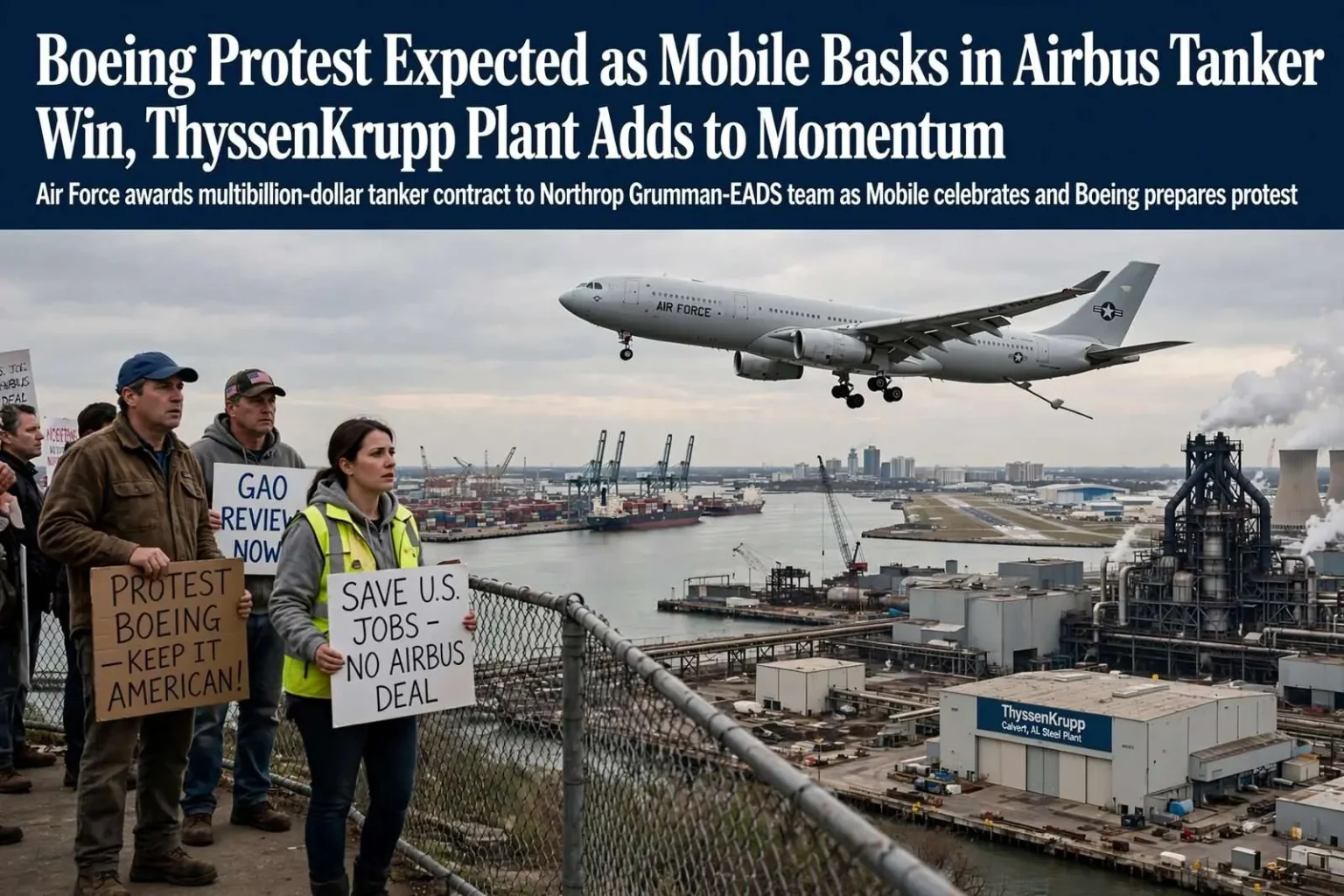
The Air Force’s decision to award the multibillion-dollar aerial refueling tanker contract to Northrop Grumman and its European partner EADS Airbus set off a wave of celebration across Mobile, where officials and residents alike began looking ahead to what the win could mean for the city’s future.
The prize was enormous by any measure. The aerial refueling tanker fleet is the workhorse of American airpower, allowing fighters and cargo planes to stay aloft for hours and reach targets around the globe without landing, and the Air Force had been trying for years to replace its aging fleet of Eisenhower-era KC-135 tankers. The contract awarded to the Northrop Grumman-EADS team ranked among the largest military procurement awards in American history, with production that would stretch across many years and involve thousands of workers.
U.S. Rep. Jo Bonner, whose district includes Mobile, said the opportunities created by landing the aircraft assembly work could benefit the region for decades to come. EADS officials said construction on the Mobile-area facility was expected to begin as the program moved forward, following roughly three years of work by local, state and federal officials to convince the Air Force, the National Guard and EADS that Mobile was the right site for the project.
A Decades-Long Pursuit
That three-year effort was a concerted campaign by a mid-sized Southern city to break into an industry it had never held. Local economic development leaders made repeated trips to Washington and to EADS headquarters, selling Mobile’s combination of deepwater port access, an available industrial site at the former Brookley Air Force Base, a cooperative state government willing to put incentives on the table, and a workforce with manufacturing roots in shipbuilding, paper and chemicals.
Brookley itself carries the story of the region’s aviation ambitions. The airfield on Mobile Bay was an active Air Force base for decades before its closure in the late 1960s, a loss that hit the local economy hard. Rebuilding an aerospace presence on that same ground became a goal of city leaders across succeeding administrations, and the tanker bid represented the most serious chance yet to make it happen. The site, now operated as the Mobile Aeroplex at Brookley, offers runway access, rail lines and a port within a single industrial campus — a combination few competitors could match.
State officials had already shown their willingness to invest when they courted the steel industry, and the same playbook — tax abatements, site preparation, worker training programs — underpinned the aerospace pitch. For a state long associated with cotton and catfish in the national imagination, landing a European aerospace partnership would signal something new.
A Protest Seems Certain
Even before the celebration had fully settled in, though, local observers were bracing for a fight. Boeing, which had been widely expected to win the contract given its decades-long hold on similar Air Force work, was seen as almost certain to file a formal protest over the award.
Boeing’s position in the tanker market stretched back to the original KC-135, which was derived from its 707 airframe and built in the 1950s. The Chicago-based company had argued that its smaller 767-based offering was the right aircraft for the mission, while the Northrop-EADS team proposed a larger airframe derived from the Airbus A330, capable of carrying more fuel and cargo. The Air Force’s selection of the bigger plane stunned industry watchers who had assumed the contract would stay American.
Formal bid protests are a routine feature of major federal procurement, and the Government Accountability Office handles hundreds of them each year. A losing bidder can file within days of an award, and the GAO typically issues a decision within about 100 days. In contracts of this size, protests are less an if than a when, and both sides staff up for a legal fight that can stall a program for months. Billions of dollars and tens of thousands of jobs across multiple states were riding on the outcome, which guaranteed that any protest would draw national attention.
Mobile officials and business leaders said they hoped any objection would be heard and resolved quickly without derailing the project, while acknowledging the sheer size of the contract — and the jobs at stake on both sides — made a challenge all but inevitable.
The stakes extended well beyond the two companies. Congressional delegations from the affected states immediately took sides, with Alabama’s officials defending the award and lawmakers from Boeing’s home territory questioning the Air Force’s analysis. Defense procurement fights of this scale routinely reach Capitol Hill, where funding decisions, oversight hearings and amendments can reshape a program regardless of how a protest ruling comes out. Mobile’s congressional delegation, Bonner in particular, faced a double role: celebrating the win at home while defending it in the committees and conference rooms where the program’s future would actually be decided.
The Steel Plant Next Door
The tanker win also arrived as Mobile was already absorbing another major piece of international investment: Germany’s ThyssenKrupp had recently selected the area for a large steel plant, part of what local boosters described as a broader pattern of European companies taking a serious look at the city and the wider Mobile Bay region.
The ThyssenKrupp facility, one of the largest private industrial investments in American history at the time of its announcement, rose on thousands of acres in Calvert, north of Mobile, taking advantage of the port, rail lines and river access that make the region a natural landing point for heavy industry. The plant brought thousands of construction jobs during its building phase and a permanent industrial workforce once operating, along with the suppliers and service companies that cluster around such facilities.
Between the two projects, officials said they expected other companies to start paying closer attention to what Mobile had to offer as a home for manufacturing and industrial investment. Economic developers call this the anchor effect: one marquee tenant legitimizes a location, and the next prospects arrive with fewer questions about whether the region can support modern industry. Alabama had already proven the model with its automotive plants, which transformed the state’s economy in the 1990s and 2000s and made international manufacturing recruitment a specialty of state and local agencies.
More Than Jobs: A Question of Identity
For longtime residents, the tanker announcement also nudged at something less tangible than jobs or dollars: civic identity. Several noted that they had grown used to needing to clarify “Mobile, Alabama” when traveling or meeting people from outside the region, just to be understood.
The city’s history gives that frustration its edge. Mobile is older than many American cities — founded by the French, passed through British and Spanish hands, and the original capital of French Louisiana — and it built its early wealth on cotton exported through its port. Yet by the late twentieth century, the city had watched Houston, Atlanta and Nashville claim the national spotlight while Mobile’s profile shrank. Landing the tanker assembly work, and the steel plant before it, suggested that the outside world was finally seeing what residents had long insisted was there: a deepwater port, a trainable workforce, an industrial-friendly climate and a location within reach of half the country’s population.
City leaders understood the reputational value of the win as clearly as the economic value. Headlines in national business publications mentioning Mobile as the site of a major aerospace facility did more for the city’s image than any advertising campaign could buy, and officials leaned into the moment, hosting tours of the Brookley site and promoting the region to site selectors who had never considered the Gulf Coast for aerospace work.
With the city landing back-to-back international investments and drawing national headlines, some said it felt like Mobile was inching toward being recognized on its own, without the qualifier.
Waiting on Washington
City and county officials said they planned to keep tracking the fallout from the award, including any formal protest from Boeing, in the weeks ahead.
That caution reflected hard experience. In major defense competitions, announced awards are sometimes reversed, and communities that celebrated too early have watched jobs go elsewhere after a protest or re-bid. Mobile’s leaders publicly maintained confidence in the selection while quietly preparing for the possibility of a protracted legal fight — a posture that acknowledged both the strength of the team’s bid and the unpredictability of federal procurement politics.
Whatever the protest’s fate, the award itself had already changed how the city saw its prospects. Mobile had entered the competition as a long shot and finished as the Air Force’s choice, and the experience — the site visits, the engineering studies, the Washington advocacy — left the region with a proven playbook and a new sense of what it could compete for. Residents would learn in the weeks ahead whether the win would hold, but the city that had spent decades explaining where it was now had a story people wanted to hear.