Behind Mobile’s Excitement Over the New Airplane Plant, a Familiar History of Waiting for Saviors
As Mobile celebrates a major new aerospace plant, some longtime observers are urging caution, pointing to a long history of the city pinning its hopes on outside projects — from the shipping channel to Brookley Air Force Base — that didn't fully deliver the transformation many expected.
News that a major new airplane plant is coming to Mobile has plenty of civic and business leaders celebrating, but a more skeptical strain of local opinion is urging caution about how much the project will really change the city’s fortunes. The debate says as much about Mobile’s history as it does about the deal itself.
Rumors in the days before the decision
Anticipation had been building across Mobile for days before word of the decision actually broke. Business leaders spent the final Friday trading rumors about timing, with talk circulating that the Air Force would not reveal its choice until after the stock market closed for the day. One persistent rumor making the rounds held that the huge contract might end up split between the Northrop Grumman/EADS team and Boeing rather than awarded outright to one side — a compromise some in Mobile’s business community viewed as plausible given the sheer size of the deal and the political stakes riding on it.
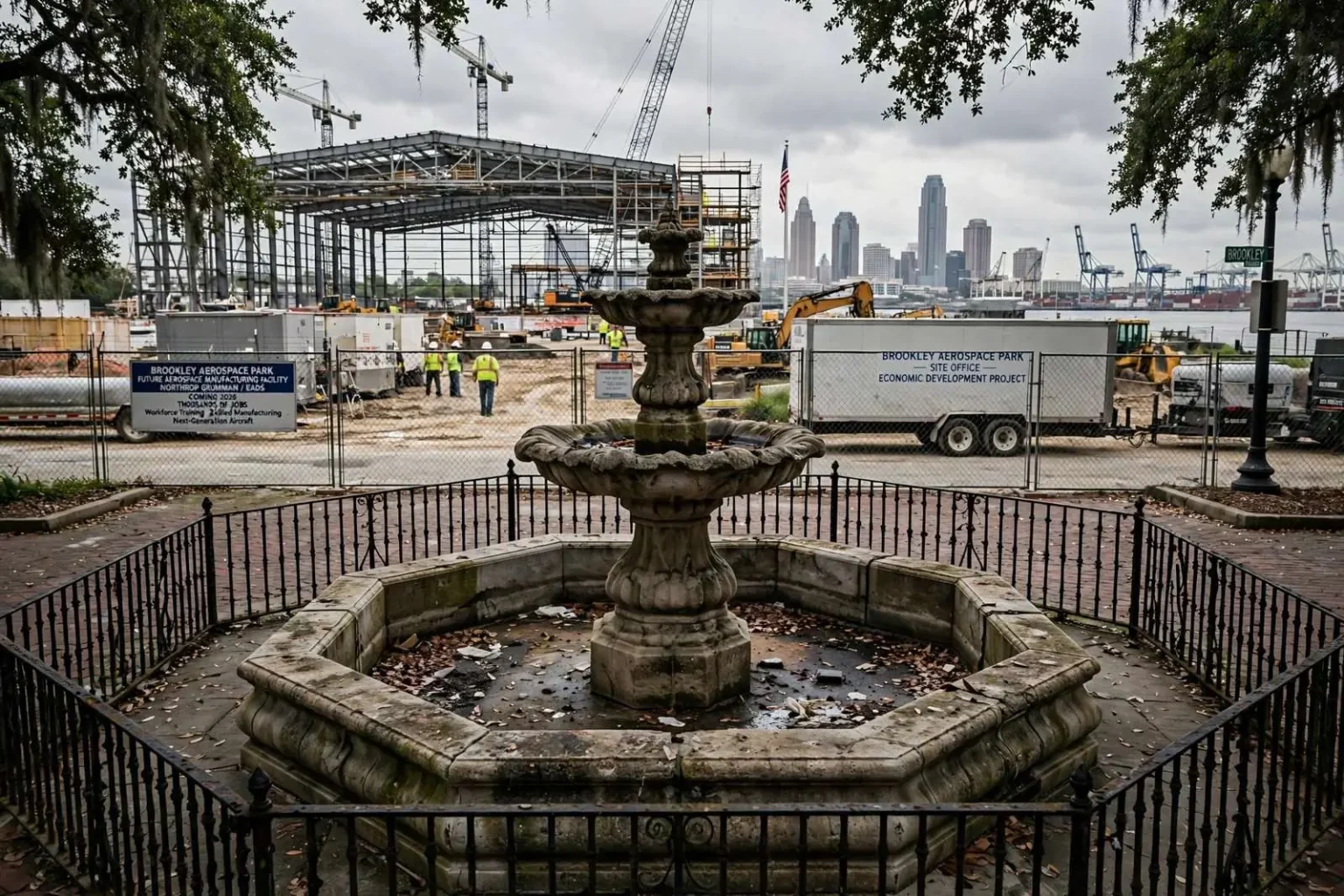
Locals joked that they would know for certain Mobile had won the moment word got back that Chamber of Commerce leadership had jumped into the fountain at Bienville Square to celebrate.
What the project could mean
On the optimistic side of the ledger, the project could be a genuine boost for Mobile’s cultural and civic life. Industries with a track record of investing in the community — Degussa is frequently cited as an example — have historically put real money behind local institutions and arts organizations. Skeptics note that other outside companies have instead treated the region as a place to extract value from cheap land and labor without investing meaningfully in return, and it remains to be seen which pattern the new project will follow.
There is real precedent for the optimistic reading along the central Gulf Coast. Large manufacturers that have settled in the region have often anchored supplier networks, training pipelines at area colleges and steady demand for skilled labor, and Mobile’s port, rail and interstate connections give an aircraft plant a logistics profile few inland sites can match. Aerospace work also tends to create durable, high-skill employment rather than seasonal hiring, the kind of payroll that supports mortgages, small businesses and civic giving.
A long history of waiting for saviors
The deeper skepticism, though, is rooted in a longer view of Mobile’s economic history. For generations, the city has looked to a series of outside interventions as the thing that would finally transform its fortunes. After the collapse of the Cotton Boom in the 19th century, Mobile pinned its hopes, in turn, on a deepened shipping channel, new port docks, improved shipyards, an Air Force base, the completed Tennessee-Tombigbee Waterway, a naval homeport, a downtown convention center and a cruise terminal. Each was, in its moment, supposed to be the project that finally made Mobile take off.
Some of those investments did what they promised. The port remains the economic spine of the city, and the convention center and cruise terminal each delivered visible, if partial, returns. Others — the waterway chief among them — never produced the wholesale transformation their backers forecast. The pattern that emerges from the list is not that Mobile wasted its opportunities, but that no single project has ever been large enough to reorganize a regional economy on its own.
The most recent entries on that list are the RSA Tower, the ThyssenKrupp steel plant and now the aerospace project involving Northrop Grumman and EADS. The RSA Tower, Mobile’s tallest building, has sat with a large share of its floors visibly unoccupied at night nearly a year after its high-profile unveiling, even as officials continue to promise new tenants. ThyssenKrupp’s plant, meanwhile, has yet to open, and its distance from the city center has raised questions about how much its economic impact will be felt in Mobile proper, particularly as fuel costs climb and commuting from outlying areas becomes more expensive.
The Brookley wound
History offers a cautionary parallel in Brookley Air Force Base, whose 1969 closure remains a defining wound in Mobile’s civic memory. Brookley’s operation while it was open did reshape Mobile in one clear way: it drove a wave of population growth and helped expand the city’s limits.
But observers who look back skeptically on that era argue its cultural impact is often overstated. Mobile’s Creole heritage, the influence of the Catholic Archdiocese of Mobile, and the enduring prominence of Mardi Gras all persisted through and after the Brookley years, suggesting that large employers alone have rarely been the deciding factor in reshaping the city’s character.
The skeptics’ core argument
That history is at the core of the skeptics’ argument: that Mobile’s trajectory has always depended less on which project lands next and more on whether residents embrace change, welcome newcomers and remain open to outside ideas and people. Proponents of that view note that many talented Mobilians have left over the decades to build careers elsewhere in music, entertainment and film, arguing that retaining and attracting ambitious, diverse residents matters as much to the region’s future as any single industrial announcement.
None of which means the new aerospace project isn’t a big deal for Mobile — thousands of potential manufacturing jobs and a foothold in aerospace production would be significant by any measure. But the debate playing out around the announcement reflects a recurring question in Mobile’s civic life: whether a single project can meaningfully change the city’s fortunes, or whether lasting change depends on something harder to build than a factory.
That question has a practical edge because of where the jobs would actually land. Plants of this scale draw workers from across the central Gulf Coast — Baldwin County’s bedroom communities, the Eastern Shore, rural Washington and Clarke counties — and the wages they generate flow through school systems, housing markets and retail corridors far beyond the fence line of the assembly hall itself.
Whether Mobile proper captures that value depends on choices the city still controls: how it develops the land around Brookley, how it trains residents for the skilled trades the plant will demand, and how quickly it converts new payrolls into downtown vitality rather than watching the spending scatter to the suburbs. Cities that have hosted comparable aerospace work — Wichita, Kansas is the classic example — have seen the industry become woven into their identity over decades, through suppliers, training programs and second-generation workers, not through any single ribbon-cutting.
For now, the fountain at Bienville Square remains dry, and the champagne jokes have given way to the slower work of negotiation and site preparation. The celebration will resume when the first airframe rolls out. What happens in the years after that — whether the plant becomes the engine Mobile has chased for generations or simply the latest name on a long list — will be decided less in the contract itself than in everything the city does around it.
It is worth keeping both readings in view, because the skepticism itself is a form of civic experience rather than mere pessimism. Mobile has been burned before by announcements that outran their payoffs, and a city that remembers its own list of unfulfilled transformations is better equipped to negotiate hard, demand accountability and measure a new employer by what it actually builds locally rather than by what it promises on announcement day.
The ground around the project has been prepared longer than most residents realize. civic and state economic development officials spent years assembling the acreage, incentives and workforce programs that made Mobile a serious contender in the first place, and the region’s community colleges and industrial training centers have already built curricula around welding, avionics and precision fabrication designed to feed plants like this one. That infrastructure — much of it funded by the same state leaders who chased the steel plant and the shipyard work — is the part of the story that persists regardless of how any one company performs.
The geography matters too. Brookley’s reopening as an industrial and aerospace park after the base closure gave Mobile a rare asset: hundreds of acres of already-developed, airport-adjacent land inside the city limits, connected to the interstate and the port. Few mid-size American cities have a comparable site ready for aerospace-scale construction, and the plant’s presence there strengthens the case that this cycle’s announcement is more than another entry on the list of hoped-for saviors.
Still, the skeptics’ deepest point survives every variation of the argument: factories employ people, but cities are built by people who stay. If the aerospace project becomes an anchor that keeps Mobile’s graduates in town, draws engineering talent from across the Southeast and gives local institutions a new stream of civic support, it will have done what no single intervention in the city’s history has managed. If it becomes an island of high-wage work connected by long commutes to everything else, it will simply be the newest name on a familiar list.
Which of those futures unfolds will not be visible on the day the first plane rolls out of the hangar. It will show up, gradually, in the enrollment numbers at local training programs, in the occupancy of the RSA Tower, in the restaurants that stay open past nine downtown, and in whether the sons and daughters of Mobilians stop having to leave the city to find the careers they trained for. Those are the measures the skeptics will be watching — and they are the right ones.