Alabama Power Warns South Alabama Customers of Fake Text Payment Scam
Alabama Power is warning Mobile and Baldwin County customers about a fake text message demanding immediate bill payment.
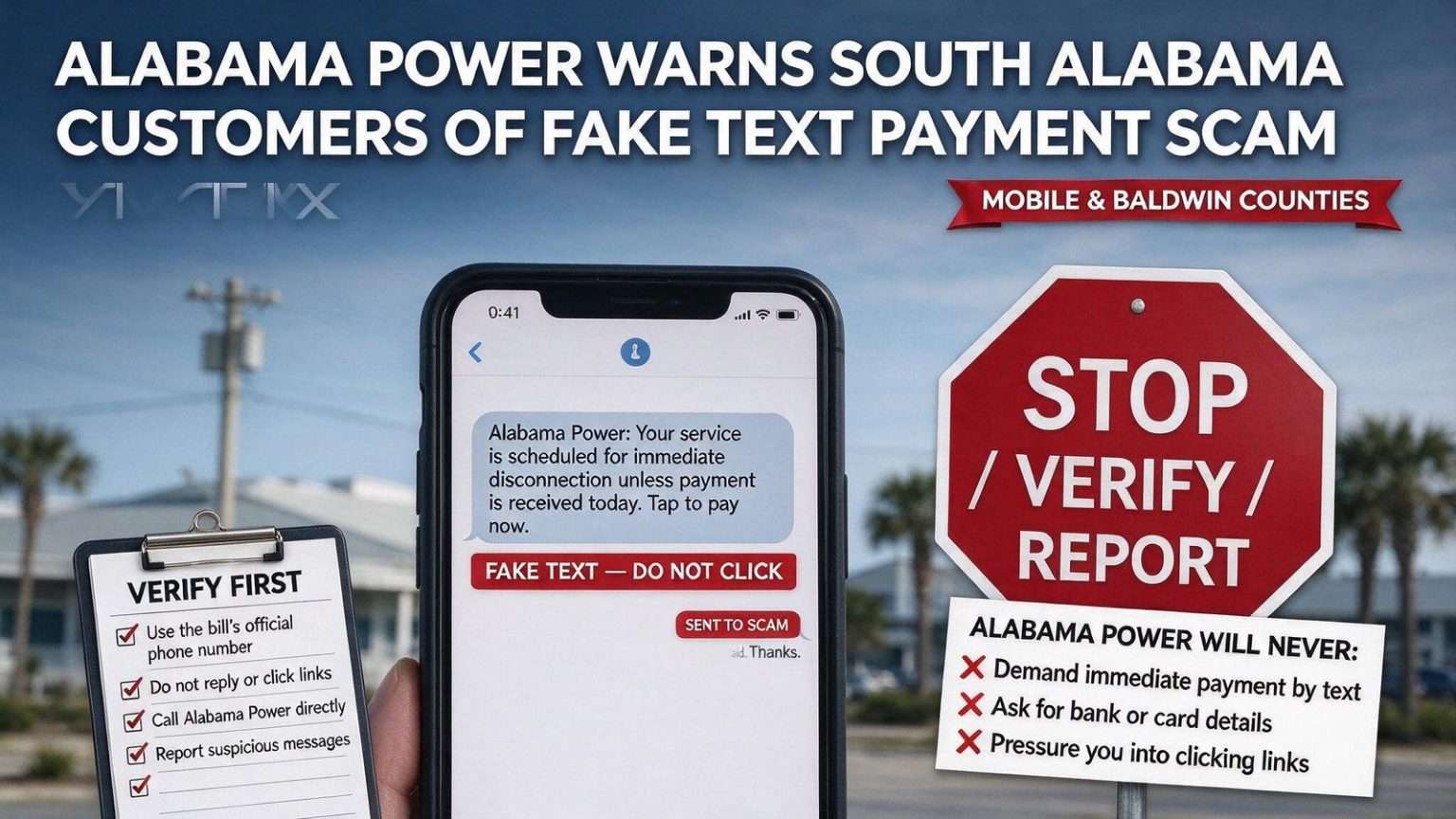
MOBILE, Alabama — Alabama Power is alerting customers across its South Alabama service area, including Mobile and Baldwin counties, to a new scam that arrives by text message rather than the usual phone call. The scheme is a modern twist on the disconnection threat that utility customers across the region have heard for years, and this time it lands directly in the palm of the hand.
A New Twist on an Old Scam
According to a company spokesperson, the fraudulent text tells recipients a payment is due immediately and directs them to send money through a legitimate-sounding payment service. The company that processes the payments referenced in the scam is a real business, the spokesperson said, but Alabama Power itself does not offer a system that lets customers pay by simply replying to a text message.
That distinction is the heart of the scheme. By routing victims to a genuine third-party payment platform, scammers lend the request an air of legitimacy that a fake website or spoofed phone number alone might not provide. The customer believes the payment service is real, because it is — it just has no legitimate connection to the utility bill the text claims to be collecting.
Once money is sent through the scheme, it is nearly impossible to recover, the spokesperson said, since the reference number used in the scam could be tied to an account anywhere, including overseas. Unlike a disputed credit card charge, a transfer made through a payment service at the recipient’s own instruction generally cannot be clawed back after the fact.
Company officials said this appears to be the first time they have seen the scam delivered by text rather than by phone, and they expect that method to become more common as more customers grow comfortable paying routine bills from their phones. The shift mirrors broader consumer behavior: as mobile payment apps become a normal way to split a dinner check or send money to family, scammers follow the habit.
The timing of the alert also reflects how quickly these operations move. A scam wave that once required hours of phone calls, one victim at a time, can now be launched across an entire service area with a few mass texts in the space of an afternoon. That speed means the utility’s warning has to reach customers before the messages do, which is why the company is pushing the alert through every channel it controls rather than waiting for reports to accumulate.
What Local Customers Should Watch For
Alabama Power says it will never call or text customers asking for bank account information or a credit card number. Customers in Mobile, Baldwin and surrounding counties who receive a suspicious text asking for immediate payment are urged not to respond or click any links, and instead to contact the company directly through its customer service line to check the real status of their account.
The guidance applies equally to emails and phone calls. Utility impostors typically manufacture urgency — a same-day disconnection, a late fee that doubles, a meter that will be pulled within hours — precisely because urgency discourages verification. A customer who hangs up and dials the number printed on their own bill will almost always discover that their account is in good standing.
Red flags worth remembering include any request for payment by wire transfer, prepaid debit card, gift card or peer-to-peer payment app; a demand that the customer keep the call or message private; and a pressure deadline measured in hours rather than days. Legitimate utility notices arrive on letterhead, through the mail or through the company’s official account channels, with time to spare.
A Pattern That Comes in Waves
Utility scams tend to spike periodically across the region, often timed around bill due dates or weather events when customers may be anxious about service interruptions. A summer heat wave, a hurricane season storm or the first cold snap of winter all create moments when a threat of disconnection carries extra weight, and scammers have learned to strike when fear of losing power is at its peak.
Local law enforcement agencies in South Alabama have previously urged residents to be skeptical of unsolicited payment requests, whether they arrive by phone, text or email, and to verify any request directly with the utility before sending money. The advice applies to every age group; while older residents are frequently singled out by phone scams, text-based schemes reach customers of all ages, often in the middle of a busy day when a quick reply seems harmless.
Why the Text Message Version Is Especially Tricky
A phone scam gives the target a voice to interrogate — background noise, a script, telltale pauses. A text message offers none of those cues, and it arrives in the same inbox as legitimate appointment reminders and delivery notices. Scammers can also send thousands of texts in seconds, casting a wide net across a company’s service area and relying on a small fraction of recipients to bite.
The mobile billing habit plays a role too. A customer who already pays several bills from a phone may find the idea of settling a utility balance by text plausible enough to act on before thinking it through. That is exactly the reaction the scheme is engineered to produce, and it is why Alabama Power is emphasizing the single clearest rule: the company does not accept payments through text replies, ever.
Customers who have already responded to a suspicious message should act quickly — contact their bank or the payment service used, attempt to stop or reverse the transfer, and report the incident to local law enforcement and to Alabama Power so the company can track the scam’s spread.
How to Verify and Report
The safest verification route is always a number the customer finds independently — the customer service line printed on a paper bill, listed on the company’s official website or available through the utility’s official app — rather than any number or link included in the suspicious message itself. Scammers frequently provide their own “customer service” numbers, which simply route the victim back to the fraudster.
Reporting matters beyond the individual case. Each report helps the utility and law enforcement track the scope of a scam wave, warn other customers and, in some cases, work with payment platforms to shut down the accounts collecting fraudulent transfers. Customers can also report scam attempts to the Federal Trade Commission, which tracks imposter scams nationwide.
Alabama Power says it continues to monitor for new variations of the scheme and will update customers as new details emerge. In the meantime, the company’s message to South Alabama is simple: hang up on threatening calls, delete suspicious texts, never send money through a channel the company does not officially offer, and call the utility directly if a bill’s status is ever in doubt.
The Broader Cost of Utility Scams
Beyond the losses borne by individual victims, utility scams carry a community cost. Households that lose hundreds of dollars to a fraudulent transfer may struggle to pay the real bill that still comes due, and the erosion of trust makes customers warier of legitimate outreach from their utility, complicating communications during genuine emergencies such as storm outages and restoration notices.
The schemes also evolve quickly. Phone-based disconnection scams have circulated for years across Alabama and the broader Southeast, and each new delivery method — email, social media, and now text — restarts the cycle with a fresh audience. Utilities across the country have responded with public awareness campaigns, and Alabama Power’s alert to Mobile and Baldwin county customers fits that pattern.
A Simple Checklist for South Alabama Customers
For residents of Mobile, Baldwin and surrounding counties, the company’s warning reduces to a short checklist. Know that Alabama Power will never request bank or credit card details by phone or text. Know that the utility does not accept payments through text-message replies. Delete and do not click links in unexpected payment texts. Verify any claimed balance or disconnection threat by calling the customer service line yourself. And report scam attempts so the next wave of texts meets a better-prepared audience.
The first reported text-message version of the scam may not be the last. As company officials noted, they expect the text method to become more common as mobile payments grow, which makes this alert less a one-time notice than an early warning for every bill-paying season to come.
Families may also want to talk through the scheme together, particularly with relatives who manage the household bills or who live alone. A quick conversation about what a legitimate utility message looks like — and what it never asks for — is one of the most effective defenses available, because the moment of doubt that saves a victim’s money most often comes from a familiar voice rather than a public warning.