Poll: South Alabama Voters Want BP Settlement Money Spent on Coastal Restoration
A new Gulf Coast poll shows strong bipartisan support for spending BP oil spill settlement funds on restoring beaches and coastal ecosystems.
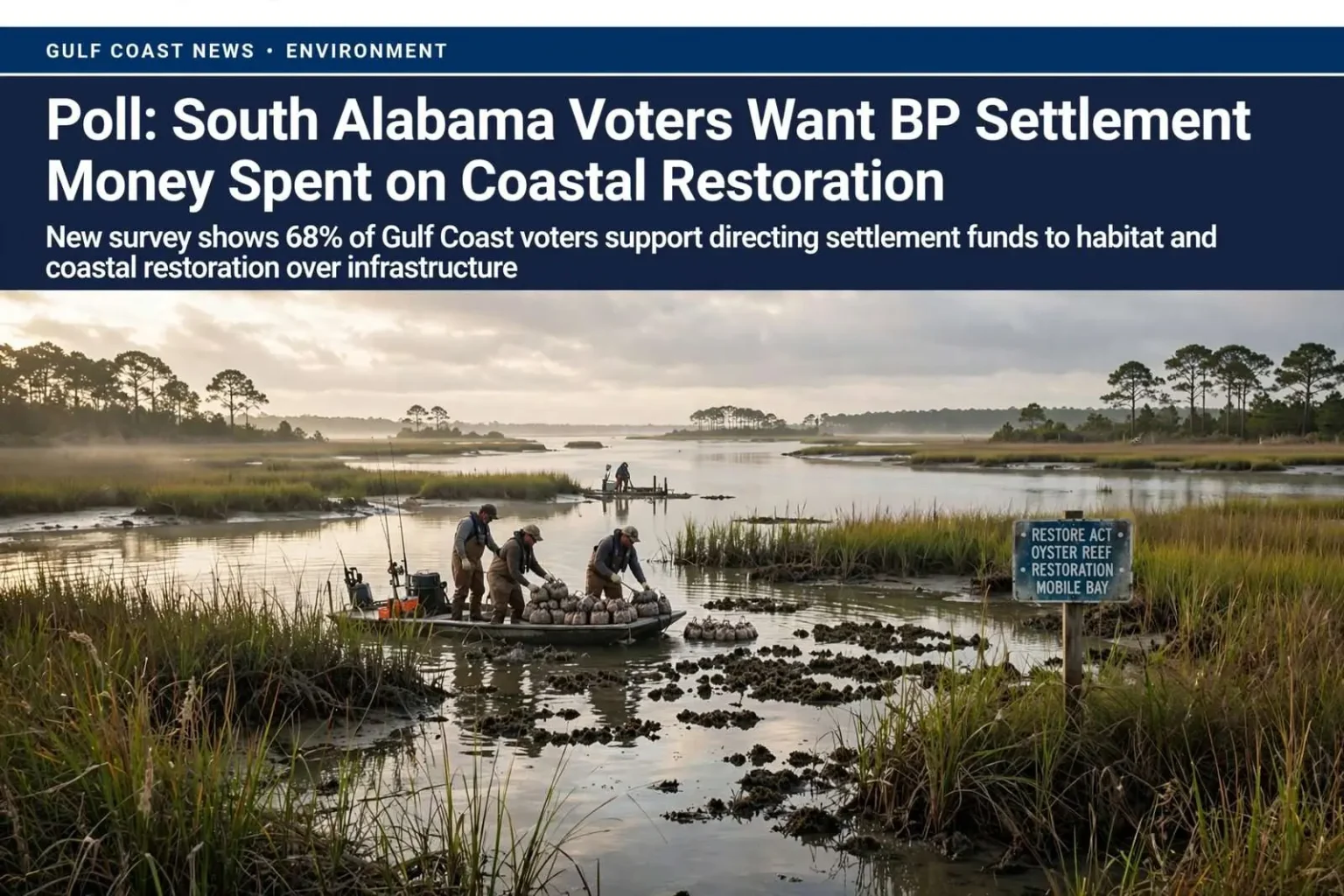
A newly released poll of Gulf Coast voters, including those along coastal Alabama, shows growing support for directing billions of dollars in BP oil spill settlement money toward environmental restoration rather than general infrastructure spending. The findings land in the middle of an ongoing debate in statehouses and county commissions across the region over how to spend the largest environmental settlement in American history.
The survey, commissioned by the Theodore Roosevelt Conservation Partnership and the Nature Conservancy, found that 68 percent of respondents across five Gulf states want RESTORE Act funds focused on rebuilding beaches, wildlife habitat and coastal waterways. That support has grown since a similar poll was conducted in 2013, reflecting continued public interest in restoring the region years after the 2010 Deepwater Horizon disaster — and, pollsters suggest, a deepening public understanding of how the RESTORE Act money actually flows.
The RESTORE Act, passed by Congress in 2012, dedicates the bulk of the Clean Water Act civil penalties paid by BP and its partners to restoration projects in the five Gulf states of Texas, Louisiana, Mississippi, Alabama and Florida. The law divides the money among several pots, including direct grants to the states, economic recovery programs and a science and observation program, with a federally chaired Gulf Coast Restoration Council approving a comprehensive plan that guides much of the spending.
Notably, the poll found more self-identified Republican voters than Democrats prioritized restoration spending over construction projects such as roads and schools, a trend pollsters attributed in part to the region’s strong hunting and fishing culture. More than a third of respondents said they had purchased a hunting or fishing license within the past three years, and sportsmen’s groups have argued that restoring wetlands, oyster reefs and seagrass beds is as much a conservation priority as it is an economic one.
“They care about the quality of the habitat and ecosystems we have,” said Chris Macaluso of the Theodore Roosevelt Conservation Partnership, describing sportsmen as a driving force behind conservation-minded views even among conservative voters. For an organization that carries the name of the conservationist president who doubled the national parks, the poll’s takeaway was straightforward: across party lines, Gulf Coast residents see restoration as the point of the settlement money.
What Alabama Stands to Receive
For coastal Alabama, the debate carries real financial stakes. The state’s overall settlement is expected to total roughly $2 billion paid out over 18 years, with about $1 billion directed to the state’s general fund. That half flowing to the general fund is available for lawmakers to spend with few restrictions — on roads, buildings or budget gaps — while the remaining money is bound more tightly to restoration and recovery purposes under the RESTORE Act’s formulas.
Local advocates argue that not enough of the money is earmarked specifically for Mobile and Baldwin counties, which absorbed the heaviest economic and environmental toll from the spill. Beaches on the Baldwin County shore saw tar balls and cleanup crews throughout the summer of 2010, and the commercial fishing fleets of Bayou La Batre were idled as waters closed; advocates have pressed for the state’s allocations to reflect that geography.
Casi Callaway, executive director of Mobile Baykeeper, said investing in environmental restoration benefits nearly every corner of the local economy, from tourism to seafood restaurants to property values along the coast. Her organization, which has monitored Mobile Bay’s waterways for decades, has argued that healthy marshes and oyster reefs are themselves infrastructure — natural systems that filter water, buffer storm surge and support the fisheries and beaches on which the regional economy rests.
She and other local advocates have pushed back against using settlement money to fill general budget shortfalls, warning that one-time dollars spent on recurring expenses will leave the coast with nothing to show once the 18-year payout ends. The restoration argument, by contrast, points to projects with lifespans measured in decades: rebuilt oyster bars, reconnected marshes, protected shorelines and improved water quality that compound in value over time.
The Politics of the Payout
The poll’s bipartisan findings arrive as state and local officials across the Gulf weigh competing claims on the money. Mayors and county commissioners see in the settlement a rare chance to fund stormwater systems, convention centers and highways; conservation groups counter that the public expects the money to fix what the spill damaged, and that diverting it risks squandering the region’s best chance at large-scale ecological recovery.
In Alabama, that debate has played out against a backdrop of tight state budgets, which makes a multibillion-dollar revenue stream tempting for purposes far afield from the shoreline. Supporters of restoration-focused spending have pointed to the poll as evidence that the public — including the state’s conservative majority — would back officials who keep the money tied to the coast.
The five-state framing of the poll also matters for Alabama’s position. Louisiana, which suffered the most oiled shoreline, has moved aggressively to fund a 50-year coastal master plan, while Mississippi has invested settlement funds in ports and infrastructure alongside restoration. Alabama’s allocations are decided by state leaders within the federal framework, giving local advocates a recurring opportunity — and obligation — to weigh in at public hearings held by the Gulf Coast Restoration Council and state agencies.
Why Sportsmen’s Voices Carry Weight
The role of hunting and angling groups in the restoration debate reflects the region’s outdoor economy. Alabama’s waters — from the Mobile-Tensaw Delta, one of the nation’s richest river deltas, to the inshore reefs of Mobile Bay and the Gulf itself — support saltwater and freshwater fisheries that draw anglers from across the Southeast, along with duck hunting in the delta’s flooded timber and marshes.
Groups like the Theodore Roosevelt Conservation Partnership have spent years organizing that constituency on Gulf issues, arguing that sportsmen have both the standing and the numbers to shape how recovery money is spent. The poll’s finding that license holders disproportionately favor restoration gives those groups a data point to carry into legislative hearings and county meetings.
The Nature Conservancy’s involvement adds a scientific backbone to that advocacy. The organization has worked on oyster reef restoration in Mobile Bay and along the Gulf, projects that demonstrate how rebuilt habitat can support both fisheries and storm protection — concrete examples of what restoration spending looks like on the water.
What Comes Next for the Money
The payouts will unfold over nearly two decades, giving coastal Alabama an extended series of decisions rather than a single one. Each year brings new allocations, new project lists and new public comment periods, and the choices made early — about which funds go to ecological restoration and which to construction — will shape what the coast looks like when the last payment arrives.
For Mobile Baykeeper and its allies, the poll is a tool for those recurring debates: evidence that the region’s voters, Republican and Democrat alike, want the settlement to leave behind a healthier coast. The alternative, advocates warn, is a generation of one-time spending that ends with the money and the opportunity both gone.
The message from the survey, in the end, is less about numbers than about intent. Five years after oil washed ashore, the people who live on the Gulf want the settlement to do what its name promised — restore — and they are watching to see whether their leaders spend it that way.
How the RESTORE Act Money Is Divided
Understanding the poll requires understanding the plumbing of the RESTORE Act itself. The law splits the penalty money into five separate components, each with its own rules. The largest direct allocation goes to the five states under the Direct Component, distributed by a formula that weighs shoreline distance and population, and spent by each state according to a council-certified plan. Other components fund the federal council’s comprehensive restoration plan, economic recovery programs in oiled counties, scientific research and monitoring, and a federal trust for infrastructure in the region.
That structure means no single official controls Alabama’s share, and it means advocacy happens in multiple venues at once — before the federal council, before state administrators and before county commissions that receive their own allocations under the economic recovery component. Mobile and Baldwin counties, as the two coastal counties directly affected by the spill, hold seats in that process that inland jurisdictions do not.
The poll commissioned by the two conservation groups was designed to measure public sentiment across that whole five-state landscape, and its 68 percent figure for restoration was consistent across state lines, pollsters reported. The growth since the 2013 edition of the survey suggests that as project lists have become public — beaches rebuilt, reefs planted, water quality projects announced — residents have formed a clearer idea of what restoration spending actually buys.
Advocates’ To-Do List for the Coast
Local restoration advocates have assembled no shortage of candidate projects for Alabama’s allocations. Proposals backed by conservation groups over the years have included large-scale oyster reef construction in Mobile Bay, living shorelines to replace failing bulkheads, upstream conservation in the Mobile-Tensaw Delta to protect the water quality that flows into the bay, and expanded public access that connects residents to the resource the money is meant to heal.
Each carries an economic argument that advocates have refined for a decade. Oyster reefs support a fishery and buffer wave energy; delta conservation protects the nursery that feeds the bay; living shorelines cost less over their lifespan than hardened armaments and preserve habitat instead of destroying it. The poll’s numbers suggest that message has found its audience.
The decision point for Alabama’s leaders remains ahead, with payments continuing for years to come. What the Theodore Roosevelt Conservation Partnership and the Nature Conservancy hope their survey establishes is a baseline: when the money is spent away from the coast, or spread thin on projects with no restoration benefit, it will contradict the clear preference of the very voters the settlement was meant to make whole.