Lightning Deaths in South Alabama Prompt Renewed Safety Warnings
After lightning strikes claimed lives across southern Alabama this year, forecasters are urging residents to take storm safety seriously this summer.
SOUTH ALABAMA — Summer storms have turned deadly in parts of southern Alabama this year, prompting forecasters to renew calls for basic lightning safety as the region heads deeper into its peak thunderstorm season. The warnings come as the Gulf Coast enters the months when afternoon storms fire almost daily.
Nationally, lightning strikes have killed 17 people so far this year, according to the National Weather Service, with three of those deaths occurring in southern Alabama. The concentration of deaths along the Gulf Coast is no accident: the region sits inside one of the most lightning-prone corridors in the United States, where summertime sea breezes off Mobile Bay and the Gulf collide with inland heat to produce thunderstorms on a near-daily basis.
Forecasters say the toll is a reminder that lightning remains one of the more underestimated weather hazards in the Gulf Coast region, where afternoon thunderstorms are a near-daily occurrence through the summer months. Unlike hurricanes and tornadoes, lightning rarely draws warnings ahead of time — it develops inside ordinary thunderstorms that most residents think nothing of working, fishing or playing through.
“There is no place outside that is safe when storms are in the area,” the National Weather Service has cautioned, adding that anyone who hears thunder is already within striking distance of lightning and should seek shelter immediately rather than waiting to see rain arrive. Forecasters use the “30-30 rule” as a rule of thumb: if the time between the flash and the thunder is 30 seconds or less, the storm is close enough to strike you, and people should remain indoors for 30 minutes after the last thunder is heard.
Staying Safe Indoors
Indoors, safety guidance includes staying off corded phones and plugged-in electronics, avoiding sinks, bathtubs and faucets, and steering clear of windows, doors and exposed porches during a storm. Lightning that strikes a home or nearby power line can travel through wiring and plumbing, which is why the bathroom — a place people assume is safe — is among the riskier rooms during a strike.
Leaning against concrete walls, which often contain metal reinforcement bars, can also pose a hidden risk of electrical conduction. The rebar inside concrete can carry a lightning current across a room, so forecasters advise standing away from walls and floors with embedded metal.
Indoor shelter means a substantial building or a hard-topped metal vehicle, not a picnic shelter, dugout, carport or open garage. Vehicles are safe because their metal shell conducts the charge around the occupants — not because of the rubber tires, a persistent misconception — but convertibles, golf carts and open boats offer no such protection.
If You’re Caught Outside
For anyone caught outdoors with no shelter available, forecasters recommend getting off elevated ground immediately, avoiding isolated trees, and staying away from cliffs, rocky overhangs, ponds, lakes and other open water. Fences, power lines and other metal objects that conduct electricity should also be avoided.
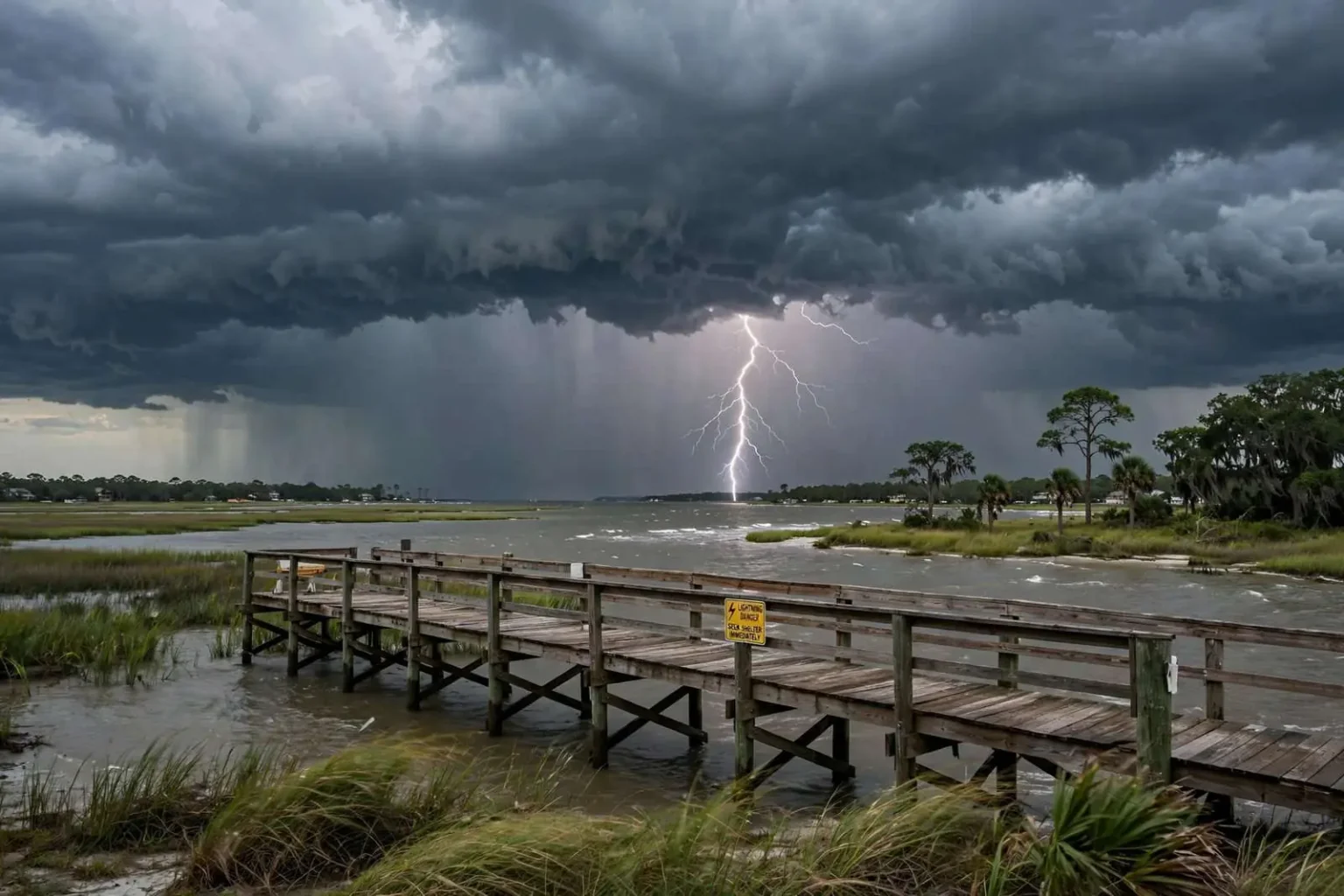
The advice matters particularly along the Alabama coast, where fishing piers, golf courses, ballfields and beaches put people in the open exactly when storms develop. Anglers and boaters are among the most frequent lightning victims nationally, because a storm’s arrival often catches them farther from shelter than they can reach in the few minutes a storm needs to build. Marine forecasters urge boaters to monitor radar and head for shore at the first sign of building towers rather than the first sound of thunder.
Youth sports present a recurring challenge. Coaches and league officials along the Gulf Coast are urged to clear fields at the first sound of thunder and keep them clear for the full 30 minutes after the last rumble, a policy the National Weather Service promotes through its lightning safety toolkits for schools and leagues. Games can be rescheduled; lives cannot.
Clearing Up the Myths
Forecasters are also working to dispel a few persistent myths. Contrary to popular belief, lightning can strike the same location more than once — the Empire State Building is famously struck dozens of times a year — and tall objects are struck repeatedly for exactly that reason.
Crouching down offers little real protection, despite generations of outdoor advice to the contrary. A crouch reduces a person’s height slightly, but it does nothing against ground current, the electricity that spreads through the earth from a nearby strike and is responsible for many injuries. The only reliable protection is getting inside a substantial building or vehicle.
Sheltering under a tree is actually one of the more dangerous choices a person can make during a storm, since trees are common lightning targets. A strike on a tree can throw sparks, split the trunk and send current through the ground around it, and people huddled beneath the canopy are close enough to be harmed by all three. If no shelter exists, the guidance is to keep moving toward one rather than to stop and wait under the nearest tree.
Why the Gulf Coast Is a Lightning Hotspot
The geography explains a great deal. Florida leads the nation in lightning deaths, but the central Gulf Coast — from southeast Louisiana across the Mississippi coast into south Alabama and the Florida Panhandle — runs a close second in flash density, the measure of how many lightning strikes hit a given area each year. The same coastal convergence that fuels the region’s afternoon storms makes it one of the most electrified places in the country.
South Alabama’s storm pattern compounds the exposure. Summer storms here are typically scattered afternoon cells rather than organized widespread events, which means a storm can be hammering one neighborhood while the sun shines two miles away — precisely the conditions that catch people outside who believe they can outrun the weather. Workers in construction, roofing, landscaping and agriculture, along with beachgoers and golfers, face the greatest routine exposure.
Lightning injuries also carry a profile many residents don’t expect. Most people struck survive, but the injuries — cardiac arrest at the moment of the strike, memory and concentration problems, chronic pain, sleep disorders — can be lasting. Bystanders can safely begin CPR on a strike victim immediately; unlike an electrical-wire shock victim, a person struck by lightning carries no charge, and prompt CPR is often the difference between life and death.
The Season Ahead
With thunderstorms a routine part of the forecast across Mobile, Baldwin and surrounding counties through late summer, officials said the message boils down to timing and respect: plan outdoor activities around the afternoon storm window, watch the sky rather than the clock, and treat the first rumble of thunder as the signal to move — not the first drop of rain.
The National Weather Service offices that serve south Alabama issue no formal “lightning warnings” for ordinary summer storms, which is why personal responsibility carries so much weight. Beach flag systems, park PA announcements and lifeguard whistles all help, but none of them substitute for the individual decision to leave the water, clear the field or come in off the pier when thunder starts.
Forecasters will keep repeating the guidance through the rest of the season, because the alternative is learning it the hard way — as 17 families across the country, three of them in southern Alabama, already have this year. When thunder roars, the advice runs, go indoors. On the Gulf Coast in summer, that simple rule has more chances to save a life than anywhere else in the country.
The three southern Alabama deaths this year are part of a pattern forecasters have documented for decades. Lightning deaths nationally have fallen dramatically since the mid-20th century — from an average of well over a hundred a year to the low dozens — thanks to better forecasting, greater public awareness and changes in how people work and spend their time. But the deaths that remain cluster heavily in the Southeast, and the Gulf Coast states consistently rank near the top of the list.
Local emergency managers say the region’s outdoor culture is the common thread. Fishing from the pier, golfing through a scattered storm, cutting grass before the rain arrives, or finishing an inning at the ballpark — the routines that define a Gulf Coast summer all put people in the open during the hours when thunderstorms are most likely. A storm that would have emptied a northern ballfield is sometimes treated in south Alabama as a brief inconvenience, and that judgment call is where the danger lives.
The National Weather Service’s forecast offices serving Mobile and Baldwin counties publish lightning safety material each summer and work with schools, parks departments and youth leagues on weather policies. Emergency managers recommend that families with outdoor plans check the forecast for storm timing, identify shelter in advance — a building, not a pavilion — and agree on a signal for when to clear the area.
The economics matter, too. Roofers, construction crews and landscaping teams face pressure to finish jobs despite afternoon storms, and workers who feel they cannot stop are among those most often struck. Safety officials stress that employers carry responsibility for lightning policies just as they do for heat safety, and that stopping work when thunder begins is the only acceptable practice.
As the season continues, forecasters will keep the tally current and the warnings plain: the storms along the Gulf Coast are as ordinary as summer itself, and the lightning inside them is just as real. The three deaths in southern Alabama this year are the region’s reminder that the safest choice is always the same one — when thunder rolls, get inside.