Fairhope’s Rebuilt Splash Pad Set to Reopen This Month
Fairhope's community splash pad is nearly ready to reopen after a concrete problem forced a rebuild, while a nearby nine-field soccer complex takes shape.
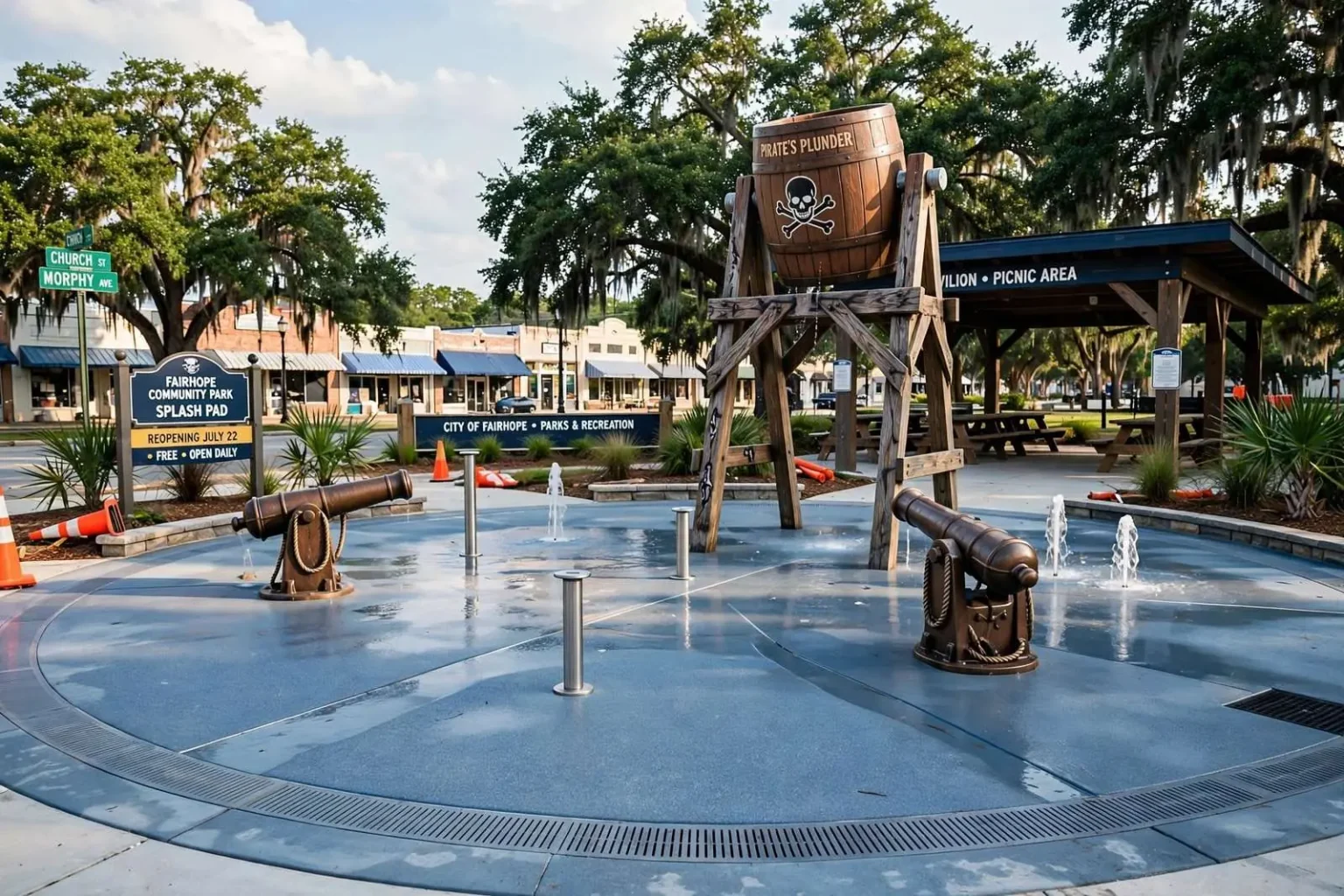
Fairhope’s splash pad is on track to reopen later this month after a construction setback forced the city to tear out and rebuild the water feature less than a year after it first opened. The do-over — rare for a municipal amenity so new — has been a visible inconvenience for families who made the downtown park’s splash pad a summer routine, and a costly lesson in construction quality control for a city that has poured money into its parks in recent years.
The splash pad debuted last August at the recently renovated community park downtown, but problems with the original concrete pad forced officials to demolish it and start over. Rather than patch the failing surface, the city concluded that a full rebuild was the only way to guarantee the feature’s longevity — a decision that meant eating the cost of work that was barely a year old. For residents, the demolition that followed was a striking sight: the colorful new pad reduced to rubble and hauled away almost as soon as families had learned its rhythm.
In April, the City Council approved a roughly $95,700 contract with a Pelham-based firm to handle the rebuild. City officials say the new splash pad is expected to open around July 22. The timeline keeps the pad in service for the heart of the summer, the season when it does its most important work as a free, family-friendly alternative to the pool, the beach drive or the backyard sprinkler.
According to Fairhope’s director of community affairs and recreation, the project has fallen slightly behind schedule due to rain delays that made it difficult to pour concrete on time, but work is otherwise going smoothly. Concrete work is famously at the mercy of the weather: a summer thunderstorm over a fresh pour can force crews to tear out and start again, and Baldwin County’s afternoon storm pattern in July makes even a few dry days precious. The delays pushed the target date but did not change the scope.
The splash pad and an adjoining pavilion sit on the south end of the roughly two-acre park at the corner of Church Street and Morphy Avenue. The location places the feature within walking distance of Fairhope’s downtown business district, an intentional piece of the city’s park planning: parents can combine a splash pad morning with lunch or shopping downtown, and the park serves as a neighborhood green space in a part of the city where land is scarce and valuable.
The refreshed design, created by outside consultants, will carry a pirate theme to match the park’s existing playground equipment, replacing the original pad’s more generic features with water cannons, geysers and dumping buckets. Themed splash equipment has become the standard for new municipal pads, which compete for families the way playgrounds do — a plain pad of ground jets no longer impresses children who have visited the region’s bigger splash attractions. The pirate motif ties the water feature to the playground beside it, giving the park a unified identity rather than two separate attractions.
Officials say the new version also addresses drainage issues that plagued the first installation, which left standing water and mud puddles after use. Drainage is the unglamorous detail that decides whether a splash pad works: the water that sprays up has to disappear quickly and cleanly through a system of slopes, drains and collection piping, or the pad becomes a slick, muddy mess between uses. Getting that engineering right is the point of the rebuild, and city officials have emphasized that the new base is designed to shed water the way the original should have.
A City Investing in Play
Together with the park renovation that preceded it, the splash pad rebuild represents a significant municipal investment in a small footprint. Fairhope has spent years upgrading its parks and public spaces, betting that quality amenities are part of what keeps the city competitive with newer suburbs up the bay. The bet rests on a simple proposition: families choosing where to live on the Eastern Shore compare parks the way they compare schools, and the city that offers the best free recreation wins the residents.
Meanwhile, on the south side of the city, crews are moving ahead on a separate and larger recreation project: a $3.5 million, nine-field soccer complex near Manley Road and Baldwin County 13. Work on that site began in June, with two of the nine fields planned as championship-sized venues. The complex, which will also include expanded parking, is expected to be completed by spring 2016.
The soccer complex answers a problem that has shadowed Fairhope’s youth sports programs for years: not enough fields for the number of children who want to play. Recreational leagues and travel clubs across Baldwin County have competed for limited field time as the county’s youth soccer enrollment has grown, forcing practices into parking lots and games into cramped schedules. Nine new fields, including two full-size championship surfaces, would let the city host regional tournaments — an economic development tool as much as a recreational one, since tournament weekends fill hotels and restaurants across the Eastern Shore.
The Manley Road site, near the junction with Baldwin County 13, puts the complex on the growing south side of the city, where residential development has pushed outward and where the city has been planning utility and road extensions to keep up. Locating the fields there serves the newest neighborhoods first, while the expanded parking is designed to handle the weekend surge that tournaments bring — hundreds of cars arriving and leaving in waves that a neighborhood park could never absorb.
Together, the two projects represent a significant investment in family recreation amenities for the fast-growing Baldwin County city, as Fairhope continues to expand park offerings to keep pace with population growth along the Eastern Shore. The strategy pairs the small and the large: a downtown splash pad that serves the city’s core within walking distance of shops and restaurants, and an edge-of-town sports complex that draws regional traffic to fields the older parts of the city have no room for.
Fairhope’s growth makes those investments a moving target. The city’s population has climbed for decades, fed by its schools, its views of Mobile Bay and its singular downtown, and each wave of newcomers arrives with expectations shaped by the amenity-rich suburbs they left elsewhere. Cities across Baldwin County have found that parks and recreation budgets, once afterthoughts, now factor directly into economic development — the amenities that recruit residents and the tournaments that recruit visitors.
City officials say they will announce a formal reopening date for the splash pad once final testing of the equipment is complete. Testing matters for a feature like this: pumps, spray nozzles, sensors and the drainage system all have to be proven together, and a pad that opens with a dead geyser or a flooded edge would undo the credibility the rebuild is meant to restore. Officials say they would rather hold the opening a few days than repeat the first installation’s experience.
When the water comes on, the city expects the pad to pick up where it left off last summer — crowded, loud and free. The do-over cost the city nearly a hundred thousand dollars and most of a second summer, but it bought something the first installation never delivered: a splash pad built to last, engineered to drain, and designed to match the park around it. Families, for their part, mostly want to know one thing — whether it will be open before school starts. City officials say that, at last, the answer is yes.
The rebuild contract went through the city’s normal purchasing process, and the council’s April approval set the summer timetable that crews have been chasing ever since. Council members asked pointed questions before approving the spending — not about whether the pad should be fixed, but about how the city would ensure the second installation performed where the first failed. The answers, involving an improved base design and closer inspection of the drainage work before the concrete is poured, shaped the project now nearing completion.
Insurance and warranty questions hovered over the demolition as well, though city officials have largely kept the financial details private. What residents saw instead was the visible progress: the ruined pad carted off, the underground drainage reworked, and the new themed equipment arriving on trucks through the spring. By early summer, the south end of the park had the look of a project on schedule, even as afternoon storms kept nudging the concrete schedule sideways.
The splash pad’s first summer, whatever its flaws, proved the concept. Attendance at the park jumped, downtown merchants reported splash-pad traffic spilling into their shops, and the pavilion became a birthday-party venue booked by word of mouth. That popularity is precisely why the city chose a full rebuild over a cheap patch: a failing pad that opened late each season and pooled after each use would have eroded the goodwill the feature earned in its debut. Done right, officials argue, the second splash pad will pay for itself in the same currency — residents who take for granted that their small city offers big-city amenities.