Prichard Families Get Free School Supplies at Drive Honoring Late Coach Mack McCall
Prichard families received free school supplies and groceries at a drive-through giveaway honoring coach Mack McCall, who died of COVID-19 in July.
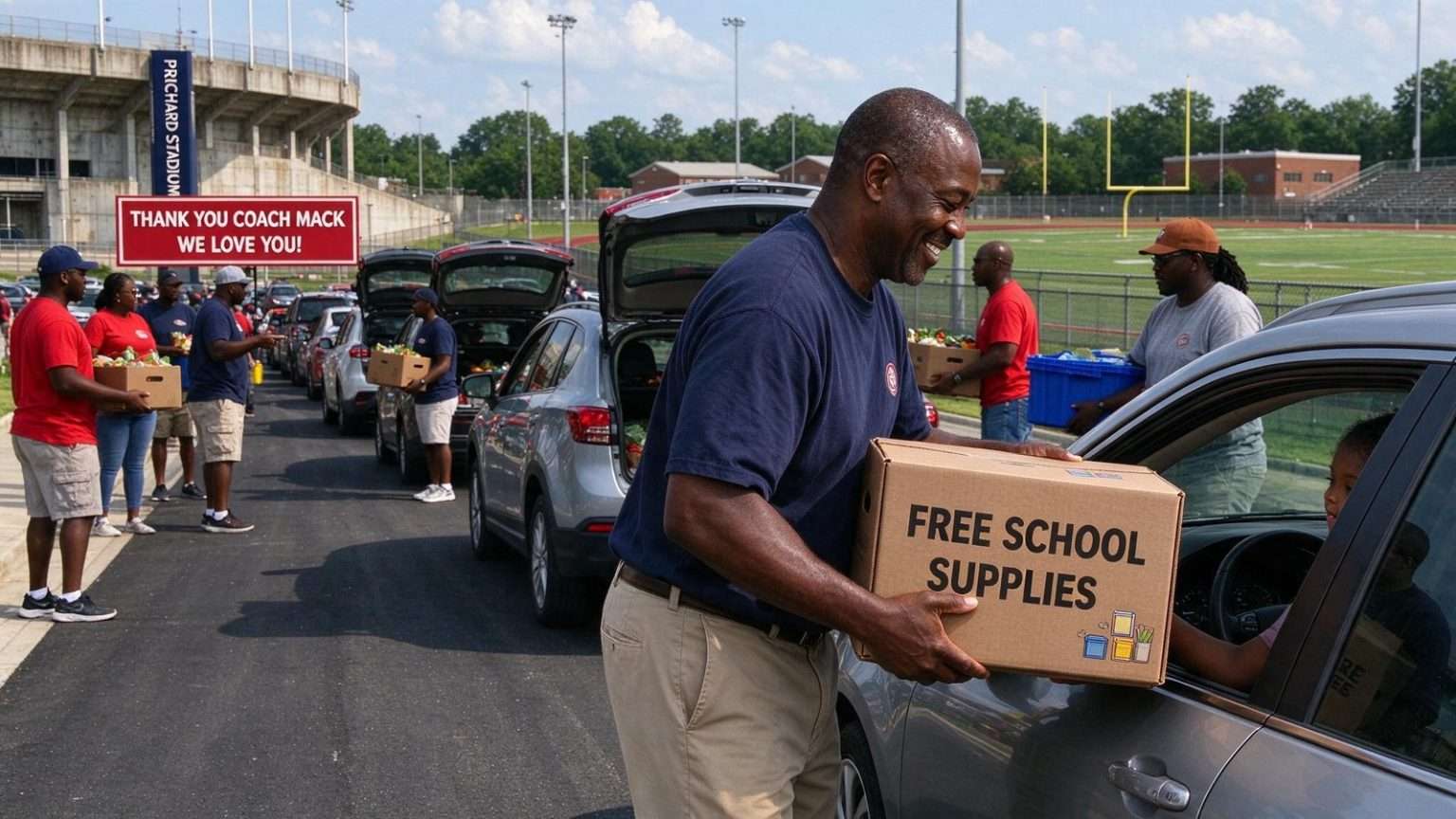
PRICHARD, Ala. — Cars lined up outside Prichard Stadium as volunteers and family members handed out free groceries and school supplies to local families at a back-to-school drive held in memory of a coach who spent decades lifting up young people in the Prichard and Eight Mile community. Coach “Mack” McCall died of COVID-19 in late July after years of coaching football and other sports in the community. The giveaway was organized as a tribute to his legacy of service.
The setting carried its own significance. Prichard Stadium has long been one of the city’s gathering places, a venue tied to generations of youth football, track meets and community events, and it sits at the center of the neighborhoods where McCall did much of his work. Families arriving there for supplies were, in a sense, coming to one of his home fields one more time — not for a game, but for the kind of practical help he had built a reputation around providing.
Back-to-school season is one of the heaviest spending stretches of the year for families with school-age children. Supply lists, uniforms, backpacks and fees can run into hundreds of dollars per student, and in a city like Prichard — where household incomes trail county and state averages and a large share of families live on tight budgets — the annual list can force hard choices. A drive that pairs school supplies with groceries addresses both sides of that squeeze at once: the classroom checklist and the kitchen table.
The drive-through format let families receive help without leaving their vehicles, an approach that has become standard for community giveaways since the pandemic began and one that suited the moment in more ways than one. It kept volunteers and recipients at a safe distance, moved the line efficiently, and — as McCall’s family would explain — matched the vision he had described for exactly this kind of event before his death.
‘A dad to many’
Lorenzo Martin, who represents Ward 1 on the Prichard City Council, said McCall poured everything he had into the city’s young people. “He spent every ounce of extra time he had working with kids and not even just coaching, but followed them through their education,” Martin said. “All of Mobile County should be celebrating the life of Coach Mack.”
Martin’s description captured the particular role a long-serving community coach occupies in cities like Prichard. A coach who stays for decades becomes more than a sports figure: he is the adult who shows up at practices in the summer heat, checks on grades, attends graduations, and keeps track of former players long after they leave the roster. The phrase “followed them through their education” describes a form of mentorship that extends well beyond any single season — the kind of continuous presence that children in under-resourced communities often have nowhere else to find.
McCall’s reach across Prichard and Eight Mile reflected how intertwined those two communities are. Eight Mile sits directly north of Prichard along the U.S. 45 corridor, and families there share schools, churches, parks and sports leagues. A coach who worked both sides of that line built a network spanning decades of young people, parents and fellow volunteers — which is why the response to his death reached well beyond any single neighborhood.
McCall’s wife, Tamara McCall, said the drive-through format had long been her husband’s vision because it centered on his love for children and the community. “It is a joy and I’m thankful that the community decided to go on with his dream because he loved helping,” she said, adding that turning the tragedy COVID-19 brought to her family into something good was the best way to honor him. “This is just the start. I hope we can do this every year.”
The decision to carry out the event after his death — rather than letting it lapse — turned a planned act of service into a memorial. For the volunteers who showed up, many of them former players, fellow coaches and community workers McCall had worked alongside, the giveaway was a way to answer his death with the same instinct he had modeled: show up, do the work, and put children first. The boxes of supplies and groceries that passed through car windows at Prichard Stadium were, in that sense, a continuation of his coaching by other means.
McCall’s death in late July placed him among the devastating toll the pandemic has taken on community figures across Alabama, particularly during the periods when cases surged across Mobile County. His passing landed hardest in the close-knit world of Prichard youth sports, where his presence had been constant for so long that many families had never known the community’s programs without him.
One last salute
After the last of the supplies were handed out, the family traveled to Eight Mile Park for a final salute — the same park where McCall built much of his legacy. The park has been the stage for years of his work with young athletes, and returning there to close the day gave the tribute a physical destination as well as an emotional one. The people who gathered there represented the full span of that legacy: children he had coached most recently, adults who had been children under his watch decades earlier, and the colleagues and family who had watched him hold it all together.
“We miss him, the community misses him and it is going to be a big void without him,” Tamara McCall said. “He was definitely a dad to many.”
That description — a dad to many — is a familiar honorific in communities where extended mentorship fills gaps that family circumstances, work schedules and economics leave open. It describes coaches, pastors and teachers who take on responsibilities well beyond their job titles: rides to practice, advice on applications, a stern word when it is needed and a steady presence when it matters more. In Prichard and Eight Mile, McCall held that role for enough young people that the void his family described is genuinely a community-wide one.
The salute at Eight Mile Park also underscored the geography of his service. A coach’s legacy in a small city is written in specific places — a particular field, a particular park, a particular stadium — and McCall’s was written across all three. Families who lined up at Prichard Stadium and then gathered at Eight Mile Park traced, in a single afternoon, the route his work had taken through their community.
What comes next
Tamara McCall’s hope that the drive can become an annual event would, if realized, convert a memorial into an institution — exactly the kind of continuation that outlasts grief. Community giveaways in memory of a lost figure have a way of becoming fixed points on the calendar in small cities, drawing volunteers who might not otherwise connect and channeling donations toward families who need them most at the moment they need them: the weeks before school starts.
For now, the drive stands as both a farewell and a blueprint. The families who left Prichard Stadium with school supplies and groceries carried away more than the items in their trunks — they carried a public reminder of what McCall spent his life doing, and a demonstration that the community he served intends to keep doing it. In a city that has weathered economic hardship and, more recently, the losses of a pandemic, that continuity may be the most fitting tribute of all: the work goes on, in his name, starting with this year’s backpacks.
Organizers of memorials like this one often say the hardest part is not the giveaway itself but the months of coordination behind it — collecting supplies, securing grocery donations, recruiting volunteers and getting the word out through churches, schools and social media. That McCall’s family and the community assembled all of it while still grieving underscores the depth of the commitment his life inspired. Volunteers at the stadium worked in a rhythm familiar to anyone who has helped at a community distribution: loading trunks, passing boxes, waving cars forward, and doing it all quickly enough to keep a long line moving in the summer heat.
The event also highlighted the role that city institutions played in making it happen. The use of Prichard Stadium reflected the city’s willingness to put its public facilities behind the tribute, and Martin’s presence on behalf of Ward 1 tied the event formally to the city government he serves. In communities the size of Prichard, that kind of cooperation between city hall, families and volunteers is not incidental — it is the mechanism by which anything of scale gets done, and it worked the way it works when everyone involved shares the same purpose.
For the children who received backpacks and supplies, the day will mostly be remembered, if at all, as the day they got what they needed for school. But the framing around it — a drive held in a coach’s name, organized by his family, at his stadium, ending with a salute at his park — teaches something too. It shows young people in Prichard and Eight Mile what service looks like when it is sustained over a lifetime and what it looks like when a community chooses to honor it. Those are the kinds of lessons McCall spent his career teaching, delivered one more time by the people he taught them to.
A community’s measure of one life
The turnout for the drive offered its own assessment of McCall’s impact. Long lines of cars at a giveaway are one thing; a line formed in memory of one man is another. Families came knowing whose name was on the event, and volunteers gave their Saturday knowing the same. In a metropolitan county of hundreds of thousands of people, the reach of one coach’s reputation across two communities and decades of graduates is a measure of how deeply one consistent person can matter.
Mobile County has lost many community figures to the pandemic, and each loss has left its own gap. What has distinguished the response in Prichard and Eight Mile is the insistence that McCall’s particular brand of service — practical, child-centered, year after year — should not end with him. The school supplies will be used up within months. The groceries will last days. The annual drive his family hopes to continue, and the standard of showing up that it represents, are the parts designed to last.