Baldwin Commissioner Frank Burt Opposes New Park Rental Fees
Baldwin County Commissioner Frank Burt is pushing back against proposed rental fees for two North Baldwin parks and a historic Stockton-area church.
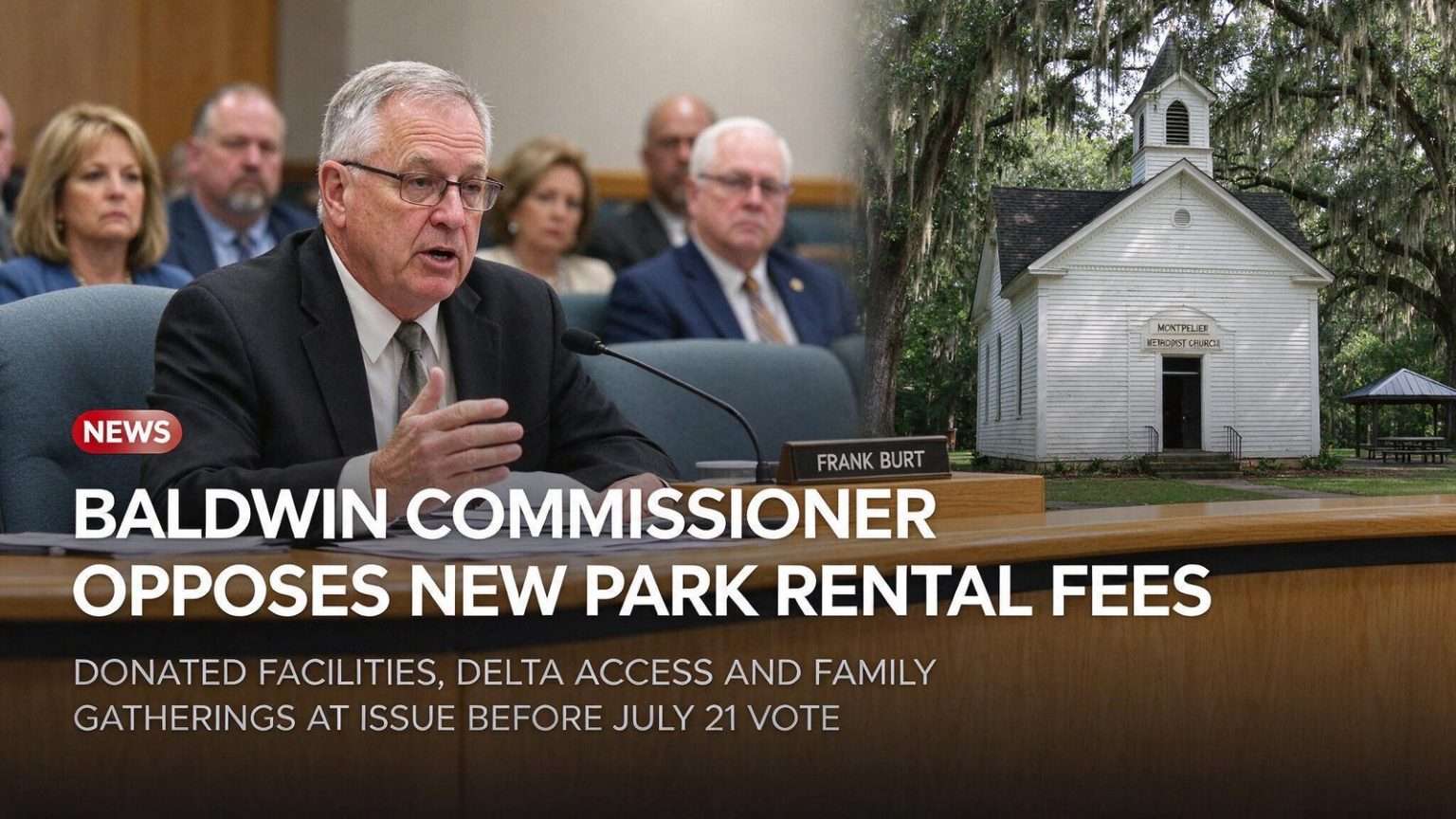
Baldwin County Commissioner Frank Burt is urging his fellow commissioners to reconsider a plan to charge new rental fees at two North Baldwin County parks and a historic church, arguing the potential revenue isn’t worth pricing out the families who use them. The debate, which has stretched across multiple meetings, has turned a routine fee schedule into a question about what the county owes the communities that donated some of its most cherished public spaces.
The Baldwin County Commission appeared close to a vote on the proposed fees during a recent work session, after months of delaying the decision. The fees would apply to Live Oak Landing and Bicentennial Park, both located near Stockton, along with the historic Montpelier Methodist Church situated at Bicentennial Park. Under the proposal, renting the church for events such as weddings would cost $300 plus a refundable $200 security deposit, with the deposit returned after a post-event inspection. Pavilion rentals at both Bicentennial Park and Live Oak Landing would run $75 each.
The two properties sit in one of the most scenic corners of Baldwin County. Live Oak Landing gives the public access to the Tensaw River at the edge of the Mobile-Tensaw Delta, the vast wetland system that spreads across tens of thousands of acres north of Mobile Bay, while Bicentennial Park serves the communities of North Baldwin as a gathering place for reunions, birthday parties and church events. The Montpelier Methodist Church building, a piece of the county’s rural history, sits within the park and has become a sought-after wedding venue precisely because of its setting.
Burt: donated facilities shouldn’t carry fees
Burt noted that one of the pavilions in question was built with donated funds, and the Montpelier church itself was donated to the county in 2012. He argued that charging fees on facilities the community effectively gave to the county sends the wrong message, particularly to lower-income families who rely on the parks for gatherings.
“It does us older souls and parents and others as well, good … there is no music like hearing happy children up there and enjoying the place,” Burt said. He added that he would rather see the commission examine its reservation policies than impose new fees, suggesting the county could manage demand at the popular sites without charging families for access.
Other commissioners have pushed back on that framing, noting the properties still belong to the county and come with real costs. Commission Chairman Charles “Skip” Gruber pointed to the expense of air conditioning the church, which regularly hosts weddings. According to an analysis from the county’s Archives Director, Felisha Anderson, electricity costs at Montpelier Methodist Church run about $2,445 annually — a figure that supporters of the fees say justifies asking event hosts to contribute toward the upkeep of the buildings they use.
The exchange has laid out the two sides of the argument in unusually personal terms. For Burt, whose district includes the North Baldwin communities that raised the money and preserved the buildings, the fees amount to a tax on family gatherings. For the fees’ supporters on the commission, the question is simply stewardship: county taxpayers are already paying to maintain the parks, and a modest rental charge asks the people who benefit most directly to share that burden.
Political undertones in North Baldwin
The debate follows accusations from David Peterson of the Save the Mobile-Tensaw Delta advocacy group, who has suggested the fee proposal amounts to political retribution against North Baldwin County. County officials have not addressed that claim directly, but the accusation has given the fee discussion a sharper edge in a part of the county where residents already watch closely for signs that their needs rank below those of the fast-growing eastern shore.
North Baldwin’s relationship with the county government has long carried that undercurrent. Communities such as Stockton, Bay Minette and the Delta settlements are farther from the population centers that drive county revenue, and questions about parks, roads and services there routinely draw scrutiny. The fee proposal, aimed squarely at two North Baldwin properties, has become the latest flashpoint in that longer conversation.
Fees already common across the county
Fees are already common at other public facilities across Baldwin County, including the Bay Minette Civic Center, the Daphne Civic Center, the Erie Meyer Civic Center in Gulf Shores, and several county-linked churches and pavilions in Foley and Bay Minette, according to the county’s own analysis. That context is one reason a majority of commissioners has seemed comfortable with the proposal: most comparable facilities in the county already charge for private use, and the proposed rates — $75 for a pavilion, $300 for the church — are in line with the range charged elsewhere.
Supporters note that reservation systems with fees also help prevent the scheduling conflicts and no-show problems that free, first-come reservations can produce. A refundable deposit, like the $200 security deposit proposed for the church, gives the county a mechanism to ensure the historic building is left in proper condition after each event without adding cost to families who treat the space well.
A delayed vote and a personal absence
Burt had earlier asked commissioners to delay a vote on the new fees until he returned to his duties, having been absent for much of June while mourning the death of his wife, Joyce. His absence kept the item in limbo through the early summer, and his return has restarted the debate at a moment when the commission appeared ready to act.
The commission was expected to take up the fee proposal again at its July 21 meeting. Whatever the outcome, the decision will set the terms of access to two of North Baldwin’s most popular public spaces — and signal how the county weighs the cost of maintaining donated landmarks against the communities that donated them.
The church at the center of the debate carries its own history. Montpelier Methodist Church served rural families in the Stockton area long before the county took ownership of the building, and its relocation to Bicentennial Park was intended to preserve a piece of North Baldwin’s heritage rather than turn it into a revenue source. Weddings held there today make use of a sanctuary that generations of local families filled on Sundays, a fact that Burt and other opponents of the fees say should shape how the county treats it.
Bicentennial Park itself was developed as part of the county’s observance of the nation’s bicentennial era, and it has since become the anchor for outdoor gatherings in the northern part of the county. Pavilion rentals are the park’s most common use, booked for family reunions, church picnics, school events and birthday parties — exactly the kinds of gatherings that small fees, opponents argue, weigh on most heavily for families watching their budgets.
What the Delta means to North Baldwin
Live Oak Landing’s location on the Tensaw River makes it more than a picnic spot. The landing is one of the few public access points to the Mobile-Tensaw Delta, the sprawling network of rivers, bayous and bottomland hardwoods that stretches from the north Baldwin uplands down to Mobile Bay. Anglers, kayakers, birdwatchers and hunters use the landing as a gateway to tens of thousands of acres of publicly accessible wetlands, and local outfitters and guides bring visitors through the site year-round.
That ecological and recreational value is why advocacy groups watch policy changes affecting the site so closely. The Save the Mobile-Tensaw Delta group has been an active voice in county decisions that touch the Delta, and Peterson’s accusation that the fee proposal amounts to political retribution against North Baldwin grew out of that longer advocacy. County officials have declined to engage the claim, keeping the public debate focused on the fee schedule itself.
The Delta’s importance to the county has grown alongside eco-tourism on the Gulf Coast. Visitors travel to Baldwin County for beaches, but a growing number come for the Delta’s paddling trails and wildlife, and public landings like Live Oak are the infrastructure that makes those trips possible. Any change in how the landing is managed, fee schedule or otherwise, draws attention from users across the region.
What happens at the July 21 meeting
When the commission takes up the proposal again on July 21, members will effectively be deciding three questions at once: whether the church rental should cost $300 with a $200 refundable deposit, whether pavilion rentals at Bicentennial Park and Live Oak Landing should cost $75, and whether the county should hold off on fees altogether at facilities the community donated. The work session discussion suggests votes are not firmly committed on either side.
County staff have laid out the maintenance costs that motivate the proposal, including the roughly $2,445 in annual electricity expenses at the church documented in the Archives Director’s analysis. Opponents have laid out the principle they believe should govern the decision — that donated community assets should stay accessible to the families who donated them. The July 21 vote will decide which argument carries the day.
For residents of North Baldwin, the outcome will be felt most directly on summer weekends, when the pavilions at the two parks fill with reunions and the church fills with weddings. A $75 pavilion fee is a modest charge for many families, but in communities where reunions draw a hundred relatives and costs are split among organizers, fees accumulate — and that, Burt argues, is precisely why the commission should think twice before charging for spaces the community gave to itself.