Fairhope Weighs Cost of Studying an Independent School System
Fairhope's City Council agreed to price out a study on breaking away from the Baldwin County school system after voters rejected a tax hike.
Fairhope city leaders took a step this week toward answering a question that has simmered for years: should the city chart its own course on public education?
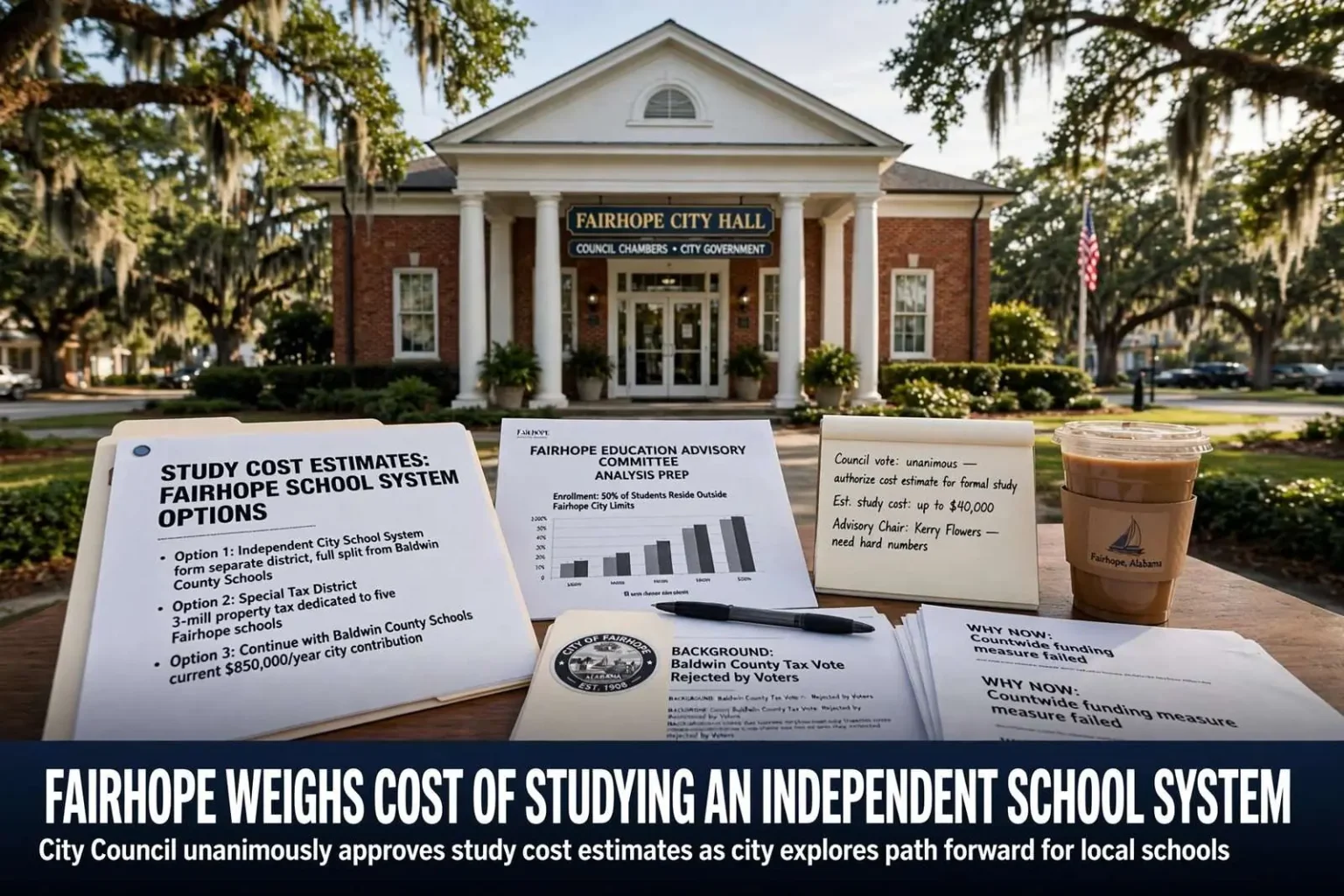
After a lengthy and at times tense discussion, the Fairhope City Council voted unanimously to have staff work with the Fairhope Education Advisory Committee to gather cost estimates for a formal study. That study would weigh three paths forward — creating an independent city school system, forming a special tax district to raise more money for local schools, or continuing to operate within the Baldwin County system while the city keeps contributing cash and in-kind support worth roughly $850,000 a year.
The vote stops short of any decision, but it moves a long-running debate from the realm of public sentiment into the realm of arithmetic. Estimates for the study itself ranged as high as $40,000, a sum the council evidently judged worth spending to replace assumptions with numbers before the city commits to anything larger.
Why the timing matters
Advisory committee chairman Kerry Flowers said the timing matters, pointing to Baldwin County voters’ recent rejection of a property tax increase meant to fund school construction and expansion countywide. He argued the community deserves hard numbers rather than assumptions about how well Fairhope schools are performing.
The failed countywide tax vote is the immediate backdrop for the council’s move. Baldwin County Public Schools, one of the largest systems in Alabama and among the fastest-growing, has pressed for new revenue to build and expand campuses across a county whose population has boomed for decades. Voters’ refusal of the increase told local officials in every corner of the county that a countywide funding answer was not coming — and in Fairhope, it sharpened the question of whether the city should act alone.
Flowers’ argument reflects the committee’s core position: whether Fairhope’s schools are thriving or strained, the discussion has been carried on anecdote and reputation, and no city can make a sound choice about a system or a tax district without a study that examines enrollment, facilities, revenues and costs on the record.
Fairhope’s schools carry a reputation that draws families to the city, and that reputation is intertwined with the town’s identity as one of the Eastern Shore’s most desirable addresses. Real estate marketing in the area leans on school quality, and city leaders are acutely aware that any change perceived as weakening the schools could affect property values and the growth that fuels the city’s budget.
The three paths on the table
One option under consideration, allowed under state law, would ask Fairhope voters to approve a 3-mill property tax dedicated to a special school district. That revenue would flow to the five schools serving the Fairhope area: Fairhope Elementary, J. Larry Newton School, Fairhope Intermediate, Fairhope Middle and Fairhope High.
A special tax district is the middle path between the status quo and a full split. Under the arrangement, voters inside a defined area approve a dedicated property tax whose proceeds are earmarked for specific schools rather than spread across the entire county system. Property owners pay more, but the money stays in the community, and the schools it funds receive resources they could not count on from a countywide budget.
Alabama law provides several mechanisms of this kind, and communities across the state have used special districts, district-wide millage votes and other targeted levies to supplement the school funding that flows from the state’s foundation program. A mill is one-tenth of a cent of assessed property value, and small millage differences can amount to substantial annual revenue in a city with Fairhope’s property base.
The third path — remaining in the Baldwin County system with the city’s current contributions of roughly $850,000 a year in cash and in-kind support — is the status quo, and the study would document precisely what that support buys and whether it is the best use of the money. City contributions to county schools typically fund items the system’s general budget cannot stretch to cover, from facilities upgrades to programs the community requests.
Creating an independent city school system, the most drastic option, would mean Fairhope separating its schools from Baldwin County entirely — a process that involves forming a school board, hiring an administration, assuming facilities and absorbing the complicated division of assets and obligations that state law prescribes. Several Alabama cities have made that leap in recent decades, but the startup costs and the transition risks make it the option least likely to be chosen without exhaustive study.
Advisory committee members noted that nearly half of Fairhope’s public school students actually live outside the city limits, a fact they said needs to be weighed carefully before any decision is made.
That demographic reality complicates every option. A tax paid only by city residents would fund schools attended substantially by students whose families pay no part of it — a fairness question that resurfaces in any special-district debate. Conversely, an independent city system would have to decide how enrollment from outside the limits fits into the new arrangement. Neither question has an obvious answer, which is precisely the kind of issue a formal study is designed to surface.
A divided council
Council members were divided on how far to take the inquiry. Three members spoke in favor of moving forward with the study, while two voiced firm opposition to researching an independent system at all, arguing county voters had already sent a clear message at the ballot box.
The opponents’ position carries practical weight: if the countywide electorate declined to raise taxes for schools, asking Fairhope voters to tax themselves more may prove just as futile, and spending $40,000 to study an outcome the voters have arguably already rejected treats the ballot result as advisory. They also warned that merely researching a split could strain the city’s relationship with the county system and its leadership.
Supporters countered that a countywide tax vote and a targeted, in-city funding mechanism are two different questions, and that hard data would inform any decision rather than predetermine it. In their view, the ballot result told Fairhope what the county as a whole will not fund, but said nothing about what Fairhope residents would choose for their own schools — a question only a study and, eventually, a city-level vote could answer.
The unanimous vote to at least gather cost estimates papered over that divide for the moment. By authorizing staff to work with the advisory committee on numbers rather than authorizing a study of the independent system outright, the council kept every option on the table while committing to none — the kind of procedural compromise that lets a divided body move without splitting.
The larger context
The debate in Fairhope is part of a pattern across Alabama, where fast-growing suburbs have repeatedly examined whether their schools should separate from county systems. City systems tend to concentrate resources in a smaller area, can supplement state funding with city dollars, and give local officials direct control — advantages that growing communities with strong property bases find attractive. County systems, meanwhile, bear the obligation of educating everyone, including the rural and less affluent areas that city splits leave behind.
Baldwin County has watched this dynamic before, and school system officials have consistently warned that splintering or districting weakens the countywide system’s ability to fund construction and retain teachers. The recent tax rejection heightened that tension: the system’s growth needs did not disappear with the vote, and communities like Fairhope are where the pressure will land next.
For the city’s families, the near-term effect of this week’s vote is minimal — a study’s cost estimates, not classrooms. But the questions underneath are large: whether Fairhope pays more to secure its schools’ future, whether the county system can serve the area adequately without new money, and how a city whose students are half non-residents defines exactly who its schools are for.
The advisory committee’s work with city staff will produce the cost figures for a formal study, which the council will then weigh. Whatever path Fairhope ultimately takes — city system, special district, or continued partnership with Baldwin County — the unanimous vote ensures that the decision will be made, for the first time in years, with real numbers in hand rather than reputation and rumor alone.
City officials have given no timeline for the next step, but the committee’s chairman has indicated the work should move promptly while the question is fresh and the county’s funding failure still shapes the conversation. A study commissioned now would position the council to act — in either direction — before another budget season passes without an answer.
Either way, the council’s decision to fund the estimates marks the furthest the city has gone toward resolving the schools question, and residents can expect the findings — and the debate that follows them — to headline local government meetings well into next year.