Recycling collection in Fairhope, AlabamaHistorical recycling coverage in Fairhope.

Historical community report, published from archived local news coverage.

Fairhope’s recycling program earned a spotlight in a 2007 community report that chronicled how one small Baldwin County city built an environmental effort with participation reaching well beyond its curbside collection routes. According to the archived local news coverage, residents, schools and businesses all played roles in keeping material out of the landfill — and the program was doing more than its share for the city’s bottom line. City officials said material sales had generated more than $100,000 in the prior year, revenue that helped offset the costs of operating the program.

That figure put Fairhope ahead of many municipalities its size. Recycling operations typically carry real expenses — collection vehicles, staff time, processing fees and the logistics of separating material — and the difference between a program that costs a city money and one that largely pays for itself often comes down to participation rates and markets for recovered material. In 2007, prices for recycled commodities such as aluminum, paper and cardboard were strong, and a community that consistently delivered clean, well-sorted material could command meaningful returns. Fairhope’s six-figure sales total reflected a population that had taken the program to heart.

A program built on participation

Fairhope, perched on the eastern shore of Mobile Bay, has long cultivated a civic identity that prizes quality of life — its parks, its bluff-top views, its walkable downtown — and environmental stewardship fits naturally into that self-image. The city’s recycling effort reached into every corner of the community. Households contributed through regular drop-off and collection of common materials such as newspaper, cardboard, aluminum cans, plastic bottles and glass. Businesses participated as well, adding commercial cardboard and office paper to the stream in volumes a city of Fairhope’s size would not otherwise capture.

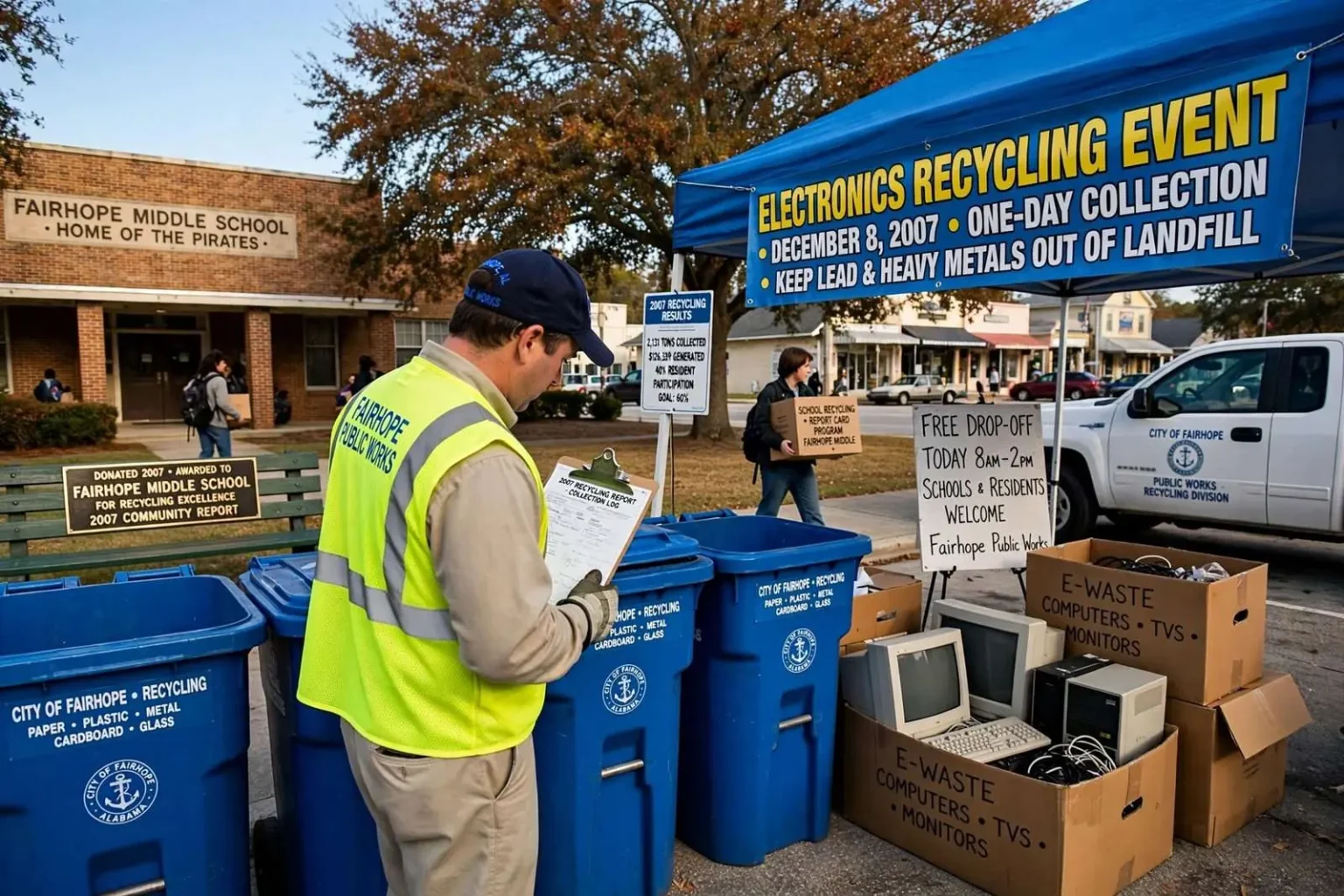
The schools were where the program showed its most visible community-building work. According to the report, schools across the city received recycling report cards — a system that graded each campus on its collection performance and turned waste reduction into a friendly, measurable competition. Students could see the results of their efforts week by week, and teachers could fold the numbers into lessons about consumption, conservation and where the city’s trash actually goes. Public recognition of that kind tends to outlast the school year; children who learn to separate materials at a young age carry the habit into their own households.

See also  New Theater Building Rising in Downtown Fairhope

One campus stood out in the 2007 coverage. Fairhope Middle School received an outdoor bench in recognition of its recycling work, a tangible reward that gave the entire student body a daily reminder of what sustained effort can produce. The prize was modest in cost but smart in design: it celebrated achievement without expense, and it placed the evidence of that achievement on campus grounds where students, faculty and visiting parents would see it every day.

The electronics problem

The report also described a one-day electronics-recycling event, an offering that addressed one of the fastest-growing waste challenges of the era. By the mid-2000s, households across Baldwin County and the rest of the country were accumulating obsolete televisions, computer monitors, desktop towers, printers and cell phones at a remarkable pace. Consumer electronics had become cheaper and more disposable, and the pace of technological change meant that a working computer could feel outdated within a few years. Traditional garbage collection was never designed for this stream — cathode-ray-tube televisions in particular were heavy, bulky and increasingly unwelcome at landfills.

The environmental concern was specific and well documented. Electronics can contain lead and other heavy metals — lead appears in the solder, in older CRT glass and in components throughout older devices — and when that equipment is buried in a landfill, those substances can pose long-term risks as containment systems age. Keeping lead-containing equipment out of landfills was a central argument for the collection event, and it remains a cornerstone of electronic-waste policy today. Federal law restricts disposal of certain e-waste, many states regulate it, and responsible recyclers dismantle devices so that glass, metals and circuitry can be recovered and hazardous components handled properly.

One-day collection events like the one Fairhope organized solved a practical problem for residents. A household with an old console television or a dead computer in the garage had few easy options — curbside pickup would not take it, and hauling it to a distant facility was a chore. Concentrating collection at a single site for a single day made responsible disposal almost effortless: residents drove up, volunteers or staff unloaded the material, and the devices moved into a recycling channel instead of the waste stream. Communities across the Gulf Coast adopted the same model, and the events frequently collected tons of material in a matter of hours.

See also  Honoring the Gulf Coast's Historic Lighthouses on National Lighthouse Day

What the economics looked like

It is worth pausing on who actually did the work behind that revenue. Municipal recycling runs on a chain of small individual decisions — rinsing a container, flattening a box, driving a trunk-load of newspapers to a drop-off point. The 2007 report’s emphasis on participation by residents, schools and businesses was not decorative; it was the operational explanation for the program’s financial performance. A city can own all the right equipment, but without consistent participation the trucks run half-empty, the material comes in mixed and contaminated, and the commodity contracts lose value. Fairhope’s numbers suggested that households and institutions alike were doing their part, and that the program’s public messaging had succeeded in making recycling feel like a shared responsibility rather than an optional gesture.

The more than $100,000 in material sales that city officials cited for the prior year deserves a closer look, because it illustrates how municipal recycling actually sustains itself. Recovered materials are commodities: cardboard and paper are sold to mills, metals to processors, plastics to re-manufacturers, and prices fluctuate with global demand. When those sales are strong, they can cover a substantial share of a program’s operating costs, reducing the burden on the city’s general fund. When markets soften — as they dramatically did in the recycling-industry downturns that followed in later years — programs with high participation and clean material are the ones best positioned to keep their contracts and their budgets intact.

Fairhope’s position on the Eastern Shore also gave its program a particular local logic. Mobile Bay’s ecosystem — and the bay’s economically vital oyster reefs, fishing grounds and shoreline — depends on the health of the watersheds that drain into it. Every ton of material diverted from a landfill is a ton that does not occupy permitted space in the county’s waste system, and reducing the overall disposal burden is part of how a growing county protects the land and water quality that make it attractive in the first place. Baldwin County was among the fastest-growing counties in Alabama during this period, and growth multiplies both waste volume and the value of programs that contain it.

See also  Gulf Shores Junior and Adult Lifeguards Turn Heads at Southeast Regional Competition

The model and its lessons

The arithmetic behind community recycling is ultimately simple. Every household that participates extends the life of the county’s landfill capacity, and every school that teaches the habit compounds the benefit for a generation. Fairhope’s program in 2007 showed that a city of modest size could make those numbers work in its favor when the whole community pulled in the same direction.

The 2007 report captured a program at a moment when the pieces fit together: civic pride, school engagement, business participation, market conditions and a city government willing to invest in collection infrastructure. The report cards for schools created accountability in a form children could understand. The bench at Fairhope Middle School turned a statistic into a landmark. The electronics event tackled a waste stream the regular program could not reach. And the sales revenue demonstrated to budget-minded officials that environmental programs could be justified on practical as well as idealistic grounds.

For other Baldwin County municipalities — Daphne, Spanish Fort, Foley, Gulf Shores and the county’s smaller towns — Fairhope’s experience offered a template worth studying. Regional cooperation on recycling has expanded along the Eastern Shore in the years since, with shared drop-off sites, household-hazardous-waste collections and periodic electronics events becoming fixtures of the local environmental calendar. The underlying challenges have not disappeared; commodity markets remain volatile, and contamination in the recycling stream remains the industry’s persistent headache. But the fundamentals the 2007 report described — make it easy, make it visible, make it matter to schools — are the same principles recycling coordinators recommend today.

Two decades on, the account stands as a useful record of how a small Alabama city turned an environmental obligation into a source of civic pride and real revenue. The specific figures, the report cards, the middle school bench and the one-day electronics collection belong to 2007; the habits they built belong to the community. This is a historical account of Fairhope’s recycling program and past event details, not a current collection notice, and residents seeking today’s schedules and guidelines should consult current city resources.