Mobile’s Prancing Elites Land Second Season on National TV
Mobile's Prancing Elites dance troupe earned a second, hour-long season of their hit Oxygen reality series after a breakout ratings debut this year.
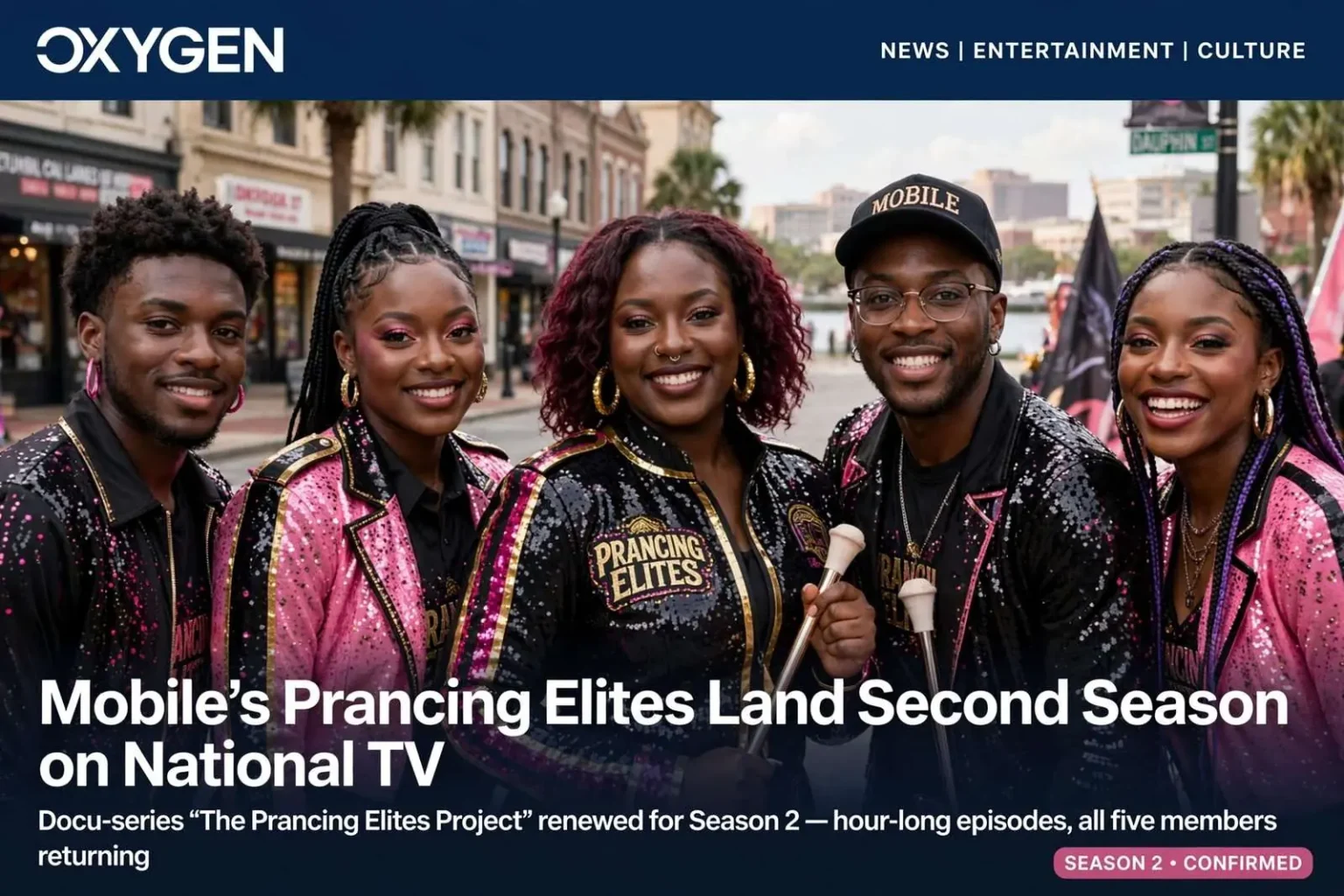
Mobile’s Prancing Elites are heading back to national television, with Oxygen Media confirming a second season of “The Prancing Elites Project” following a strong ratings debut for the network. The renewal locks in another round of episodes for a series that quickly became one of the most talked-about launches in the network’s recent history. Production details announced with the confirmation point to a bigger, more expansive season than the first.
The docu-series follows the Prancing Elites, a gender-nonconforming dance and majorette team based in Mobile, as they navigate both their performing careers and personal lives. Cameras trail the group through rehearsals, performances and the everyday friction of life in a city where their style of performance has not always been welcomed. The first season paired dance-floor energy with quieter moments, showing the members dealing with family, health and relationships while building their reputation.
All five original members are set to return for the new season, keeping the ensemble intact for the audience that followed them from the beginning. Episodes will also expand from a 30-minute format to a full hour, giving the group more room to tell their story. The longer format allows each member’s individual arc to develop at a pace the half-hour episodes could not match, and gives producers space to follow performances from first rehearsal to final routine.
Oxygen executives said the series has resonated strongly with the network’s target audience of young, multicultural viewers since its debut. The show follows an African American, gay and gender-nonconforming dance troupe as they challenge stereotypes through their performances and public visibility, themes executives said aligned closely with the network’s broader programming strategy. In the years since its rebrand, the network has leaned into unscripted series built around distinctive personalities, and the Prancing Elites fit that model from the start.
Numbers behind the renewal
According to figures released by the network, the show’s premiere ranked as Oxygen’s highest-rated launch across key demographics since the network rebranded in late 2014. For a network repositioning itself in a crowded cable landscape, a debut of that size made an early renewal all but inevitable. Executives reportedly tracked the series’ performance across successive weeks as much as its premiere, and the show held its audience well enough to secure the second-season order.
The series also built a substantial social media following, with related hashtags trending nationally during the premiere and drawing tens of millions of impressions across Twitter and Facebook over the course of the first season. Viewers responded in real time to the group’s routines and setbacks, turning episode nights into recurring national conversations. That kind of live engagement has become a key measure of a docu-series’ health, often mattering as much as overnight ratings when renewal decisions are made.
“The Prancing Elites’ unique and emotional journey is a resounding hit with Oxygen’s diverse, millennial audience,” said one network executive involved in the show’s development, crediting the group’s resilience and humor for connecting with viewers well beyond Mobile. The executive noted that the series works because it is anchored in real relationships rather than manufactured conflict, an approach that has paid off with loyal viewership.
A significant moment for visibility
The renewal comes at a moment the network described as significant for LGBTQ visibility nationally, with executives pointing to the show’s success as part of a broader cultural moment. Television audiences have been seeing more LGBTQ stories in recent seasons, but few series have centered a group like the Prancing Elites, whose members occupy multiple identities at once. The network has framed the show as both entertainment and a platform, and its performance suggests the audience was ready for it.
For the members themselves, the second season represents a chance to build on momentum that neither they nor the network fully anticipated. A troupe that formed around majorette-style dance, a tradition rooted in Southern marching culture, has become the face of a national conversation about gender, performance and acceptance. The hour-long episodes should let that story breathe in a way the first season’s compressed format never could.
How the group got here
For Mobile, the series has offered an unusual spotlight on a local performing group that built its reputation through majorette-style routines at parades and public events across the region before catching national attention. Majorette dance, with its precise footwork, baton work and high-energy showmanship, has long been a fixture of parades and halftime shows across the Deep South, and Mobile’s deep parade tradition gave the group a natural stage. The Elites’ willingness to perform that style on their own terms is what set them apart.
The Prancing Elites first drew wider notice performing in local parades, where their high-energy routines stood out from traditional marching band and dance team performances. Some appearances drew applause and some drew hostility, and the group’s response to both became part of its public identity. Word of their performances spread through social media clips long before a television crew arrived, which is ultimately what brought them to a national network’s attention.
That local following eventually caught the attention of national media, culminating in the Oxygen series that has now been renewed for a second, longer season. The jump from Gulf Coast parades to national cable television is a rare trajectory for a community performance group, and it has made the Elites minor celebrities in the city that watched them grow. Members have continued to perform locally between production commitments, keeping the connection to the audiences that supported them first.
What it means for Mobile
City boosters and local arts advocates have pointed to the show’s success as a rare example of homegrown Mobile talent reaching a national audience, adding to the city’s profile in entertainment circles beyond its usual coverage for tourism and history. Mobile’s cultural reputation has long rested on its Mardi Gras heritage, its historic districts and its port economy, and a nationally televised series rooted in the city’s contemporary arts scene adds a dimension those staples do not. Local officials and business owners have noted that national exposure of any kind tends to ripple into visitor interest.
The second season also carries economic and creative implications closer to home. Production activity brings crews, locations and spending into the local economy, and the group’s continued rise gives young Mobile performers an example of a path that does not require leaving the Gulf Coast. Arts educators in the region have pointed to the Elites as proof that the discipline and showmanship of majorette dance can translate into opportunity far beyond the parade route.
What to expect in season two
With the format expanding to a full hour and all five members returning, the new season is positioned to go deeper on both the performances and the personal stories that made the first season connect. Viewers can expect more of the routines that built the group’s following, along with the offstage challenges that come with sudden national attention. The network has scheduled the season as a centerpiece of its unscripted lineup.
For a troupe that began with local parades and a stubborn commitment to performing as themselves, a second season on national television is a milestone neither the group nor Mobile is likely to take for granted. The first season proved there was an audience; the second will test how far the story can travel. Either way, the Prancing Elites have already secured their place as one of the most visible performing groups the city has produced in a generation, and Mobile will be watching along with the rest of the country when the new episodes arrive.
The timing of the renewal also reflects how quickly the television business has changed around shows like this one. Unscripted series live or die on the conversations they generate between episodes, and the Prancing Elites demonstrated in their first season that they could hold a national audience’s attention week after week. Executives weigh that engagement alongside traditional ratings when deciding which series to keep, and few of the network’s launches matched the Elites on either measure.
The group’s journey has also become a point of pride in Mobile’s close-knit performance community, where marching units, dance teams and parade krewes have long competed for attention during the city’s festival seasons. A hometown troupe reaching national television has prompted renewed interest in majorette-style dance among younger performers across the Gulf Coast, with parents and coaches reporting growing interest in classes and auditions. That pipeline of new talent may prove to be one of the show’s most lasting local effects.
For now, the members are preparing for a production cycle that will be noticeably larger than their first. Longer episodes mean more footage, more performances and more scrutiny, but also a fuller portrait of a group that has never shied away from telling its own story. If the first season was about introducing the Prancing Elites to the country, the second is about showing what they have become since the cameras first arrived in Mobile.