University of South Alabama Mobile
Mobile Restaurant Owner Launches Nonprofit to Aid Nepal Earthquake Recovery
A Mobile restaurant owner and a friend turned neighborhood fundraising into a lasting nonprofit to help Nepal recover from its devastating April earthquake.
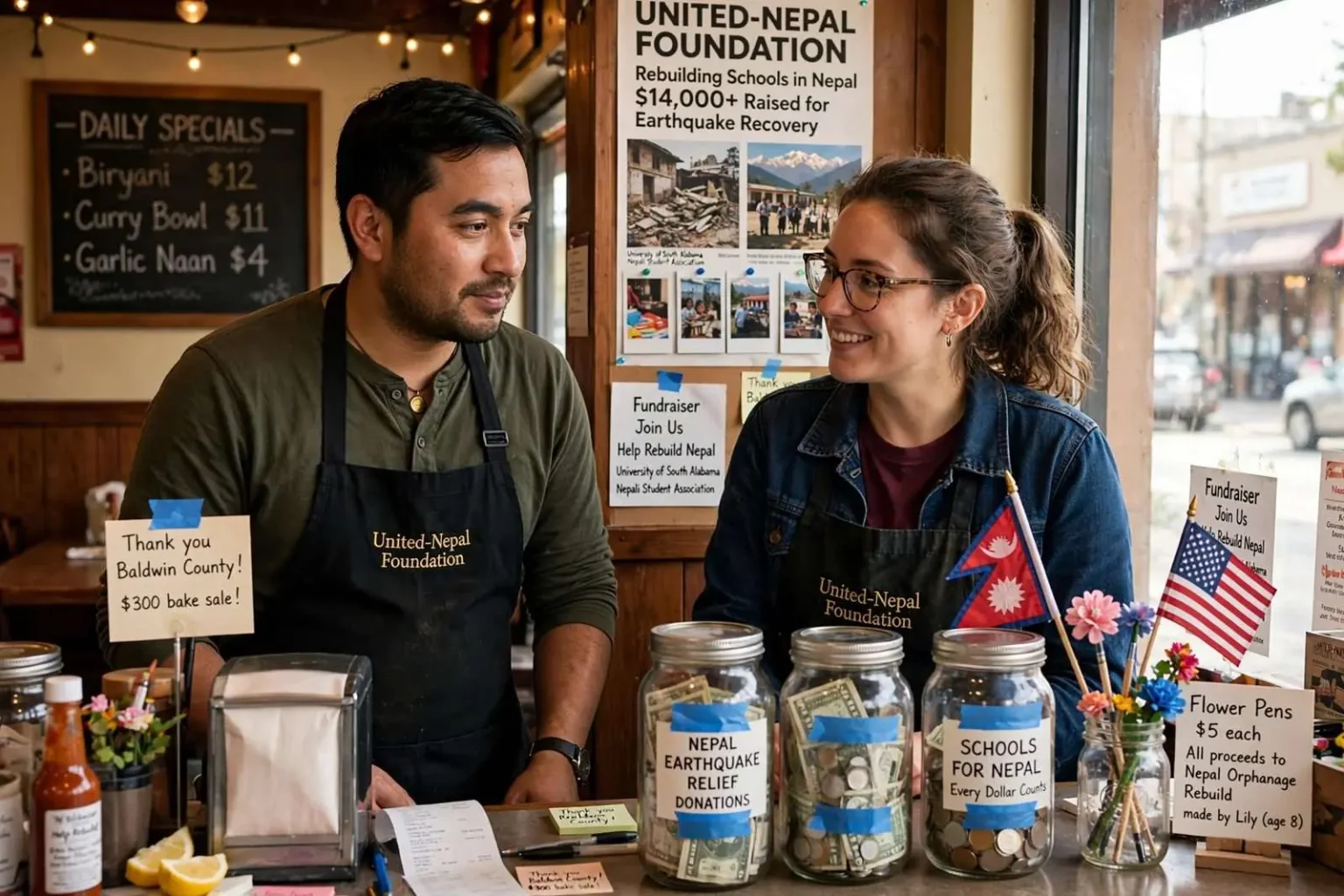
A midtown Mobile restaurant has become an unlikely hub for international disaster relief, after its owner and a close friend turned neighborhood generosity into a full-fledged nonprofit organization aimed at helping Nepal rebuild. What began with donation jars by the register has grown into an organized effort with a name, a mission and a network of supporters spanning the Gulf Coast and the Himalayas.
Salam Lama, who runs restaurants in Mobile and Fairhope, moved to the United States in 2006 to attend the University of South Alabama after growing up in a remote village in Nepal. His path from a mountain village to the Gulf Coast runs through the common story of international students who arrive for an education and build lives where they land, carrying their home communities with them.
When a magnitude-7.8 earthquake struck his home country in April, killing thousands and displacing millions, Lama said he felt an urgent need to act despite being thousands of miles away. The quake, centered in the mountainous terrain northwest of Kathmandu, devastated villages across the region, collapsing homes, schools and temples, and the scale of the destruction left the global Nepali diaspora scrambling to help from afar.
He began holding fundraisers at both restaurant locations and setting out donation boxes. With support from Nepali students at the University of South Alabama, the effort raised roughly $14,000. The university’s Nepali student community became the campaign’s backbone, providing the cultural connection and urgency that turned a restaurant fundraiser into a sustained relief operation.
Donations kept arriving from unexpected places, including a $300 gift from students at a Baldwin County school who held a bake sale and lemonade stand in Nepal’s honor. The cross-bay contribution illustrated how the story traveled: news of the effort spread through schools, churches and social media, prompting small-scale fundraising far from the restaurant counters where it started.
From fundraiser to foundation
Alongside his friend Ester de Aguiar, who works at one of the restaurants, Lama formalized the effort into the United-Nepal Foundation, a nonprofit designed to funnel donations directly to volunteers and relief workers on the ground in Nepal. The structure matters in disaster relief: money that passes through too many hands can dissipate in overhead before it reaches the communities that need it, and the foundation was designed specifically to route contributions straight to people doing the work.
The organization is meant to support long-term rebuilding rather than just immediate relief, Lama said, noting that reconstruction costs in Nepal are estimated in the billions of dollars. The distinction reflects a hard lesson from past disasters: emergency aid flows quickly in the weeks after a catastrophe, but the slower work of rebuilding homes and schools extends for years, by which time the world’s attention and donations have usually moved on.
Nepal’s challenge is compounded by geography and economics. The country is among the poorest in Asia, its terrain makes construction difficult and expensive, and building standards in rural villages offered little protection against a quake of the April temblor’s magnitude. Rebuilding to stronger standards costs more than simply replacing what fell, which is one reason reconstruction estimates run so high and why organizations focused on the long term play an outsized role.
De Aguiar’s young daughter contributed to the cause in her own way, selling handmade flower pens outside the restaurant and at a stand in her front yard, raising more than $400 for an orphanage that was destroyed in the earthquake. The child’s project became one of the campaign’s most talked-about gestures, demonstrating in miniature the same principle driving the foundation: that people far from the disaster could still reach it, one small contribution at a time.
The family has stayed connected to relief efforts through friends who have traveled to Nepal to help rebuild schools and support children affected by the disaster. Those firsthand connections serve as the foundation’s accountability structure, letting donors in Mobile see photographs and hear reports from the villages their money is reaching rather than relying on distant reports.
A community answers
Lama said the response from the Mobile community has been humbling. Members of the local Nepali student population, area churches, and even strangers moved by news coverage of the disaster have found their way to the restaurants to give, and the effort has drawn in people with no prior connection to Nepal at all.
The University of South Alabama’s Nepali students form one of the more visible international student communities on campus, and the earthquake transformed their American experience overnight. Students who came to Mobile to study found themselves fundraising, coordinating with families back home and translating the disaster’s scale for classmates and neighbors, and their partnership with Lama gave their energy an organized outlet.
Faith communities across the area added their own reach. Churches in Mobile and Baldwin County regularly support international mission and relief work, and the Nepal effort gave congregations a direct line to a disaster that dominated the spring’s news. The involvement of schools, churches and individual donors has given the United-Nepal Foundation a donor base broader than the restaurant clientele where it began.
The foundation’s focus on schools and children reflects the earthquake’s particular toll on education. Thousands of classrooms were destroyed or rendered unsafe across the affected regions, leaving entire communities of students without school buildings, and rebuilding schools has become a signature focus of international recovery efforts in Nepal. For Lama, who made his way from a Nepali village school to an American university, the symbolism of rebuilding classrooms is personal.
The restaurants themselves remain the operation’s physical home base, with donation boxes still in place and events continuing as the relief work shifts from emergency response to reconstruction. The businesses have long served as gathering points for the area’s small Nepali community, and that role has deepened as the foundation’s work has made them a destination for anyone wanting to help.
The long road ahead
Relief organizations working in Nepal have cautioned that recovery will take the better part of a decade, with the monsoon season and mountain winter each year narrowing the windows for construction. Donations raised along the Gulf Coast move through the United-Nepal Foundation to volunteers and workers on the ground, funding materials, labor and school rebuilding projects that proceed village by village.
For Mobile, the effort has built a bridge to a part of the world most residents had never thought much about before April. Lama has said he intends for the foundation to be a lasting institution rather than a one-time response, positioned to support Nepal through the full arc of recovery — and, in doing so, to keep alive the connection between a remote Himalayan village and two restaurant dining rooms on the Gulf Coast where a relief effort began with jars by the register.
The story of the United-Nepal Foundation’s first year — from $14,000 in restaurant donations to a formal nonprofit with schoolchildren selling flower pens in its support — stands as a portrait of how local communities now respond to global disasters: not waiting for large institutions to act, but organizing through the places and people they already trust.
The magnitude-7.8 earthquake that struck in April ranks among the deadliest natural disasters in Nepal’s recorded history, and its effects rippled far beyond the collapse statistics. Aftershocks continued for weeks, terrifying residents already sleeping outdoors and complicating rescue and assessment work, while landslides in the steep terrain cut off villages from roads and supplies. For diaspora communities watching from abroad, the difficulty of getting reliable information from remote villages added a particular anguish that organizations like the United-Nepal Foundation were created to address.
The fundraising mechanics that Lama and de Aguiar developed relied on the advantages a restaurant offers: a steady stream of customers, a physical place to meet, and a proprietor whose face and story neighbors know. Every table conversation became a chance to explain where the money goes, and every regular who donated became a messenger to others. That person-to-person model built the trust that allowed the effort to grow from spare-change jars into thousands of dollars in organized contributions.
Contributions large and small have defined the campaign’s character, from the university students’ coordinated fundraising to the $300 bake sale proceeds from Baldwin County to a child’s $400 in flower pens. Foundation organizers have said that mix reflects their belief that relief giving should be accessible to everyone, and that small donors sustained over time accomplish more than occasional large windfalls — particularly for reconstruction work that will continue for years.
As the foundation moves forward, its priorities are expected to remain anchored in rebuilding schools and supporting the children affected by the disaster, the work its on-the-ground volunteers and friends have already begun. Donations continue to be accepted at both restaurant locations, and organizers have emphasized that even after the initial emergency faded from the headlines, Nepal’s recovery — and Mobile’s part in it — is only beginning.