Mobile Police Gain Live Access to More Than 2,000 Surveillance Cameras
Mobile police unveiled a new network giving officers live access to more than 2,000 surveillance cameras at schools, the mall and other sites.
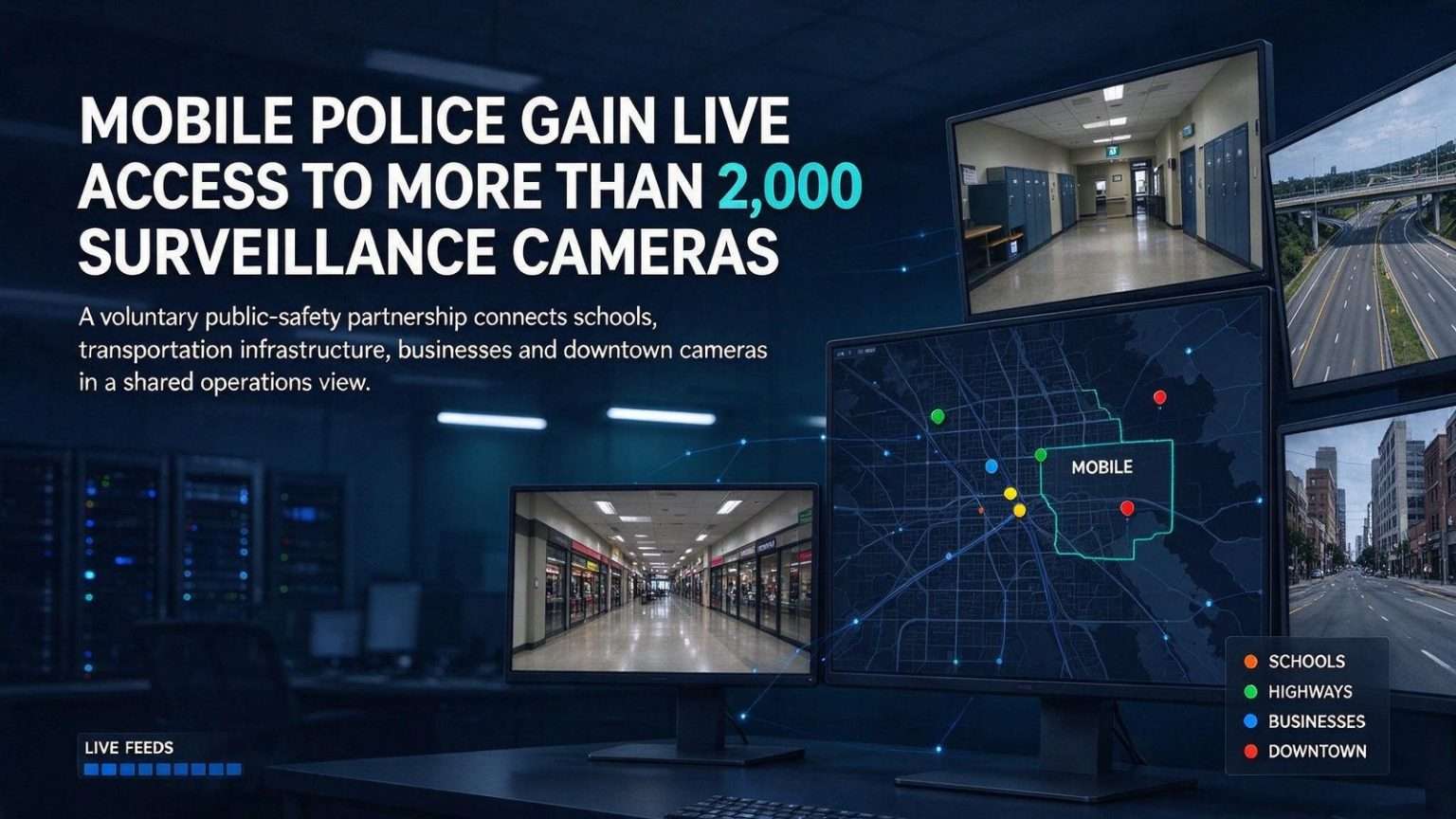
Mobile officials unveiled a sweeping new public safety initiative this week, giving police live access to more than 2,000 surveillance camera feeds from schools, businesses and state transportation infrastructure across the region.
As of the announcement, the Mobile Police Department had tapped into camera networks operated by the Mobile County School System, the Alabama Department of Transportation, Bel Air Mall and the department’s own downtown camera system. Officials described the partnership as a voluntary collaboration between police and participating institutions rather than a mandatory surveillance expansion.
The scale is what separates the initiative from earlier piecemeal efforts. Two thousand cameras is no longer a tool for a single incident — it is a standing grid that, when aggregated in one room, lets a dispatcher or commander look across school campuses, highway interchanges, retail corridors, and the downtown business district simultaneously. Each participating partner retains ownership of its own network; what the initiative adds is the plumbing that lets MPD view those feeds live, in one place, when seconds matter.
Police Chief James Barber said the goal is to give officers a broader, real-time picture during emergencies. “The main purpose of this is so that we can provide a protective umbrella throughout the city of Mobile and even throughout the region,” Barber said, calling the network a “force multiplier” that gives responding officers intelligence they might otherwise miss entirely.
The active-threat scenario
Barber pointed to active-threat situations at large facilities, like a shopping mall or school campus, as the clearest example of the system’s value. With live camera access, he said, officers can quickly isolate where an incident is unfolding, contain the area, begin evacuations and address the threat with far less guesswork than in years past.
The mathematics of an active-shooter response explain the emphasis. The national standard developed after the Columbine shooting — immediate entry by the first officers on scene rather than waiting for a perimeter — depends on knowing where the threat is within minutes of arrival. In a complex the size of Bel Air Mall, with hundreds of cameras already mounted in its corridors, parking decks, and entrances, an officer who can see which wing the suspect moved through can go directly to the fight instead of clearing stores one by one. In a school, floor plans paired with live hallway feeds can direct officers to the exact building and floor while students are still sheltering.
Public Safety Director Richard Landolt added that beyond emergency response, the expanded camera access could serve as a deterrent, making would-be criminals think twice knowing police may already be watching a given location.
The deterrent argument rests on visibility of a sort that is hard to measure. A criminal cannot tell which cameras in a corridor are connected to MPD’s system and which are not, so the mere existence of the partnership raises the perceived risk of any location near a participating institution. Retail security managers have long made a version of the same argument — cameras change behavior even when nobody is watching — and police officials cite it as a return on investment that shows up in fewer incidents rather than in arrest statistics.
Chief Barber’s umbrella framing also extends beyond the city limits. The regional reach comes from the partners’ footprints: ALDOT’s cameras cover interchanges far outside downtown, school system campuses stretch across the county, and the mall sits on the Airport Boulevard corridor between the city and its western suburbs. An incident at any of those nodes is, under the new arrangement, visible to MPD commanders in real time even when the address itself lies beyond the city’s jurisdiction — with formal response authority still belonging to the agency whose territory it falls in.
Inside the Joint Operations Center
At the department’s Joint Operations Center inside MPD headquarters, officials demonstrated the new system with large screens displaying live feeds alongside campus blueprints and aerial imagery.
The Joint Operations Center is designed to be the room where a crisis is managed — a configuration Mobile already uses for hurricane response and major public events, now extended to day-to-day crime response. During the unveiling, several screens showed footage from Davidson High School alongside detailed floor plans, illustrating how officers might use the tool to navigate an unfamiliar building quickly during a crisis. The pairing is the point: a feed tells responders what is happening; a floor plan tells them how to get there; aerial imagery ties both to the streets and staging areas outside.
The demonstration also showed how the system scales down to ordinary police work. The same feeds that serve an active-threat response can support pursuits along ALDOT-maintained corridors, locate a missing child near a school, or verify an alarm at a downtown business before officers commit to a response. Officials describe the center as able to bring in additional agency partners during declared emergencies, which is how a city system becomes a regional one.
The center’s role in the department’s larger communications picture is worth noting: it sits alongside the dispatch operation that routes 911 calls, meaning a call-taker’s report of trouble at a school can be checked against the school’s own cameras before the first officer even rolls. For a department that has worked for years to shorten the gap between a call and an accurate response, the camera network functions as eyes that arrive before the cruisers do.
Training is the quiet prerequisite. Commanders, dispatchers, and patrol officers all need practice navigating a thousand-plus-feed environment — knowing which partners’ cameras cover which intersections, how to call up a floor plan alongside a live feed, and how to hand a clear picture to the officers approaching the scene. The department’s rollout included training sessions using the same demonstration material shown at the unveiling, with Davidson High School serving as the model campus.
The partners behind the feeds
Each of the named participants brings a different network to the table. The Mobile County Public School System operates cameras at its campuses across the city — and, in Davidson’s case, demonstrated how school security infrastructure built for day-to-day discipline can double as crisis-response intelligence. The Alabama Department of Transportation’s traffic cameras cover the interstate interchanges and major arteries that carry both commuters and fleeing suspects. Bel Air Mall, the city’s largest enclosed retail center, has long operated one of the densest private camera grids in the area. And MPD’s own downtown system anchors the network with city-owned cameras along the business district and waterfront.
The voluntary structure matters legally. In private networks like the mall’s, the owner decides whether and when police may view the feeds — a cooperation agreement rather than a seizure of the cameras themselves. School participation runs through the school system’s own security policies, which governing board officials say are intended to balance campus safety with the privacy expectations of students and staff. No institution has surrendered its network; each has agreed to let the police department see it.
A national trend, with familiar questions
The initiative reflects a broader trend among municipal police departments nationally toward integrating public and private camera networks for faster emergency response, though it also raises questions common to such systems about oversight, data retention and privacy that Mobile officials did not fully address during the rollout.
The pattern is well established: departments from major cities to mid-sized suburbs have spent the past decade linking private and public cameras into unified view centers, variously branded as real-time crime centers or fusion points. The technology is straightforward — modern network cameras can be viewed anywhere their owner permits — but the governance questions follow every installation: who watches the watchers, how long recordings are kept, whether footage is used for purposes beyond emergencies, and how citizens learn when they have appeared in a feed.
Mobile’s rollout left those questions largely for later. Officials described the program as focused on live viewing during incidents rather than mass recording or analysis, but the policies that would pin down retention limits, audit trails, and public accountability were not detailed at the unveiling. Civil liberties advocates nationally have pressed cities to adopt written policies before, not after, networks expand, and the experience elsewhere suggests Mobile’s framework will face the same requests as the system grows.
City leaders framed the camera-sharing partnership as a proactive step following a string of school and public-space security concerns nationally, positioning Mobile among a growing number of mid-sized cities investing in integrated surveillance infrastructure.
What it means for Mobile
For residents, the practical effect depends on where they are. A shopper at Bel Air Mall, a parent at a Mobile County school, or a driver passing an ALDOT interchange is now within a network a police commander can see in real time — a change invisible on the street but significant in an emergency. The department’s message has been that the network is protection; the unanswered questions are about everything else it might become.
What is settled is the direction of travel. The initiative’s architecture — voluntary partners, a joint operations room, and shared feeds — is built to grow, and officials have made clear they intend to add more business and institutional networks over time. Mobile joins the long list of American cities whose downtowns, schools, and malls are now, in effect, one interconnected camera system with the police department holding the monitor — and the debates about where that ends are just beginning.