Montgomery Man Gets 20 Years for Fatal Gulf Shores Spring Break Crash
A Montgomery man was sentenced to the maximum 20 years in prison for a hit-and-run crash that killed a college student during Spring Break in Gulf Shores.
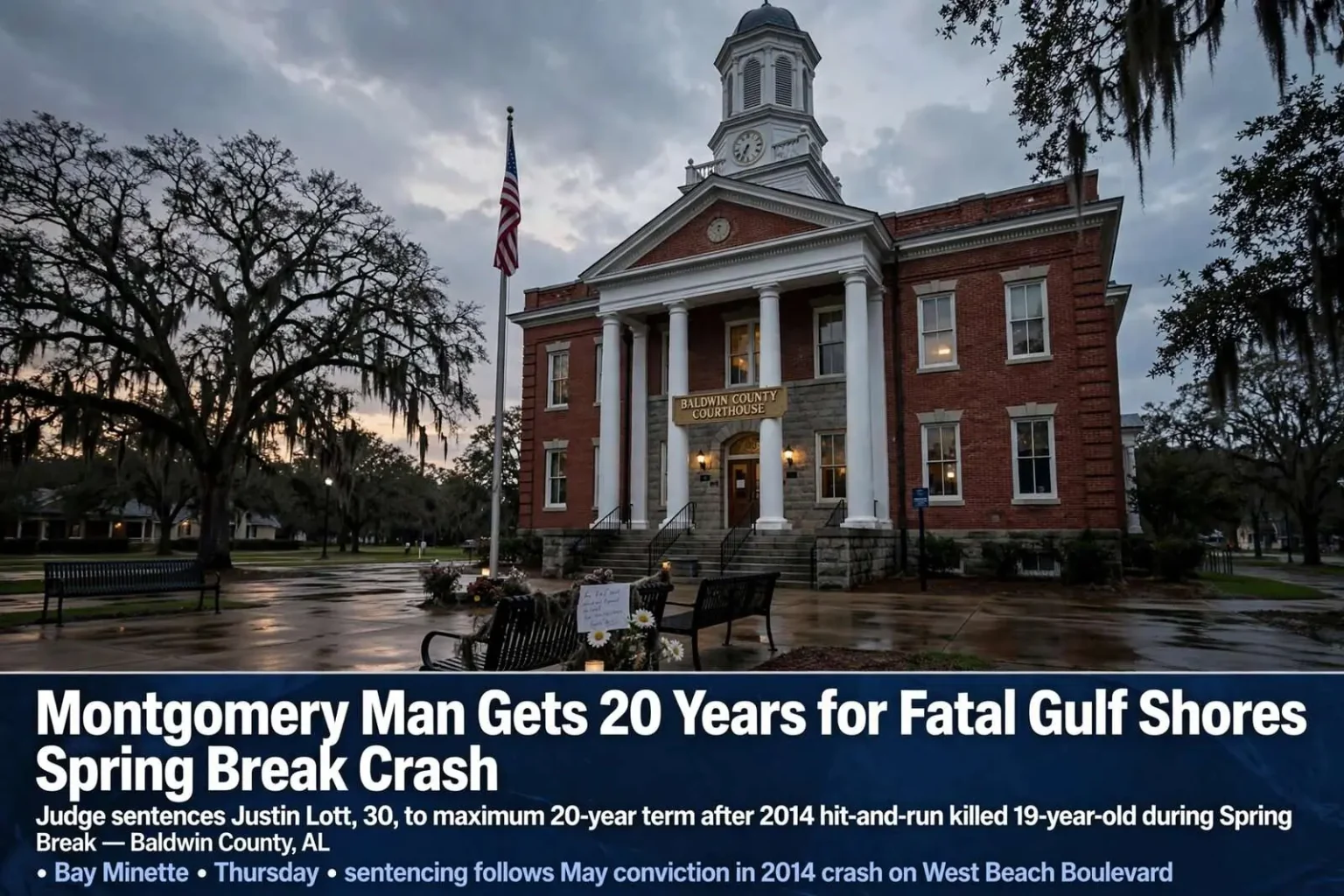
A Baldwin County judge handed down the maximum sentence Thursday for a Montgomery man convicted in a hit-and-run crash that killed a 19-year-old college student during Spring Break in Gulf Shores in 2014. Judge Joseph Norton sentenced Justin Lott, 30, to 20 years in prison following an emotional hearing at the Baldwin County Courthouse in Bay Minette. The sentencing brought to a close the trial phase of a case that had hung over the beach community for more than a year and drawn attention to the dangers that accompany the coast’s busiest tourist season.
A jury had convicted Lott in May of manslaughter, leaving the scene of an accident and assault in connection with the March 2014 crash. The multi-count verdict reflected the sequence of events prosecutors laid out at trial — a fatal strike, a driver who kept going and the injuries and loss that followed. Leaving the scene of an accident involving a death is a serious felony in Alabama on its own, and its pairing with a manslaughter count gave the judge a broad range of sentences to weigh at the hearing.
According to testimony at trial, Lott’s truck was headed west along the 1400 block of West Beach Boulevard in the early morning hours when it struck a young woman walking along a bike path with two friends toward the condominium where she was staying with sorority sisters during Spring Break. She died at the scene. Lott’s truck did not stop.
The Night of the Crash
West Beach Boulevard runs parallel to the Gulf of Mexico through the densest stretch of Gulf Shores’ beachfront, a corridor of condominium towers, rental houses and crosswalks that sees constant pedestrian traffic during Spring Break weeks. The bike path that parallels the roadway is used year-round by walkers, joggers and cyclists, and in March it becomes one of the busiest pedestrian routes on the Alabama coast. Testimony placed the victim and her two friends on that path in the early-morning hours, making their way back toward the condominium where they were staying for the week.
Police pulled Lott over a short time later and arrested him after he failed a field sobriety test. Investigators said he had spent the previous night at a gathering in Orange Beach connected to his brother’s bachelor party, and while he admitted to officers that he had been drinking, he later declined a breath test at the police department and again declined to have his blood alcohol level checked at a nearby hospital, despite initially agreeing to do so.
The refusals became a point of contention throughout the case. Alabama’s implied consent law requires drivers to submit to chemical testing when lawfully requested, but the consequences of refusal are administrative rather than physical compulsion, and defense attorneys routinely advise clients of that reality. Under Alabama law, a refusal to submit to testing can be used as evidence at trial, and jurors were told about the sequence of declined tests as they weighed the state’s account of that night.
A police detective who testified during the trial acknowledged he had not sought a court order to compel a blood alcohol reading, a decision he described as a mistake. In Alabama, officers can obtain a search warrant to draw blood from a suspected impaired driver who refuses voluntary testing, and prosecutors in fatal cases routinely push for that step. The detective’s admission gave the defense a thread to pull during trial, though the jury evidently found the overall account of the crash persuasive.
Investigators recovered beer cans from inside Lott’s truck, though he maintained he had not been drinking from them. The cans were among the physical items cataloged after the stop, and their presence in the vehicle figured into the broader picture of impairment that prosecutors presented. Lott’s account that the cans were not his to drink — without explaining who consumed them — became part of the competing narratives the jury had to sort through before returning its verdict in May.
The Sentencing Hearing
Lott has remained in custody at the Baldwin County Corrections Center since the jury’s verdict. His attorney asked the court to release him so he could return to his job in Montgomery ahead of sentencing, but the judge declined the request. The denial meant that Lott remained behind bars for the weeks between conviction and sentencing, a period his attorneys had argued could have been spent preparing for the transition a prison sentence would bring.
The hearing at the Bay Minette courthouse drew family members of the victim, who were present as the sentence was imposed. Baldwin County’s main courthouse in Bay Minette sits well inland from the beach communities where the crash occurred, but it is where the county’s felony dockets are heard, and cases arising from Gulf Shores, Orange Beach and Foley all make their way to its courtrooms. The 20-year sentence represented the maximum available for manslaughter under Alabama law, and Norton’s imposition of the full term reflected the weight he gave to the circumstances of the crash.
Defense attorneys indicated they intend to appeal the conviction. An appeal in an Alabama felony case moves first to the Alabama Court of Criminal Appeals, where issues such as the sufficiency of the evidence, trial rulings and jury instructions are reviewed. The process typically takes many months, and Lott will remain in state custody while it unfolds unless a court grants bond pending appeal — a request that is rarely made and more rarely granted in cases involving a fatal crash.
Spring Break and the Safety Conversation
The case drew significant attention along the Alabama Gulf Coast, where Spring Break traffic and late-night pedestrian activity along beach roads have long raised safety concerns for local law enforcement and residents alike. Gulf Shores and Orange Beach welcome an enormous influx of college students and families each March, when the population of the beach communities swells far beyond their year-round size and the roadways fill with visitors unfamiliar with local streets.
Police departments in both beach cities respond each year with heightened patrols, DUI checkpoints and emphasis on pedestrian safety along West Beach Boulevard and the Perdido Beach corridor. The 2014 crash became a recurring reference point in those seasonal campaigns — an example cited by officers and community leaders of how quickly a celebratory week can turn tragic when drinking and driving intersect with heavy pedestrian traffic after dark.
For the victim’s family and her sorority sisters, the sentencing closed one chapter of a loss that began with a walk along a beach road. The 19-year-old’s death prompted an outpouring of grief from her campus community and from Gulf Shores residents who followed the case from the first reports of the crash. Speaking at hearings throughout the process, family members described a promising young life cut short by a decision made in the early-morning hours on a road lined with celebrations.
Legal observers noted that the case will likely be studied along the coast for two reasons: the jury’s willingness to convict on a manslaughter theory built in part on refusals to test, and the detective’s candid acknowledgment that a missed step in obtaining a blood sample could have complicated the prosecution. For police agencies along the Gulf, the lesson has been incorporated into training on impaired-driving investigations — seek the warrant, document the refusals and preserve every physical detail from the vehicle.
Lott’s appeal will determine whether the conviction stands as handed down, but the 20-year sentence has already become the benchmark in Baldwin County for fatal Spring Break crashes. As another season of visitors arrives on the Alabama coast each March, the case stands as a reminder to travelers and residents alike of what is at stake on West Beach Boulevard after dark, and of the lasting consequences that follow a decision to drive after drinking.
Under Alabama sentencing law, the 20-year term Judge Norton imposed represents the ceiling for the manslaughter count, though judges may order sentences on multiple counts to run consecutively or concurrently depending on the circumstances. The court’s disposition of the accompanying counts — leaving the scene of an accident and the assault conviction — was addressed as part of Thursday’s hearing, with the manslaughter term anchoring the overall sentence. Court records will reflect how each count was resolved in the final judgment entered by the clerk.
The Baldwin County District Attorney’s office, which prosecuted the case, has consistently emphasized that fatal hit-and-run crashes along the coast will be pursued to the fullest extent of the law. In this instance, the office’s trial team assembled witness testimony from the victim’s friends, responding officers and crash reconstruction findings to establish both the sequence of the collision and the driver’s failure to stop. That combination of evidence proved decisive for the jury in May and gave the judge a detailed record on which to base the maximum sentence.