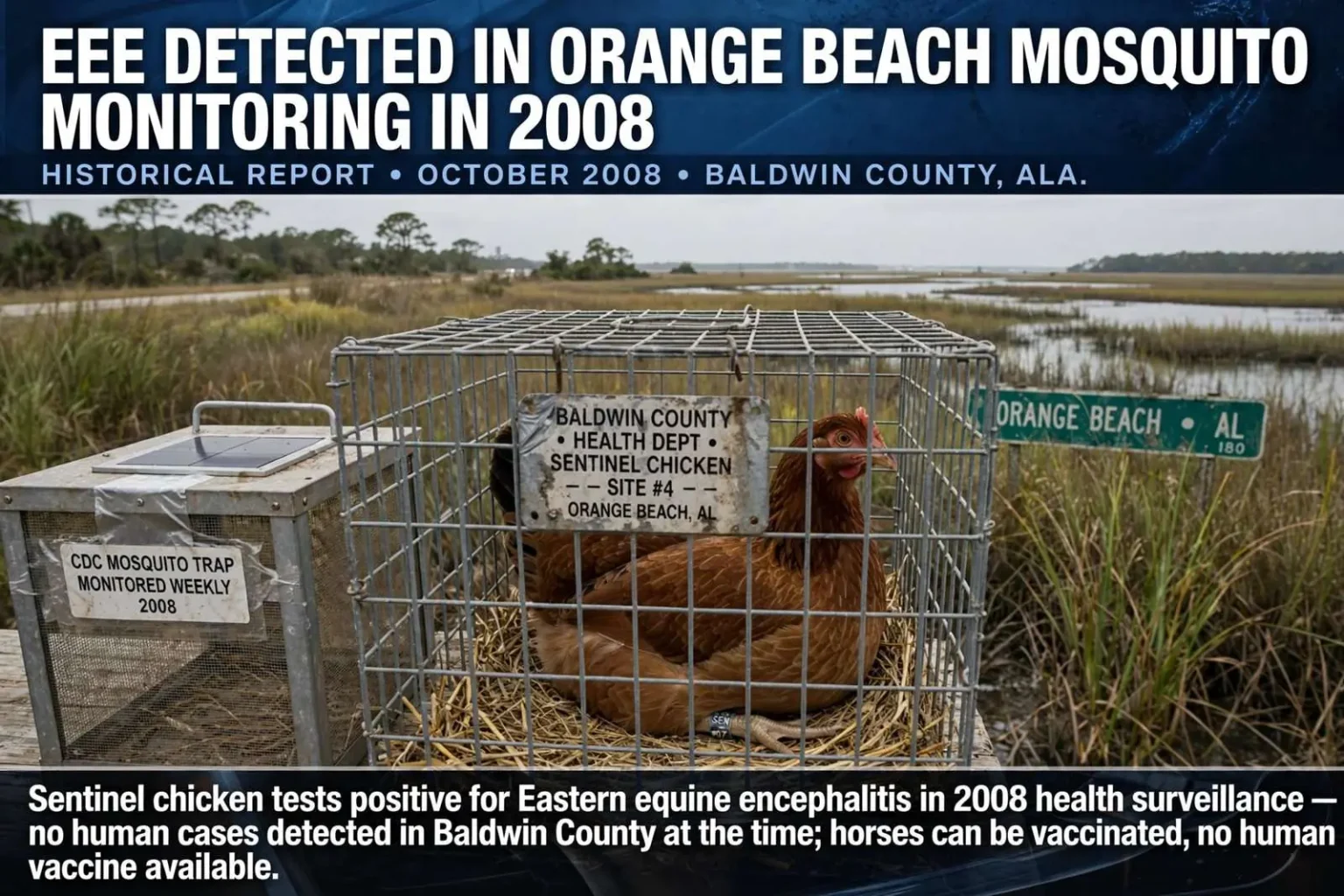
Historical report preserved from an archived 2008 local news story.
ORANGE BEACH, Ala. — A chicken kept by health workers as part of Baldwin County’s mosquito-monitoring program tested positive for Eastern equine encephalitis in 2008, an archived local news report shows, marking the presence of the mosquito-borne virus in the Orange Beach area that year.
The sentinel chicken was one of several birds health workers kept at stations around the county during mosquito season. The birds are used to monitor mosquito-borne viruses because the animals are immune to the diseases themselves — mosquitoes can infect them, and the birds develop detectable antibodies, but they do not become seriously ill. That makes each chicken a living alarm system: when a bird tests positive, health workers know the virus is circulating in mosquitoes nearby.
The report said Eastern equine encephalitis could be transmitted to people and horses by mosquitoes, and that horses had vaccines available while no human vaccine existed at the time. The Baldwin County Health Department said it had not detected mosquito-borne viruses in people in the county at that point in 2008.
The finding in Orange Beach put coastal Baldwin County communities on notice during the heart of mosquito season, when warm temperatures, afternoon rains and standing water in low-lying areas combine to produce the region’s heaviest mosquito activity of the year.
How Sentinel Chickens Work
Sentinel chicken flocks have been a staple of mosquito surveillance across the South for decades, and Baldwin County’s program followed the standard practice. Health workers keep coops of birds at fixed locations — near wetlands, in neighborhoods close to tidal marsh, at parks and other spots where mosquito activity runs high — and draw small blood samples from the birds on a regular schedule throughout the season.
The samples are tested for antibodies to the viruses that circulate in regional mosquitoes, principally Eastern equine encephalitis and West Nile virus. A chicken bitten by an infected mosquito will develop antibodies within days without falling ill, so a positive sample tells health officials exactly what they need to know: the virus is active at that location, right now. Unlike testing individual mosquitoes, which requires trapping and sorting thousands of insects, a chicken sits in one place and gets bitten by whatever flies by.
The birds are not a health risk to the community. Because the chickens do not develop high levels of virus in their blood, they cannot pass the infection back to mosquitoes or to people — they record the virus’s presence without amplifying it.
When a sentinel bird converts from negative to positive, the health department’s response follows a playbook: intensify mosquito trapping and testing around the site, notify municipal mosquito-control crews to increase spraying in the area, and remind residents to protect themselves until the threat eases.
What Eastern Equine Encephalitis Is
Eastern equine encephalitis, known as EEE, is one of the most serious mosquito-borne diseases in North America. The virus circulates naturally between mosquitoes and birds in freshwater swamps and marshes — habitat that Baldwin County has in abundance along its bays, bayous and tidal creeks. Most mosquitoes never carry it, and most birds never spread it, but when the virus jumps into the mosquitoes that bite people and horses, the results can be severe.
In people, EEE infection ranges from a flu-like illness to inflammation of the brain — encephalitis — that can cause seizures, coma and death. Cases are rare, but the disease has historically carried one of the highest fatality rates of any mosquito-borne illness in the country, and survivors can be left with lasting neurological damage. There was no human vaccine and no specific treatment at the time of the 2008 report, and that remains true today; care is supportive.
Horses are even more vulnerable than people. EEE in an unvaccinated horse is almost always fatal, and outbreaks among equines in the Gulf Coast states have been a recurring summer problem. That is why the vaccine point in the archived report mattered to Baldwin County’s large horse community: vaccination for horses is inexpensive, widely available through veterinarians, and considered one of the most effective steps an owner can take.
The Public Health Response in 2008
The Baldwin County Health Department’s message in the wake of the positive chicken followed the standard lines of mosquito-season advice. Residents were encouraged to avoid outdoor activity at dawn and dusk, when the mosquitoes most likely to carry the virus are most active; to wear long sleeves and long pants when outside; and to use insect repellent containing DEET or comparable ingredients.
Homeowners were also urged to dump standing water — in buckets, birdbaths, flower pots, old tires and clogged gutters — because mosquitoes breed in any container or depression that holds water for a week or more. In a coastal county dotted with retention ponds, ditches and marsh edges, municipal crews supplemented those efforts with larvicide treatments and truck-mounted spraying, and cities along the coast ran their own control programs during peak season.
The health department noted that it had not detected mosquito-borne viruses in people in the county at that point in 2008 — a reassuring caveat that put the finding in context. A positive sentinel chicken means the virus is present in mosquitoes; it does not mean anyone has been infected, and the surveillance system exists precisely to catch the virus before human cases occur.
Why the Program Matters on the Gulf Coast
South Alabama sits in one of the country’s most active regions for mosquito-borne disease. The combination of subtropical climate, wetlands, heavy summer rainfall and dense bird populations means viruses like EEE and West Nile circulate every year at some level, and health departments from Mobile County to the Florida line maintain surveillance to track them. Baldwin County’s chickens were one part of that network, which also included mosquito trapping and testing and, in some years, reporting of horse cases by veterinarians.
The data the program produces has real consequences. Positive birds change where spraying trucks run, when advisories go out to schools and outdoor employers, and what advice veterinarians and physicians receive. Over the years, sentinel programs across the Gulf Coast have detected virus activity weeks before human cases appeared, giving communities time to act.
This article records a 2008 health update from an archived local news report and is not current medical guidance. Mosquito-borne disease surveillance continues in Baldwin County today under the county health department, and residents with questions about current mosquito activity, vaccination for horses or personal protection should consult the department, their physician or their veterinarian.
For coastal residents, the lesson of the 2008 finding has not changed in the years since: the virus is a seasonal fact of life along the bays and marshes, the chickens keep watch for it, and the precautions that mattered then — repellent, long sleeves, dumped standing water, vaccinated horses — remain the region’s standing defense.
Mosquito Season Along the Coast
Baldwin County’s geography explains why its surveillance program is so busy. The county stretches from Mobile Bay across tidal rivers, pine flatwoods and agricultural land to the beaches at Gulf Shores and Orange Beach, and its low-lying coastal edge is laced with salt marsh and freshwater swamp — ideal habitat for the mosquito species that carry encephalitis viruses. Summer thunderstorms refill every ditch and container, and the season typically runs from spring well into fall.
Orange Beach, sitting between the bay and the Gulf with canals, wetlands and marinas throughout, has long been one of the county’s most mosquito-active corners. The city’s own control efforts, combined with the county’s surveillance, track activity through the warm months, and the 2008 positive chicken was recorded as part of that routine monitoring rather than in response to any reported illness.
What Eastern Equine Encephalitis Is
12|
Eastern equine encephalitis, known as EEE, is one of the most serious mosquito-borne diseases in North America. The virus circulates naturally between mosquitoes and birds in freshwater swamps and marshes — habitat that Baldwin County has in abundance along its bays, bayous and tidal creeks. Most mosquitoes never carry it, and most birds never spread it, but when the virus jumps into the mosquitoes that bite people and horses, the results can be severe.
13|
In people, EEE infection ranges from a flu-like illness to inflammation of the brain — encephalitis — that can cause seizures, coma and death. Cases are rare, but the disease has historically carried one of the highest fatality rates of any mosquito-borne illness in the country, and survivors can be left with lasting neurological damage. There was no human vaccine and no specific treatment at the time of the 2008 report, and that remains true today; care is supportive.
14|
Horses are even more vulnerable than people. EEE in an unvaccinated horse is almost always fatal, and outbreaks among equines in the Gulf Coast states have been a recurring summer problem. That is why the vaccine point in the archived report mattered to Baldwin County’s large horse community: vaccination for horses is inexpensive, widely available through veterinarians, and considered one of the most effective steps an owner can take.
15|