University of South Alabama Mobile
Mobile County Freshmen Learn Cybersecurity Skills at USA Summer Camp
Top-performing Mobile County high school freshmen spent part of their summer at USA learning cybersecurity fundamentals through a free national program.
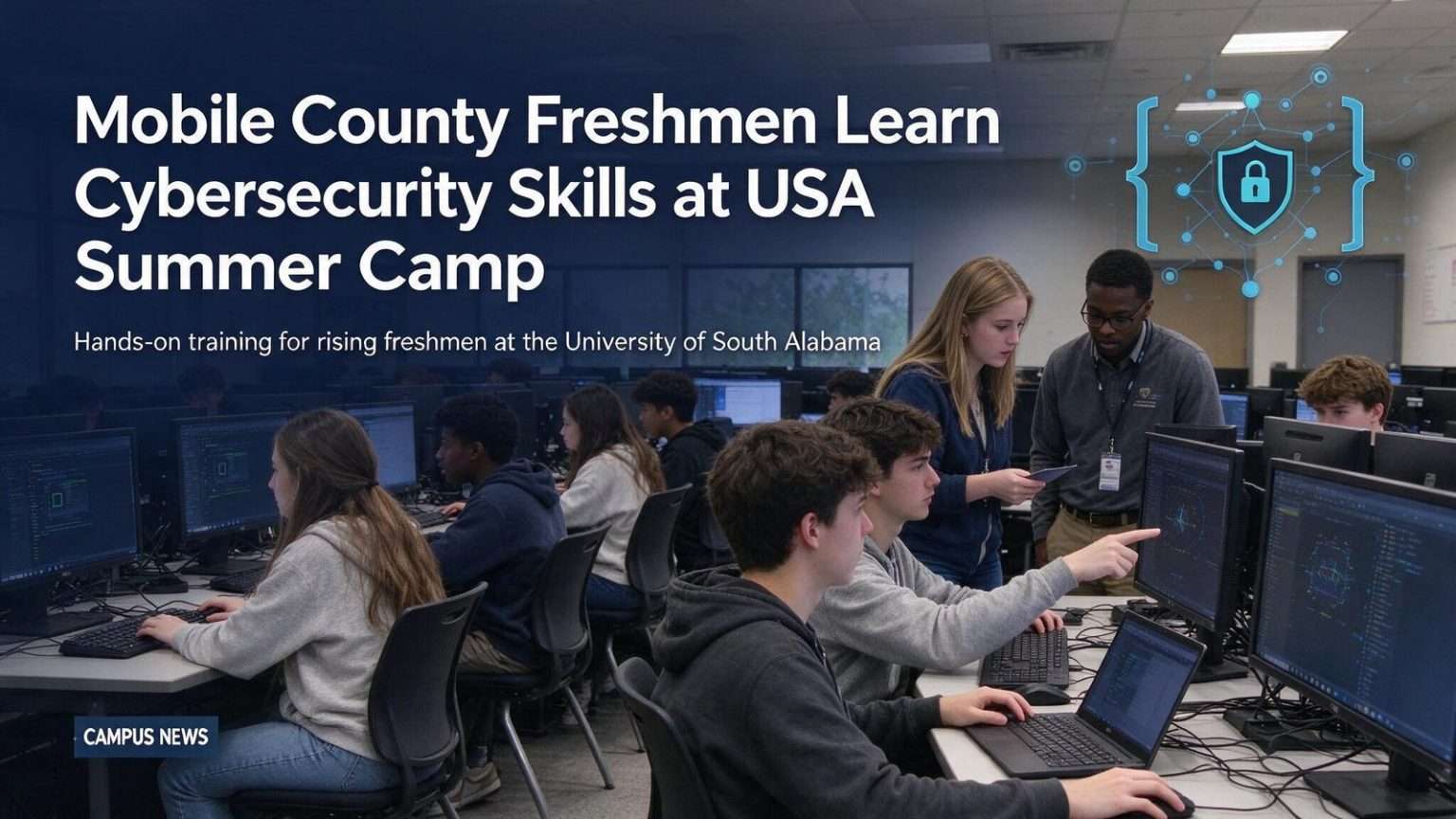
More than two dozen incoming high school freshmen from Mobile County spent part of their summer break getting a head start on a potential career in cybersecurity, thanks to a free camp hosted at the University of South Alabama. The GenCyber camp, sponsored by the National Security Agency and the National Science Foundation, gave students a crash course in cybersecurity fundamentals at no cost to participants.
The national GenCyber program exists for a simple reason: the country does not produce nearly enough cybersecurity professionals to meet demand, and federal agencies have concluded that the solution has to start in middle school and high school rather than in college. By funding camps at universities across the country, the NSA and the National Science Foundation give students hands-on exposure to the field years before they would otherwise encounter it, and at no charge to the families.
Organizers say the program is designed to spark early interest in computing fields at a time when demand for skilled workers in the industry far outpaces the supply of qualified graduates. The timing is deliberate as well. Incoming freshmen are on the verge of choosing high school course tracks, and a week spent inside a university computing lab can shape which math and science classes a student signs up for that fall, and in the years after.
Who Took Part, and Why
Les Barnett, director of USA’s Center for Forensics and Information Technology, said participants were selected from among the top 10 percent of students in the Mobile County Public School System. That selection standard makes the camp both an honor and an investment: the students chosen are the ones most likely to succeed in demanding technical coursework, and the ones the region most needs to keep on a computing pathway.
He said workforce development was a driving reason behind starting the camps in the first place. For the Gulf Coast economy, that motive is straightforward. Cybersecurity jobs are among the fastest-growing and best-paying careers in the region, spanning defense contractors, healthcare systems, banking, port and logistics operations, and government agencies, and Mobile-area employers routinely report difficulty finding qualified applicants.
“There are roughly three jobs for every graduate with a degree in computing,” Barnett said, noting that USA’s School of Computing offers five undergraduate degrees along with graduate and doctoral programs in the field. A three-to-one ratio of openings to graduates means that students who complete a computing degree enter a seller’s market for their skills, with leverage on salary and location that few other new graduates enjoy.
He said the bigger challenge is finding enough students with strong math backgrounds to fill the pipeline. That bottleneck is precisely what programs like GenCyber are built to address. Students who fall behind in mathematics in middle school rarely choose computing majors in college, so reaching them as rising freshmen, before high school math sequences harden, is one of the few interventions with real leverage on the long-term supply of technical talent.
A National Program With a Local Home
USA’s program was one of just 43 GenCyber camps held at 29 universities across 18 states this summer, reflecting a broader national push to build cybersecurity talent starting well before college. Being selected to host one of the small number of national camps places the university alongside a short list of institutions the NSA trusts to deliver the curriculum, and it means Mobile County students can access a federal program without leaving home.
The recognition follows a February honor from the NSA, which recognized USA’s cybersecurity degree program for its academic strength. Federal designation of that kind matters for more than prestige: it signals to employers and to prospective students that the university’s curriculum meets the standards of the agency that knows cybersecurity better than any other organization in the country.
USA School of Computing Dean Alec Yasinsac said the university has positioned itself among the top cybersecurity training programs in the region. “We feel we are the preeminent cybersecurity institution in the state and one of the preeminent in the southeast,” he said following the NSA’s recognition earlier in the year.
Yasinsac’s claim rests on a broad foundation. The School of Computing’s five undergraduate degrees, combined with its graduate and doctoral programs, give USA a depth of course offerings that few institutions of its size can match, and its Center for Forensics and Information Technology extends that work into digital forensics, an adjacent discipline where law enforcement needs overlap directly with cybersecurity skills. The February NSA recognition followed years of building faculty, labs, and degree pathways around the discipline.
For the university, the camp also functions as a recruiting tool. A rising freshman from a Mobile County high school who spends a week on USA’s campus meets faculty, sees the computing labs, and begins to picture a college pathway that ends in one of those five degrees. University officials have long noted that many students rule out technical careers simply because no one ever showed them what the work looks like, and a week of hands-on camp activities is the most direct remedy available.
Why Early Exposure Matters
For the Mobile County freshmen who took part, the camp offered a rare opportunity to explore a high-demand career field years before most students would typically encounter it in a classroom setting. Most American students first hear the term “cybersecurity” in a college brochure, if at all. By that point, the students who lack the math preparation, or the early interest, needed for a computing major have often already sorted themselves out of the field.
Organizers hope early exposure like this will help keep local students engaged in math and computing coursework throughout high school, ultimately feeding more graduates into a regional workforce hungry for technical talent. The math-to-career pipeline is well documented: algebra by eighth grade, strong performance through precalculus, and early computing coursework are the strongest predictors of whether a student will complete a computing degree. A camp that reaches students at the front end of that sequence can change its trajectory.
The stakes for the Mobile area are considerable. The regional economy increasingly runs on technical employers, from aerospace and shipbuilding to healthcare networks and the growing digital operations along the Gulf Coast, and every one of those sectors competes for the same limited pool of computing graduates. Camps like GenCyber will not close the gap on their own, but they are among the few programs that intervene at the age when students’ career ambitions are still forming.
University officials say they plan to continue hosting the camp in future summers, with hopes of expanding the number of Mobile-area students who can take part as interest in cybersecurity careers continues to grow nationally. Each summer’s cohort of two dozen students represents a small fraction of the district’s incoming freshmen, and officials have framed the expansion goal as a matter of meeting demand, both from students who want in and from employers who want the talent pipeline the program is designed to build.
For now, the first cohorts have taken the first step. A few dozen Mobile County freshmen head into high school this fall having written security exercises on a university campus, met the faculty who teach the field, and heard directly from working professionals that roughly three computing jobs await every graduate. Whether that early start turns into degrees and careers will play out over the next decade, but the pipeline has officially opened.
The free nature of the camp is a central part of its design. Summer enrichment programs in computing often carry tuition that puts them out of reach for many families, which has the effect of narrowing the pipeline to students who already have advantages. By covering the full cost through the NSA and National Science Foundation sponsorship, GenCyber removes the price barrier entirely, so that admission depends on a student’s ability and interest rather than a family’s budget. For a district as large as Mobile County Public Schools, one of the biggest school systems in Alabama, that open door matters.
The center Barnett directs sits at the intersection of two disciplines that increasingly rely on each other. Digital forensics applies investigative technique to computers, phones, and networks, supporting everything from criminal prosecutions to corporate investigations, while information technology security focuses on keeping those same systems safe from intrusion. Students who begin in one field frequently find careers in the other, and exposure to both during a summer camp week gives participants a wider view of the options than a single classroom course could provide.
The camp curriculum typically blends lectures with hands-on exercises, letting students move between the concepts of the field and the practice of it. Rising freshmen who arrive unsure what cybersecurity even means leave having worked with the same categories of tools and problems that professionals face, in a form scaled to their level. That blend of theory and activity is what separates a camp that changes minds from a lecture series that does not.
Beyond the week itself, the program creates a connection between the university and the school system that can pay off in later years. Students who attend a GenCyber camp often return to campus for other enrichment programs, dual-enrollment coursework, and eventually degree programs, and the relationships formed with faculty during the camp give them contacts to ask when questions arise. Building that bridge early is part of why USA has invested in hosting the camp rather than leaving summer outreach to others.
The broader national picture reinforces the local effort. Federal agencies, industry groups, and universities have all warned for years that the shortage of cybersecurity professionals poses a national security and economic problem, with unfilled positions growing faster than the education system produces qualified candidates. Programs like GenCyber, which pair federal sponsorship with university delivery and local school-system recruitment, have become the standard response, aiming to add new talent to the pipeline at the earliest point where intervention still works.
For the students, though, the takeaway is simpler than any policy framework: a field they may have never heard of in June had become, by the end of a single week, a possible future, one with strong job prospects, university pathways close to home, and a clear road running from this fall’s math classes to a career.