University of South Alabama Mobile
Bernie Sanders Campaign Holds Live Webcast Rally at USA in Mobile
A Bernie Sanders presidential campaign event scheduled at the University of South Alabama will let attendees hear his platform via live webcast.
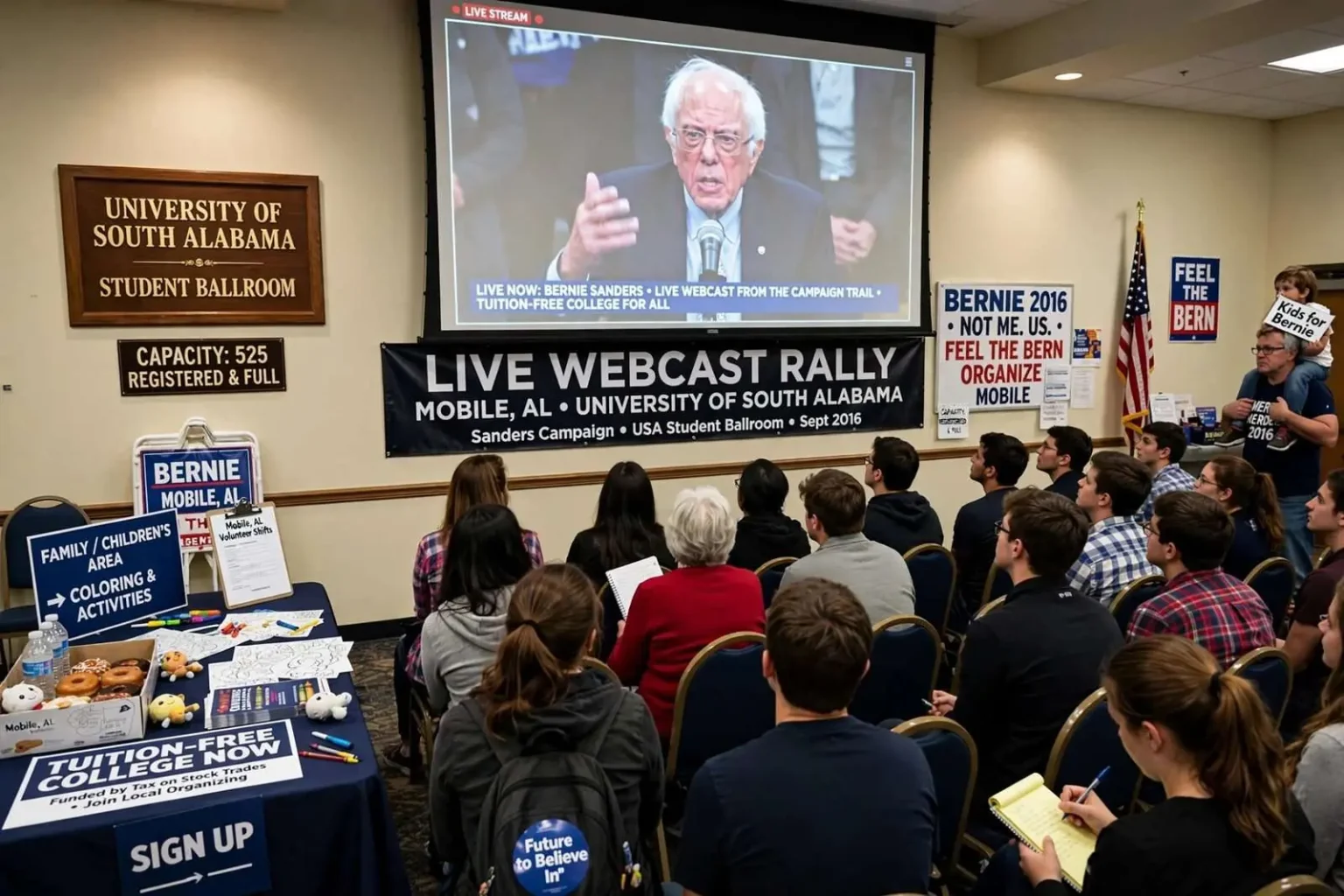
Supporters of Democratic presidential candidate Bernie Sanders are gathering at the University of South Alabama for a campaign meetup that will let attendees hear the senator’s platform through a live webcast rather than an in-person appearance. The event brings the Vermont senator’s campaign to Mobile in a form increasingly common in modern presidential politics, where technology allows candidates to address supporters in dozens of cities simultaneously without ever leaving the campaign trail’s main route. The event, scheduled for the USA student ballroom, is capped at 525 attendees and is one of several similar meetups planned across the southern United States in the coming months, including a stop in New Orleans. Organizers say the format allows the campaign to reach college towns and mid-sized cities without the logistics of an in-person tour stop.
The webcast format reflects the practical realities of an early-stage presidential campaign, when a candidate’s schedule can accommodate only so many cities but the appetite for organizing exists far beyond the major media markets. By streaming a live address to volunteer-hosted gatherings, the campaign can seed local organizing groups in communities that would otherwise wait months for any direct contact. For Mobile, the meetup puts the city alongside New Orleans and other Southern stops on the campaign’s early map, a notable position for a market far from the traditional early-voting states that dominate presidential campaign itineraries.
Sanders, the longest-serving independent in congressional history, has built his campaign around themes likely to resonate with a college audience, including a proposal for tuition-free public universities. His plan would fund the initiative through a small tax on stock trades, an idea he has framed as part of a broader effort to address income inequality. The tuition proposal speaks directly to students and recent graduates confronting the rising cost of higher education, an issue that has moved to the center of national political debate as student debt has grown. For a campus audience at South Alabama, the pitch offers a concrete answer to the question of how middle-class families will afford college in the coming decades.
Local organizers say the event is designed to be welcoming to families, with a designated area set aside for children so parents can participate in campaign discussions. The family-friendly arrangement reflects the grassroots character of the campaign’s organizing model, which treats meetups as community events rather than strictly political gatherings. Organizers hope the openness will widen the circle of attendees beyond the students and party regulars who typically populate campaign events, drawing in residents who are curious about the candidate but not yet committed to his candidacy.
A campaign built on grassroots organizing
The meetup format, increasingly common in modern presidential campaigns, allows local volunteers to host watch parties and discussions even when the candidate cannot travel to every city personally. The approach turns each viewing location into an organizing hub, where attendees can sign up for volunteer shifts, join mailing lists and begin the local work of building support. Campaign strategists have found that these early gatherings create durable networks of supporters who carry a campaign through the months when national attention has not yet arrived.
Mobile’s meetup reflects a broader pattern of grassroots organizing that has characterized Sanders’ campaign, which has relied heavily on small-dollar donations and volunteer-driven events rather than large-scale rallies in its early stages. The campaign’s financial model, built on contributions from ordinary donors rather than large fundraising events, pairs naturally with a volunteer organizing structure in which local supporters take responsibility for building presence in their own communities. Together, the two approaches have allowed the campaign to spread into cities and campuses across the country at a pace that would be difficult to achieve through traditional campaign infrastructure alone.
How Mobile residents can participate
Attendees interested in joining the Mobile meetup can register online through the campaign’s official website, where the USA location is listed among dozens of similar events nationwide. Registration helps organizers plan seating, materials and the children’s area, and it gives the campaign a measure of local interest in each city on the webcast schedule. Organizers say interest in the local event has been strong enough that they expect the attendance cap to be reached ahead of the scheduled date, a signal of the campaign’s early appeal in a region where Democratic presidential primary organizing has historically been modest.
The ballroom setting limits the event’s size by design, and organizers have emphasized that attendees who miss the cap will have future opportunities to engage as the campaign’s Southern organizing expands. The New Orleans meetup and other Southern stops form a network of nearby events that Mobile supporters can also plug into, giving the region a cluster of active organizing centers rather than isolated gatherings. That regional approach mirrors how campaigns build momentum ahead of primary season, linking local groups into larger state and multi-state structures.
What the event says about Mobile politics
Whether the event translates into lasting local support for Sanders’ campaign remains to be seen, but organizers say the turnout itself reflects growing political engagement among younger voters in the Mobile area heading into the 2016 election cycle. College campuses across the country have become proving grounds for presidential campaigns precisely because student organizing can generate energy that extends into the surrounding community, and South Alabama’s role in this meetup places Mobile within that national pattern. The city’s political landscape has long been shaped by local and state races as much as national ones, but presidential campaign activity tends to raise the visibility of political engagement overall.
The meetup also arrives at a moment when the technology of campaigning has lowered the barriers between national candidates and local supporters. A webcast costs the campaign little but gives volunteers in cities like Mobile a direct connection to the candidate’s message, something that once required a plane ticket or a visit from campaign staff. Organizers here have leveraged that accessibility to bring a presidential campaign into a market that might otherwise see little early activity.
For the University of South Alabama, hosting the event reinforces the campus’s identity as more than an educational institution — it is a civic space where the community comes together around the issues of the day. Students who attend will hear the case for tuition-free college directly from the candidate proposing it, and residents who join them will get an early look at a campaign whose grassroots model has already carried it into cities across the South. Whether the energy in the ballroom becomes an organized presence in Mobile’s political scene will depend on the volunteers who leave the meetup ready to do the work of building a campaign in the months ahead.
The University of South Alabama’s central role in hosting the event underscores the campus’s function as a gathering point for political activity in the Mobile area, regardless of party affiliation. University ballrooms and student centers regularly host candidate forums, civic discussions and party events, and the campus draws residents from across the metropolitan area who come for the space and accessibility the university provides. Hosting the Sanders meetup continues that tradition, placing the campus at the center of the 2016 campaign’s earliest organizing wave in Mobile.
Sanders’ place in the 2016 field
Sanders entered the Democratic presidential race as a self-described democratic socialist and a longtime independent voice in the Senate, positioning himself to the left of the Democratic field on issues of economic inequality, campaign finance and higher education. His campaign has drawn notice for the size of its individual donor base and the enthusiasm of its volunteer network, qualities that early meetups like the one at South Alabama are designed to convert into organized local support. The senator’s rallies in larger cities have drawn substantial crowds, but the webcast meetups extend the campaign’s reach into places the candidate himself may never visit.
For Alabama Democrats, the campaign’s Southern organizing push comes in a state where the party’s fortunes have been shaped by decades of shifting political alignment. Mobile’s Democratic community remains active in local politics, and presidential primary season offers an early opportunity for voters to weigh in on the party’s direction. The Sanders campaign’s investment in webcast meetups across the South suggests it sees potential in communities that are often bypassed by early-stage campaigns focused on the traditional early-voting states.
The stock-trade tax idea at the heart of the tuition-free college proposal has been part of Sanders’ economic platform for years, framed as a way to make higher education a public good funded by the financial sector rather than by students and their families. Supporters view it as a straightforward answer to rising student debt, while critics have questioned its economic effects, a debate that will play out nationally as the campaign develops. At campus events like the Mobile meetup, the proposal is often the policy that draws the most attention from students weighing the cost of their own educations.
As the meetup approaches, organizers’ attention turns to the practical work of filling the ballroom: registration tracking, volunteer assignments and the logistics of streaming the webcast for a full room. Whatever the event’s long-term political impact, it stands as an early marker of the 2016 campaign’s arrival in Mobile, and a test of how much organizing energy a webcast can spark in a city far from the campaign trail’s well-worn stops.