Gulf Coast Recovery Council Holds Off on BP Settlement Spending
Local officials overseeing BP oil spill settlement funds for Mobile and Baldwin counties are pausing new decisions until federal guidance arrives.
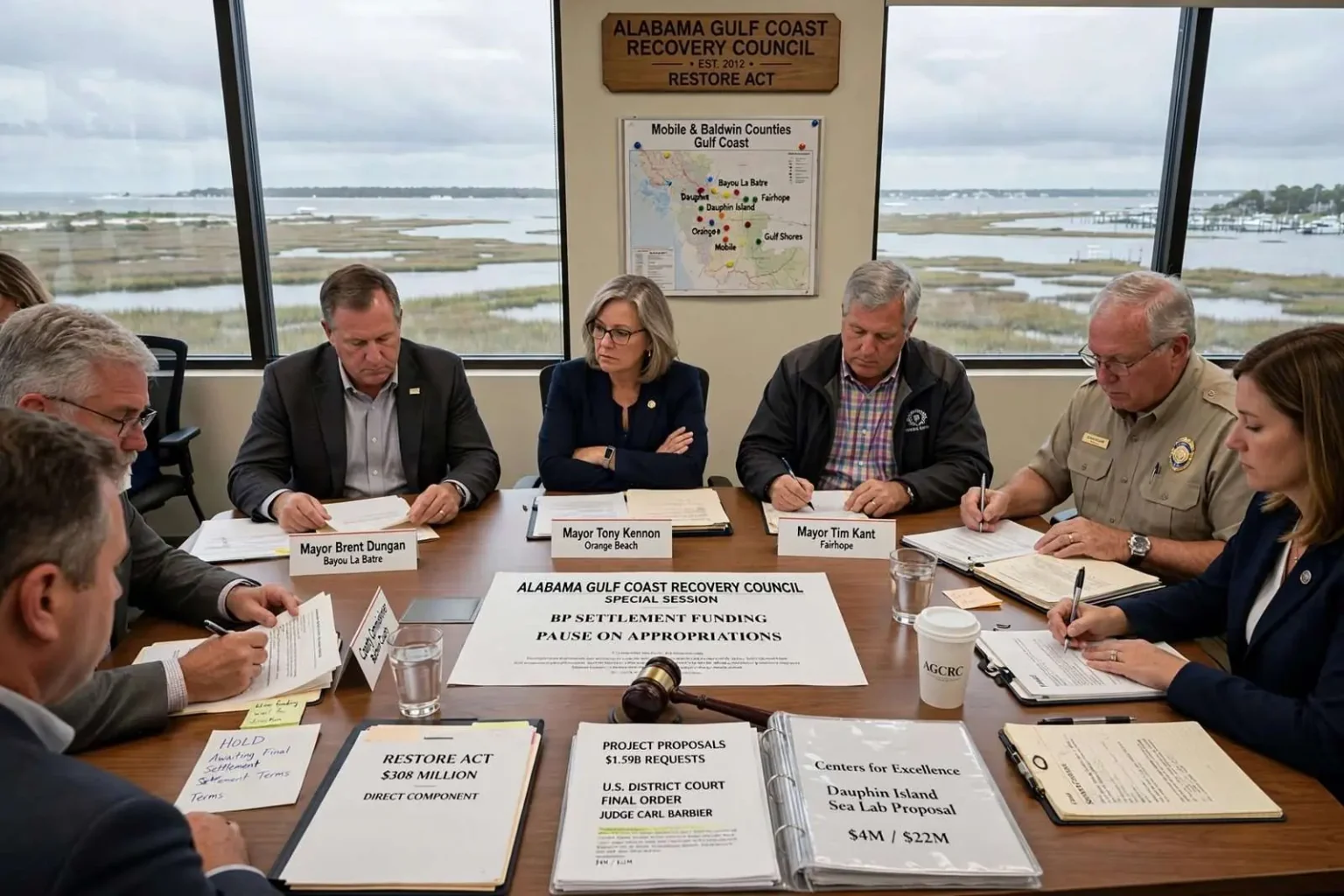
The board of local officials responsible for steering hundreds of millions of dollars in BP oil spill settlement money toward South Alabama has decided to hold off on new spending decisions until it receives clearer direction from federal courts and regulators. The Alabama Gulf Coast Recovery Council, made up of mayors and county commissioners from Mobile and Baldwin counties, voted last week to pause its appropriations process. Board members said they are waiting on U.S. District Judge Carl Barbier to finalize the broader settlement stemming from the 2010 Deepwater Horizon disaster before committing any additional funds.
The pause is less about indecision than arithmetic. With the final terms of the settlement still moving through federal court, committing council money now could mean guessing wrong about how much funding will ultimately be available, what restrictions will attach to it, and how the various buckets of penalty money will be allowed to overlap. For a body charged with distributing public funds under intense scrutiny, the members concluded that waiting for a final judicial order is the safer path than locking in projects against a moving target.
The Deepwater Horizon disaster, which began with the April 2010 explosion of the drilling rig and the months-long oil spill that followed, remains the largest environmental settlement process in American history, and its money reaches the Gulf Coast through several distinct legal channels. The council’s share is only one part of that flow, but it is the part that local mayors and commissioners control directly.
“More oversight than ever”
Bayou La Batre Mayor Brent Dungan said the sheer scale of federal oversight attached to the settlement money has made the process slower and more complicated than many residents realize. “There is more oversight on this money than there ever has been in the history of America,” Dungan said, adding that keeping the process transparent requires significant behind-the-scenes work.
Dungan’s characterization reflects the reality facing every entity that touches RESTORE Act dollars. The statute that created the funding streams layered federal trustee requirements, Treasury regulations, reporting mandates and audit obligations on top of the ordinary controls that govern municipal spending. Projects have to be evaluated for restoration value, documented against the spill’s impact, approved through the proper funding bucket and tracked for years afterward. None of that happens quickly, and the council’s members — mostly part-time local elected officials with their own cities and counties to run — have had to absorb a federal compliance workload that would challenge a dedicated state agency.
The money at stake
The council was created under the 2012 RESTORE Act, the federal law that directed the bulk of BP’s Clean Water Act penalties to the Gulf states for restoration and economic recovery. The Alabama Gulf Coast Recovery Council has discretion over $308 million in Clean Water Act penalties tied to the spill, according to state and federal officials. That discretion covers the Direct Component of the RESTORE Act funding, the share that flows to the council itself rather than through state agencies or federal trustees, and it is the pool against which the council’s project list is drawn.
Local leaders, including U.S. Rep. Bradley Byrne, have pushed for faster federal action, noting that project requests already submitted for consideration total roughly $1.59 billion — far more than the council currently has available to spend. The gap between requests and resources is the central tension of the entire process. Communities from Bayou La Batre to Gulf Shores submitted proposals spanning sewer systems, harbor improvements, ecosystem restoration, tourism infrastructure and workforce programs, each with a plausible claim on spill-related need. With five times more demand than money, every funding cycle forces choices that leave valued projects waiting.
An additional pool of roughly $300 million in penalties will also require sign-off from a separate federal council before it can be released. That second stream, administered through the federal-side structure of the RESTORE Act rather than the local council, follows its own approval pipeline, meaning even money destined for Alabama projects passes through a Washington-area body with its own calendar and priorities.
Where the rest of Alabama’s settlement stands
Those RESTORE Act dollars are part of a larger $2 billion settlement Alabama expects to receive overall, with $1 billion of that directed to the state’s General Fund over an 18-year period. The General Fund share, secured through the state’s legal claims against BP, gives lawmakers in Montgomery a long-drip revenue stream that will be appropriated through the normal legislative process rather than through any coastal council — a fact that has periodically frustrated coastal officials who argue the spill’s damage was concentrated on their shoreline. The remaining billion flows through restoration channels, including the council’s $308 million, with the split dictated by the interlocking statutes and consent decrees that govern the settlement.
Orange Beach Mayor Tony Kennon said unresolved financing questions are part of why the board chose to wait. The concern is practical: several large projects on the council’s list would need to be financed with bonds repaid from future RESTORE payments, and the repayment math changes depending on how the final settlement is structured. Committing to debt service before the payment schedule is known could leave the council committed to obligations its actual receipts cannot cover.
The Sea Lab’s bid for a bigger role
The only new item the council reviewed at its recent meeting was a proposal from the Dauphin Island Sea Lab to serve as a regional “Centers for Excellence,” a designation that would let the lab administer at least $4 million already received by the council, with the potential for roughly $22 million more in future funding. The Sea Lab, a state marine science facility on Dauphin Island, anchors marine research and education for Alabama’s public universities and has been a fixture of the island’s scientific community for decades. A Centers for Excellence designation would formalize its role in the restoration economy, putting research capacity and grant administration under one roof.
The Sea Lab was the sole applicant for that role, according to AGCRC executive director Eliska Morgan, who said the council wants a fuller picture of the settlement before moving forward. With no competing applicant, the council has the luxury of delaying the decision without losing the candidate — but deferring it also means the lab’s planning and any projects that would flow through the center remain in limbo alongside everything else.
Fairhope Mayor Tim Kant said whoever administers grant funding needs deep environmental expertise to guide applicants effectively. Kant’s point speaks to a recurring critique of spill-money processes: local governments often lack the in-house scientific staff to design projects that satisfy federal restoration standards, and applicants without expert guidance can spend months on proposals that never clear review. An administrator with genuine environmental credentials could act as both gatekeeper and coach, improving the quality of applications before they ever reach the council’s agenda.
Prioritizing the hardest-hit communities
Kennon voiced support for prioritizing Bayou La Batre and Dauphin Island, calling them the hardest-hit communities on the Alabama coast. The two waterfront communities sit at the center of the spill’s Alabama footprint — Bayou La Batre as a working seafood port whose fleet and processing houses were idled by fishery closures, and Dauphin Island as a barrier island whose beaches, economy and coastline absorbed the spill’s direct physical impact. Both communities are small, with modest tax bases, which is precisely why their leaders have argued they need the settlement money most and can least afford to wait through repeated delays.
Dungan agreed, noting the seafood industry in south Mobile County bore an outsized share of the spill’s economic damage and said federal bureaucracy will likely continue to slow how quickly any of the money reaches local projects. The seafood towns south of Mobile watched their docks go quiet in 2010 as closures swept through the Gulf’s fishing grounds, and recovery for those businesses has tracked closely with consumer confidence in Gulf seafood as much as with actual water quality. For Bayou La Batre’s mayor, the irony is hard to miss: the communities damaged first by the disaster are the last in line behind a federal process designed, in part, to make them whole.
What the pause means for local projects
The practical effect of the council’s vote is that no new appropriations move forward until the court’s final word arrives, leaving cities and counties that submitted proposals in a holding pattern. Project sponsors who were counting on RESTORE dollars to match other funding sources now face a scheduling problem: federal and state grant cycles do not pause, and a project that misses one window may have to wait another year for the next. The council’s members are aware of that risk, but concluded that a delayed project is preferable to a mis-structured commitment made before the settlement’s final shape was known.
For residents trying to follow the process, the overlapping structures can be genuinely confusing. Alabama’s spill money arrives through the RESTORE Act’s multiple components, the Natural Resource Damage Assessment process, the National Fish and Wildlife Foundation, and direct state claims — each with its own administering body, eligibility rules and public calendar. The AGCRC controls only its own slice, and its deliberations are only one thread in a settlement process that will play out over decades. The $2 billion Alabama expects overall will arrive over an 18-year horizon in some streams, meaning the effects of last week’s pause will be measured against spending that continues well into the future.
The balance between speed and scrutiny
The debate inside the council echoes a larger argument that has run through Gulf Coast restoration since the first settlement dollars appeared. One camp, embodied in Byrne’s push for faster federal action, argues that communities harmed by the spill should see benefits while the need is current, and that endless review becomes its own kind of harm. The other camp, reflected in Dungan’s account of the oversight burden, counters that the money exists precisely because the disaster was catastrophic, and that the public will only trust the process if every dollar is documented, audited and tied to demonstrable restoration or economic benefit.
Both arguments have force, and the council’s vote last week essentially declined to choose between them. By pausing rather than either rushing appropriations or scrapping the process, the board kept its project list intact while protecting itself from commitments that might conflict with the court’s final order. When Barbier’s judgment finalizes the settlement’s terms, the council will have certainty about its receipts, its restrictions and its timeline — and can resume allocating the $308 million with confidence about what it actually has to spend.
Until then, the projects worth roughly $1.59 billion remain proposals rather than contracts, the Sea Lab’s Centers for Excellence bid remains pending, and the hardest-hit communities on the Alabama coast continue to wait — as they have since 2010 — for the money to move.