Byrne Points to Gulf Energy Revenue as Funding Source for I-10 Bridge
Rep. Bradley Byrne says Gulf oil and gas revenue sharing could help pay for the proposed I-10 Bridge and Bayway expansion in Mobile.
A Federal Revenue Stream for the Bridge
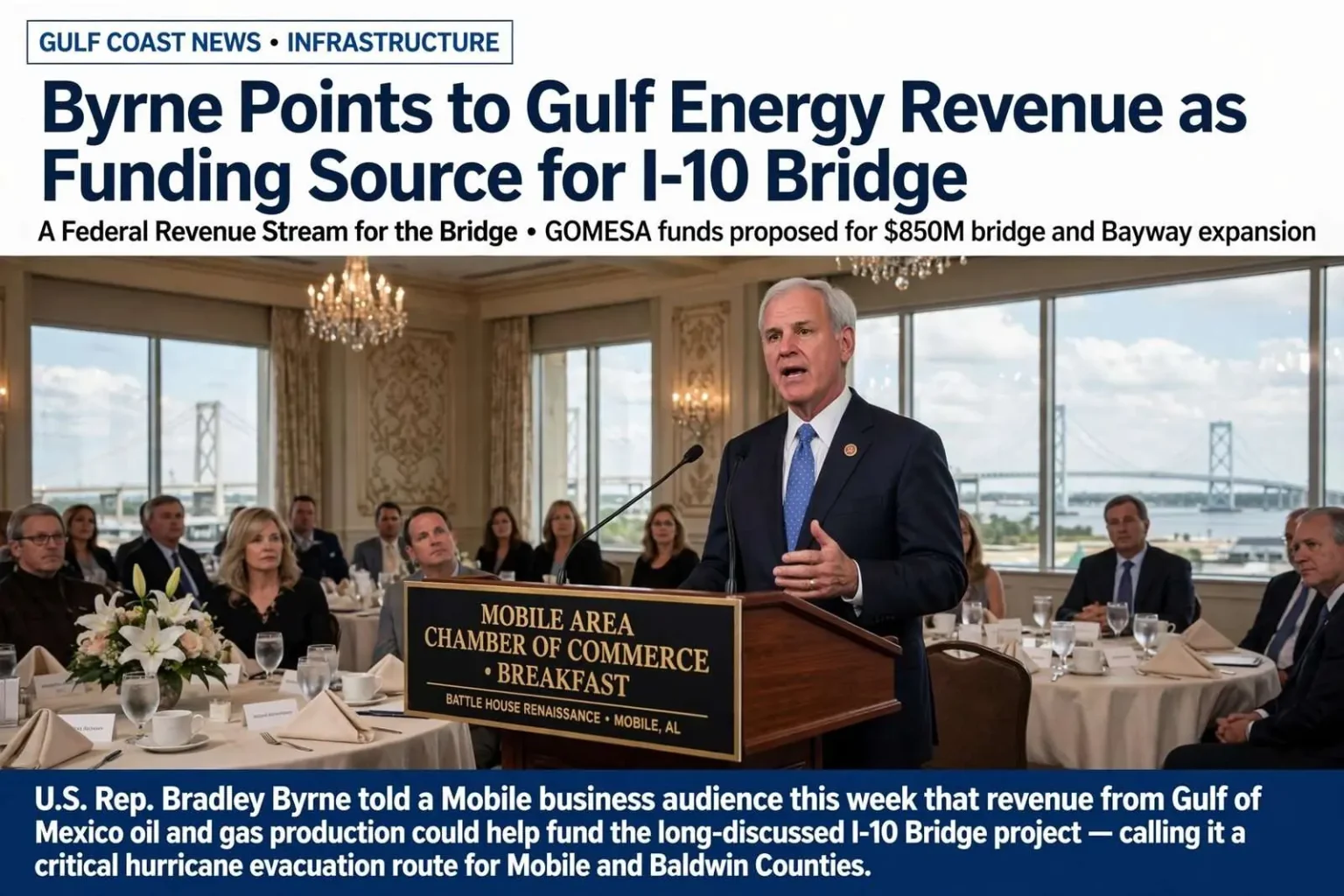
U.S. Rep. Bradley Byrne told a Mobile business audience this week that a federal revenue-sharing program tied to Gulf of Mexico oil and gas production could become a significant funding source for the long-discussed Interstate 10 Bridge and Bayway expansion project. Speaking to roughly 170 people at a Mobile Area Chamber of Commerce breakfast at the Battle House Renaissance hotel, Byrne, a Republican from Fairhope, said money flowing to Alabama through the Gulf of Mexico Energy Security Act, commonly known as GOMESA, could be directed toward the estimated $850 million bridge and bayway project.
The pitch matters because few infrastructure projects in south Alabama have struggled more openly with the question of how to pay for themselves. The new bridge over the Mobile River and the widening of the Bayway across the bay carry a combined estimate of about $850 million, a sum far beyond what any single local government could borrow, and state transportation budgets alone have never been large enough to cover it outright. Byrne’s argument is that Washington has already set aside money with this region’s name on it, and that officials simply need to claim it.
Under the federal law, Alabama, Louisiana, Mississippi and Texas receive a share of revenue generated by offshore oil and gas leasing as compensation for the environmental impact of that activity along their coastlines. In Alabama, the money is restricted to projects in Mobile and Baldwin counties and is intended for coastal restoration, conservation and hurricane protection work. That restriction, written into the statute, is what makes the two coastal counties the only places in the state where the revenue can legally be spent.
Byrne argued that the bridge project fits within those allowed uses because it would double as a hurricane evacuation route for the two counties. Anyone who has sat in evacuation traffic before a Gulf storm knows the problem: the single crossing between Mobile and the Eastern Shore becomes a parking lot precisely when lives depend on getting out quickly. A larger crossing with added capacity changes that equation.
“As someone who lives in Mobile and Baldwin counties, I don’t know of a bigger priority for these two counties than to get this bridge built,” he told the chamber crowd.
How GOMESA Works
GOMESA was enacted by Congress in 2006 to give the four Gulf-producing states a direct share of the royalties and leasing bonuses the federal government collects from offshore energy development in federal waters. Before the law, coastal states bore the brunt of offshore activity, from hurricane damage to wetlands loss, while the revenue flowed entirely to the federal treasury. The law phases in larger state shares over time, with amounts rising as new leasing areas are opened.
The revenue is modest by the standards of a multi-hundred-million-dollar bridge, which is why Byrne described it as a significant source rather than a complete answer. Annual GOMESA receipts for Alabama have been projected to grow in future years as the phase-in deepens, and even a partial contribution can anchor a financing plan by covering debt service or matching other federal programs. State and local officials would decide the allocation, and Byrne’s speech was part of an effort to make sure infrastructure rises on that list.
The GOMESA funding is separate from money Alabama expects to receive under the RESTORE Act, which channels a portion of BP’s Deepwater Horizon oil spill settlement back to Gulf Coast states. Byrne noted that settlement money is likely to be reserved largely for environmental mitigation efforts, while GOMESA dollars could be freed up for infrastructure like the bridge. The distinction is an important one for budget planners, because the two streams carry different legal purposes and different local expectations, and combining them into a single pot would almost certainly invite legal and political challenges.
Tolls and the Rest of the Package
State transportation officials are separately studying whether tolls could help finance the new span across Mobile Bay, a prospect that has drawn criticism from residents and business leaders wary of adding a toll to daily commutes. Thousands of drivers cross the bay every day for work, school and commerce, and a toll on that routine trip would function like a tax on living on one side of the water and working on the other. Critics have made the case at public meetings and in local editorials ever since tolling entered the conversation.
Mike Lee, who chairs the chamber’s bridge-building coalition, said a mix of funding sources, including bonding, tolling and GOMESA revenue, will likely be needed to get the project built. That blend mirrors how major crossings have been financed elsewhere in the country, where no single revenue stream is usually large enough to carry a project of this size. The coalition’s task is to assemble those pieces in a combination local residents will accept.
Not everyone welcomed the idea of redirecting GOMESA money toward a highway project. Environmental advocates who have pushed to use coastal restoration funds for conservation work raised concerns that tapping GOMESA for the bridge could come at the expense of habitat and water quality projects along the Alabama coast. The Gulf’s marshes, oyster reefs and coastal streams depend on sustained restoration investment, and those advocates argue that the revenue-sharing law was written first and foremost to compensate for environmental damage.
Byrne acknowledged the tension, saying that setting priorities for the money ultimately requires trade-offs. His position is that a hurricane evacuation crossing is itself a form of coastal protection, since the road system that lets residents flee a storm is part of the region’s safety infrastructure. That argument does not end the debate, but it reframes the bridge as a candidate for the same dollars that guard the coast rather than a rival to restoration spending.
The Clock and the Calendar
Alabama is expected to begin receiving its share of GOMESA revenue in 2017, giving state and local officials a few years to decide how the money will be allocated between infrastructure and environmental priorities in Mobile and Baldwin counties. That window is both an opportunity and a risk. Decisions made before the first payments arrive will set the pattern for how the revenue is treated for years afterward, and officials who want the bridge funded will need to make that case formally, through the state and county processes that assign the money.
For the business community, the timeline adds urgency. Chamber leaders have spent years organizing around the bridge, building a coalition of employers, chambers and local governments from both counties, and they see a federal revenue stream arriving on a known schedule as the most predictable piece of the financing puzzle. The breakfast crowd at the Battle House, a downtown hotel that anchors Mobile’s convention trade, represented the hotels, contractors, manufacturers and port-related businesses that say congestion on the current crossing costs them money every day.
Why the Crossing Matters
The I-10 Bridge and Bayway project has been discussed for years as a way to relieve chronic congestion on the current bridge and causeway, particularly during peak commuting hours and storm evacuations, and remains a top infrastructure priority for business leaders across the region. The Bayway’s low clearance and narrow shoulders make wrecks there especially disruptive, closing the main route between Mobile and the Baldwin County beach communities for hours at a time. Freight traffic bound for the port and for distribution centers across the region adds a steady stream of trucks to the mix.
A new river crossing paired with a widened Bayway would also give the region a second high-capacity route between the counties, which matters far beyond daily commuting. Hospital access, emergency response times and storm recovery logistics all improve when a metro area is not dependent on a single chokepoint. Planners have pointed to those resilience benefits in arguing that the project deserves a place alongside traditional hurricane protection spending.
The political path forward runs through Montgomery and Washington. State transportation officials must weigh the bridge against competing needs across Alabama, and the congressional delegation must defend Gulf Coast revenue programs that have faced attempts to redirect or reduce them. Byrne’s argument to the chamber was, in effect, that the region should not leave its own money on the table while the project waits.
For residents of Mobile and Baldwin counties, the debate over GOMESA dollars will help decide not just whether the bridge gets built, but what kind of coastal investment their region prioritizes for a generation. The revenue arriving in 2017 is recurring, so every allocation cycle will revisit the same question of balance between roads and restoration. The chamber breakfast made one thing clear: the bridge’s backers intend to be at the table when those decisions are made, with a congressman making their case in person.