Hangout Music Festival Arrests Nearly Double From Previous Year
Gulf Shores police reported 113 arrests during this year's Hangout Music Festival, nearly double the total from the previous year's event.
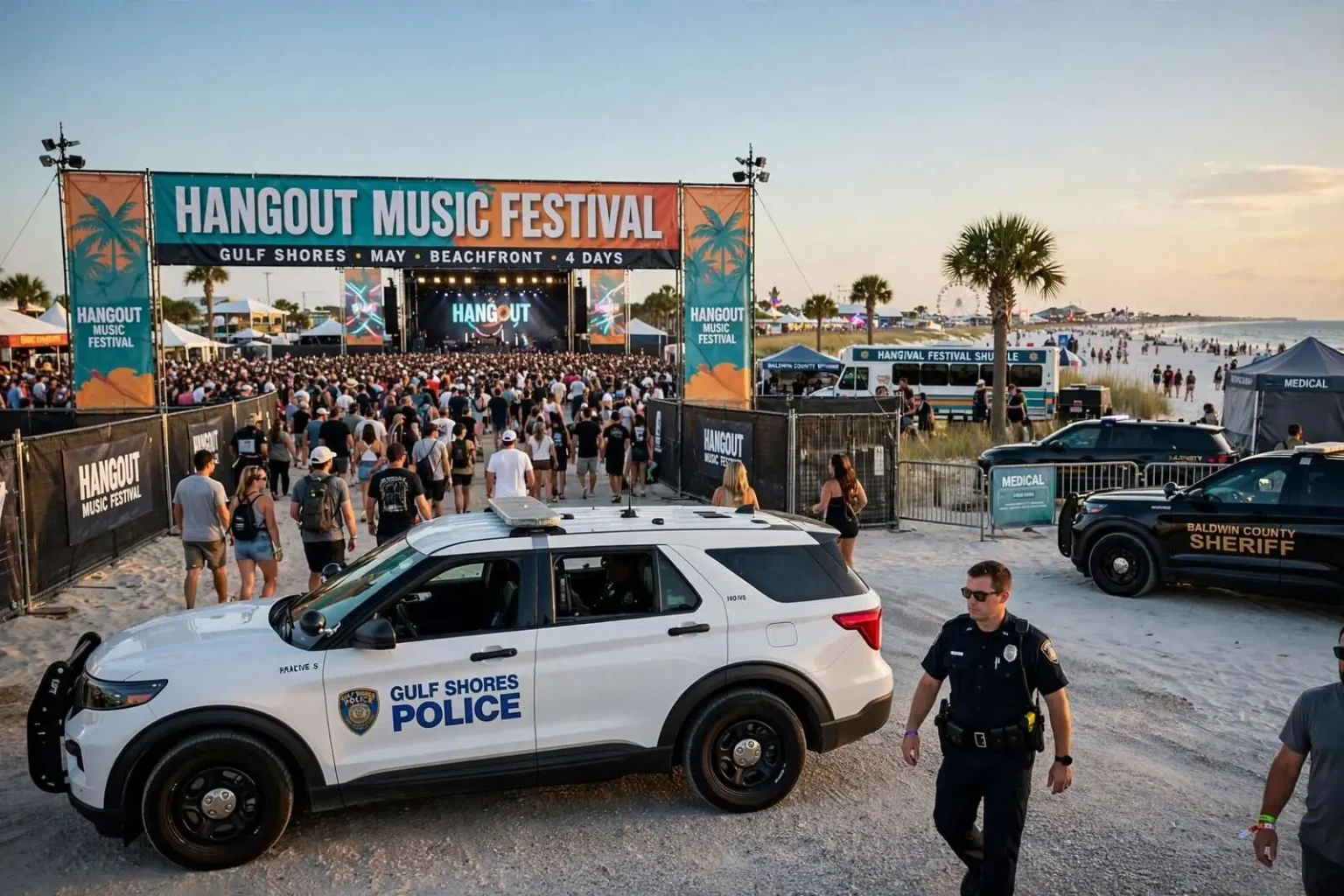
Local law enforcement agencies made 113 individual arrests and filed 126 criminal charges over the four-day run of this year’s Hangout Music Festival in Gulf Shores, according to statistics compiled by the Gulf Shores Police Department. The numbers, released in a detailed breakdown after the festival ended, offer the clearest picture yet of the law enforcement workload that descends on this beachfront city each spring when tens of thousands of music fans arrive for one of the Gulf Coast’s signature events.
The figures represent a sharp increase from the previous year, when Gulf Shores police reported 32 individual arrests and the Baldwin County Sheriff’s Office charged an additional 33 people at the beachfront venue, meaning this year’s combined total roughly doubled prior numbers. The jump naturally raises questions about whether the festival crowd changed, whether enforcement changed, or both, and it is a question police officials themselves acknowledge will factor into planning for future editions of the event.
The largest single category of arrests involved unlawful possession of a controlled substance, accounting for 39 bookings, followed by public intoxication with 32 arrests. Those two categories together accounted for well over half of all arrests, a pattern that matches what law enforcement sees at major music festivals nationwide, where the combination of dense crowds, young attendees and multi-day beachside partying produces a predictable profile of offenses.
Other charges included 13 counts of second-degree marijuana possession, six counts of drug paraphernalia possession and 11 arrests for minors in possession of alcohol. The number of minors in possession arrests reflects the age skew of the festival crowd, which draws heavily from college campuses across the Southeast each May, and Alabama law leaves officers little discretion when underage festivalgoers are found with alcohol in hand.
The public intoxication and controlled substance numbers also illustrate the difference between festival policing and everyday patrol work in a city Gulf Shores’ size. During a normal week, the department’s arrests are spread across residents and visitors in roughly the pattern of any beach town, but during festival week the venue itself concentrates tens of thousands of young visitors into a few fenced acres, and the arrest statistics for those four days can rival a month of ordinary activity elsewhere in the city.
The Smaller, More Serious Charges
A full breakdown released by police also included a smaller number of more serious charges: one count of carrying a pistol without a license, one count of third-degree domestic violence, one count of second-degree theft of property, one count of third-degree theft of property, and one case involving the use of false identification to obstruct justice. Though each stands alone in the statistics, charges like these represent the kind of incidents that demand the most from officers working a festival, where an arrest in a dense crowd can quickly pull half a dozen officers away from their posts.
Additional charges covered resisting arrest, disorderly conduct, criminal littering, leaving the scene of a traffic accident, and outstanding warrants or failures to appear in court. The warrant arrests illustrate a quieter function of festival policing: with so many people passing through a compact venue, officers routinely detain people wanted elsewhere in Alabama and beyond, and the festival becomes an unexpected clearinghouse for outstanding cases.
Two people were also cited for operating a business without a license, and two others for sleeping in a vehicle, both city ordinance violations. Those citations might sound minor against a backdrop of drug arrests, but they point to the range of municipal rules that come into play when a city’s public beach becomes, for four days, one of the busiest entertainment venues in the state.
The ordinance citations for unlicensed business activity and vehicle camping are, in their way, a sign of the festival’s drawing power. Every large event attracts vendors who arrive hoping to sell outside the gates and travelers who try to sleep in their cars to avoid lodging costs, and Gulf Shores’ codes exist largely to manage exactly that pressure. Enforcement in those categories stays light relative to the crowd, which officials cite as evidence that the city’s approach relies more on order maintenance than heavy-handed policing.
A Smooth Event Despite the Numbers
Despite the higher arrest total, a Gulf Shores police spokesman said the event ran smoothly overall, crediting improvements made since the festival’s launch in 2010. That experience gap matters. The first Hangout festivals strained a police department that had never handled an event of that scale, and each year since has produced refinements in everything from officer staffing plans to the physical layout of the venue’s entrances and perimeter.
He said the city and the Baldwin County Sheriff’s Office streamlined the onsite booking process this year, which helped agencies process the larger number of arrests without major disruption. Onsite booking is one of the invisible logistics that make or break a festival’s security operation. Without an efficient process close to the venue, every arrest means a deputy or officer is off the festival grounds for hours transporting a prisoner, and a spike in arrests can quietly strip the event of its coverage. Processing arrests on or near the site keeps the arrest and the paperwork within a short cycle.
The sheriff’s office role deserves particular note for a county operation. The Baldwin County Sheriff’s Office covers one of the largest counties by area in Alabama, stretching from the Mobile Bay shore to the Florida line, and dedicating personnel to a single municipal event for four days requires the kind of interagency agreement that has taken years to refine. Officials on both sides describe the relationship as essential to the festival’s operation, and the streamlined booking process this year was a joint product of the two agencies.
Traffic flow around the venue was also described as notably improved, with officials pointing to the festival’s shuttle system as a key factor in easing congestion during the multi-day event. Traffic is the complaint Gulf Shores residents raise most consistently during festival week, when the streets around the public beach, normally manageable, absorb an influx of vehicles that can overwhelm a city of Gulf Shores’ size. Shuttle systems that move attendees from remote lots have become standard practice for beach festivals for exactly that reason.
The Scale of the Undertaking
The Hangout Music Festival draws tens of thousands of visitors to the Gulf Shores public beach each spring, making it one of the largest annual events on the Alabama Gulf Coast and a significant undertaking for local police, fire and emergency services. The festival transformed Gulf Shores’ national profile when it launched, putting the city’s white sand beaches in front of a young audience that tourism officials across the state had spent years trying to reach, and hoteliers and restaurant owners along the beach highway plan their springs around the revenue it brings.
Coordinating security, medical response and crowd management across the four-day event requires cooperation between multiple agencies, including city police, the county sheriff’s office and festival organizers. The division of labor between the Gulf Shores Police Department and the Baldwin County Sheriff’s Office has evolved with the festival itself, with deputies supplementing city officers inside the venue and handling support functions that range from transport to beach patrol. Private security hired by the festival handles entry screening, leaving sworn officers to handle the situations that require arrest powers.
Medical planning is a parallel operation that rarely makes headlines but matters enormously at an event of this kind. Multi-day beach festivals in the Southern heat generate a steady stream of heat exhaustion cases, minor injuries and occasional emergencies, and the festival’s medical tents, staffed to treat attendees on site, keep the vast majority of those cases from ever reaching a hospital or a police report.
What the Numbers Mean Going Forward
Officials did not indicate any major policy changes planned for future festivals, though the year-over-year jump in arrest numbers is likely to factor into planning discussions ahead of next year’s event as the festival continues to grow in size and attendance. The comparison between this year’s 113 arrests and last year’s combined 65 will draw scrutiny precisely because the festival’s attendance and enforcement methods have both been evolving, and city officials have historically used each year’s after-action review to adjust staffing for the next.
For the city’s permanent residents, the festival’s footprint extends beyond arrest statistics into the rhythms of the week itself. Streets near the beach change character, some residents plan their own getaways during festival days, and businesses outside the tourism core adjust hours around the influx. City officials have generally balanced those disruptions against the event’s economic weight, which tourism leaders rank among the most significant single weekends of the Gulf Shores calendar.
There is also a question of perspective in how the numbers read. A four-day festival drawing tens of thousands of people will produce arrests in any city that hosts it, and a per-attendee view of the statistics tells a less alarming story than the raw totals. Police officials in Gulf Shores have generally framed their festival statistics that way, emphasizing that the overwhelming majority of attendees never come into contact with an officer and that the event’s serious incidents remain rare given the scale of the crowds.
For now, the breakdown stands as both a scorecard and a planning document, the kind of data that a maturing event accumulates as it grows. The Hangout Music Festival has become part of the rhythm of the Alabama Gulf Coast’s year, and the work of the officers and deputies who police it, measured in numbers like these, is a large part of what keeps it that way.