Mobile BayBears Offering Free Grandstand Tickets for Canned Food Donations
Mobile BayBears fans can trade two non-perishable food items for a free grandstand ticket at select home games benefiting the Bay Area Food Bank.
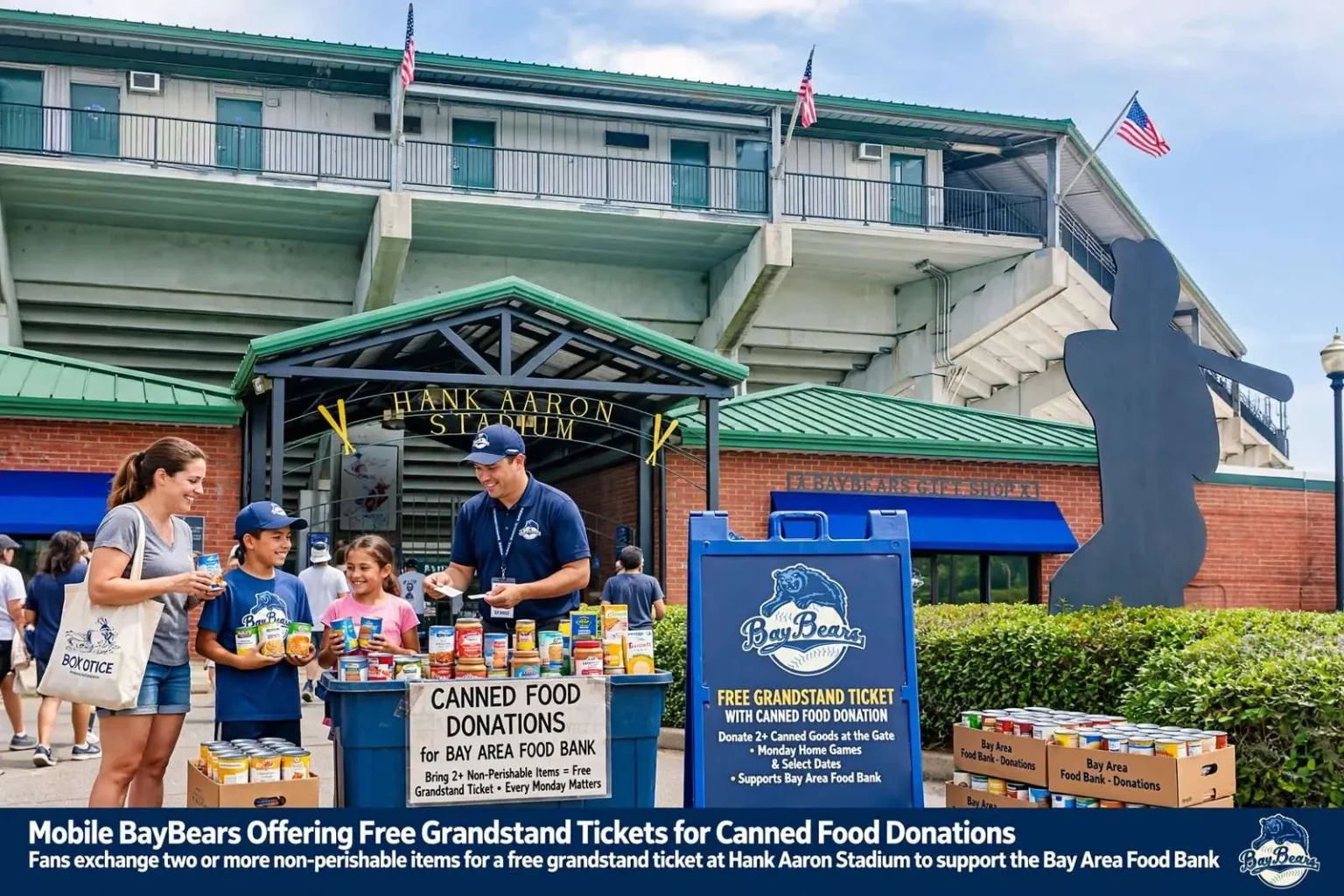
Baseball fans looking for a free night out at Hank Aaron Stadium have a way to catch a Mobile BayBears game without paying for a ticket this season, as long as they are willing to bring along a couple of cans of food. The exchange — groceries for grandstand seating — is one of the longest-running community promotions on the BayBears’ calendar, and it turns an ordinary weeknight ballgame into a fundraiser for the region’s food bank.
Under the team’s ongoing promotion, fans who bring in two or more non-perishable food items to select home games receive a free grandstand ticket in exchange. The mechanics are deliberately simple: no advance registration, no coupon, no minimum purchase. A fan who shows up at the gate with a couple of cans walks through with a ticket, and the stadium’s box office staff handle the exchange as part of regular admissions.
All of the donated food is given to the Bay Area Food Bank, which distributes non-perishables to families across the tri-state region spanning parts of Alabama, Mississippi and Florida. The food bank’s service territory covers some of the most food-insecure counties on the Gulf Coast, and donations of shelf-stable goods — canned vegetables, peanut butter, pasta, rice — form the backbone of what it hands out through pantries and partner agencies.
The promotion is tied to the team’s recurring “Every Monday Matters” event, which has become a fixture of the BayBears’ home schedule at Hank Aaron Stadium. Monday games are traditionally the quietest night on a minor league schedule — families are recovering from the weekend and the workweek is just beginning — and the team has built the theme night into a reason to show up anyway, pairing the food drive with the kinds of family-friendly extras that have become standard across minor league baseball.
Fans attending those games are encouraged to bring canned goods directly to the gate in exchange for grandstand seating, with additional food-drive games scheduled throughout the season as the team continues its partnership with the regional food bank. That means the Mondays are the anchor, but not the only chances — the schedule includes other designated dates when the donation-for-ticket trade applies, spreading the collection opportunities across the spring and summer months.
Affordable baseball with a purpose
Team officials said the promotion is designed to give fans an easy way to support their community while also enjoying minor league baseball at an affordable price, particularly for families looking for low-cost entertainment options during the summer months. For a family of four, two cans each turns a night at the ballpark into a free outing — with the price of admission measured in groceries rather than dollars. The trade also gives children a direct role in giving, which is part of why the promotion has developed a following among youth groups, church groups, and school organizations looking for summer activities with a service component.
The Bay Area Food Bank, which serves communities across Mobile, Baldwin and several surrounding counties, has said food drives tied to local sporting events have become an increasingly important source of non-perishable donations, especially during warmer months when donation levels to food banks typically decline. The summer slump is a well-known pattern in food banking: holiday-season drives fill warehouse shelves in November and December, while the long stretch from May through August sees donations taper off just as children out of school lose access to school meal programs and household food budgets strain.
Against that seasonal math, a minor league team collecting cans every Monday through the summer is more significant than it might appear. A stadium promotion gathers from thousands of attendees what a traditional drop-off drive gathers from hundreds — and it does so repeatedly, on a schedule, throughout exactly the months when the food bank’s shelves need it most.
A team rooted in Mobile’s baseball tradition
The BayBears, Mobile’s longtime Double-A minor league baseball team, have hosted various community-oriented promotions at Hank Aaron Stadium over the years, ranging from military appreciation nights to youth-focused giveaways. The team arrived in Mobile in the late 1990s and has been a fixture of the Southern League since, playing its home games in the west Mobile stadium named for the city’s most famous native son.
Hank Aaron Stadium itself carries the weight of that name. Aaron, who grew up in Mobile and broke baseball’s home run record, is commemorated in the park’s design and its museum elements, and the stadium has served as more than a ballpark — it hosts community events, youth baseball, and charity gatherings throughout the year. For a team playing in Aaron’s hometown, community engagement is not an accessory to the product but a central part of it.
Minor league baseball has long operated on a business model that treats promotions as essential rather than peripheral. Double-A clubs draw families with ticket prices far below big-league levels, and the experience — themed nights, giveaways, fireworks, and community causes — is what fills the stands on weeknights. The BayBears’ food drive fits the pattern: it costs the team nothing but tickets that might otherwise go unsold on a slow Monday, and it produces measurable benefit for a regional charity and goodwill for the club.
The canned food promotion has remained one of the more popular recurring events, giving budget-conscious families a way to attend multiple games throughout a single season without paying full ticket prices. Fans who plan around the schedule can make the food-drive Mondays a standing outing, and team officials have noted that many of the same faces return week after week with their bags of cans — a loyalty that benefits the food bank’s collections as much as the team’s turnstiles.
How to take part
Participating is as simple as the promotion’s design suggests. Fans attending a designated game bring two or more non-perishable items to the Hank Aaron Stadium box office or gate, where staff exchange them for grandstand tickets. Canned vegetables, soups, peanut butter, and other shelf-stable goods are the food bank’s priorities, and donations should be unopened and within their use-by dates — food bank partners can distribute only items that are safe and shelf-ready.
The “Every Monday Matters” theme nights pair the food drive with the rest of the weeknight program, and families planning a visit can check the BayBears’ schedule for the list of Monday games and additional food-drive dates scattered through the season. Gates open before first pitch, and arriving early both secures parking and gives families time to make the exchange before settling into the grandstand.
For the Bay Area Food Bank, each Monday’s collection feeds into a distribution network of pantries and agencies across the tri-state region — organizations that sort, shelve, and hand out what the stadium gathers in the days that follow. A single game’s haul is measured in boxes; a season’s haul is measured in pallets.
For Mobile, the promotion is a small piece of the city’s baseball tradition that works exactly as intended: a night at the ballpark that costs a family nothing but a few cans, a food bank that gets help during its leanest months, and a Double-A team that has turned its quietest night of the week into one of its most meaningful. As long as the summer schedule holds, the exchange continues at the gates of Hank Aaron Stadium — two cans, one ticket, and a community that shows up for both.
The economics of the promotion illustrate why minor league teams and food banks make such natural partners. A grandstand ticket on a Monday night has a face value, but its marginal cost to the team is close to zero — the seat would otherwise sit empty, the stadium would be no quieter, and no incremental expense is incurred when a fan redeems cans for admission. The food, meanwhile, has real value to the food bank, and the collection itself becomes part of the night’s atmosphere, with donation bins visible to every fan walking through the gates.
For sponsors, the alignment is equally clean. Local businesses that underwrite theme nights get their names attached to the community’s most visible weekly act of giving, and the food bank gets not only the cans but the publicity that drives separate donations to its own collection points. The arrangement has held together across seasons precisely because every party gives up something it values little and gains something it values more.
The seasonal rhythm matters as well. Food banks plan their inventories around the calendar, and the summer stretch — when school meal programs go dark and holiday drives are months away — is when a steady weekly source of non-perishables is most valuable. A Monday promotion produces a rhythm of collection that food bank logistics can plan around: bins from the stadium go into the distribution stream on a predictable cycle rather than arriving in one overwhelming holiday surge.
What families get out of it
For the families who take part, the promotion delivers more than savings. A minor league game is an evening designed for children — affordable concessions on theme nights, entertainment between innings, and the close-to-the-action seating that big league parks sold out decades ago. Tying that experience to a concrete act of giving gives parents an easy lesson in community participation, and many have made the Monday outings a summer routine.
Youth organizations have followed the same logic. Scout troops, church groups, and summer programs around Mobile have used the food-drive games as ready-made service activities: the group collects cans in advance, attends the game together, and sees exactly where their contribution goes. The team’s group sales staff have long accommodated such outings, and the food-drive Mondays give organizers a standing date to build around.
The grandstand seating that comes with the exchange is general admission, which suits the promotion’s family focus — groups can sit together, move around, and take in the full ballpark experience without reserved-seat pricing. Season-ticket holders and regulars know the drill, and stadium staff have the exchange process down to a matter of seconds per fan at the gate.
As the season progresses, the team’s schedule will determine how many more chances fans have to trade cans for tickets, with the food-drive dates listed alongside the rest of the promotional calendar. The BayBears’ front office has framed the promotion as open-ended — a fixture rather than a campaign — and the food bank partnership it supports has become one of the quiet successes of Mobile’s minor league tradition: two cans at a gate, every Monday that matters, all season long.