Bentley Says Money, Not Politics, Is the Real Hurdle for I-10 Bridge
Governor Robert Bentley told a Mobile business audience that funding, not regulatory approval, remains the biggest obstacle facing the long-sought I-10 bridge.
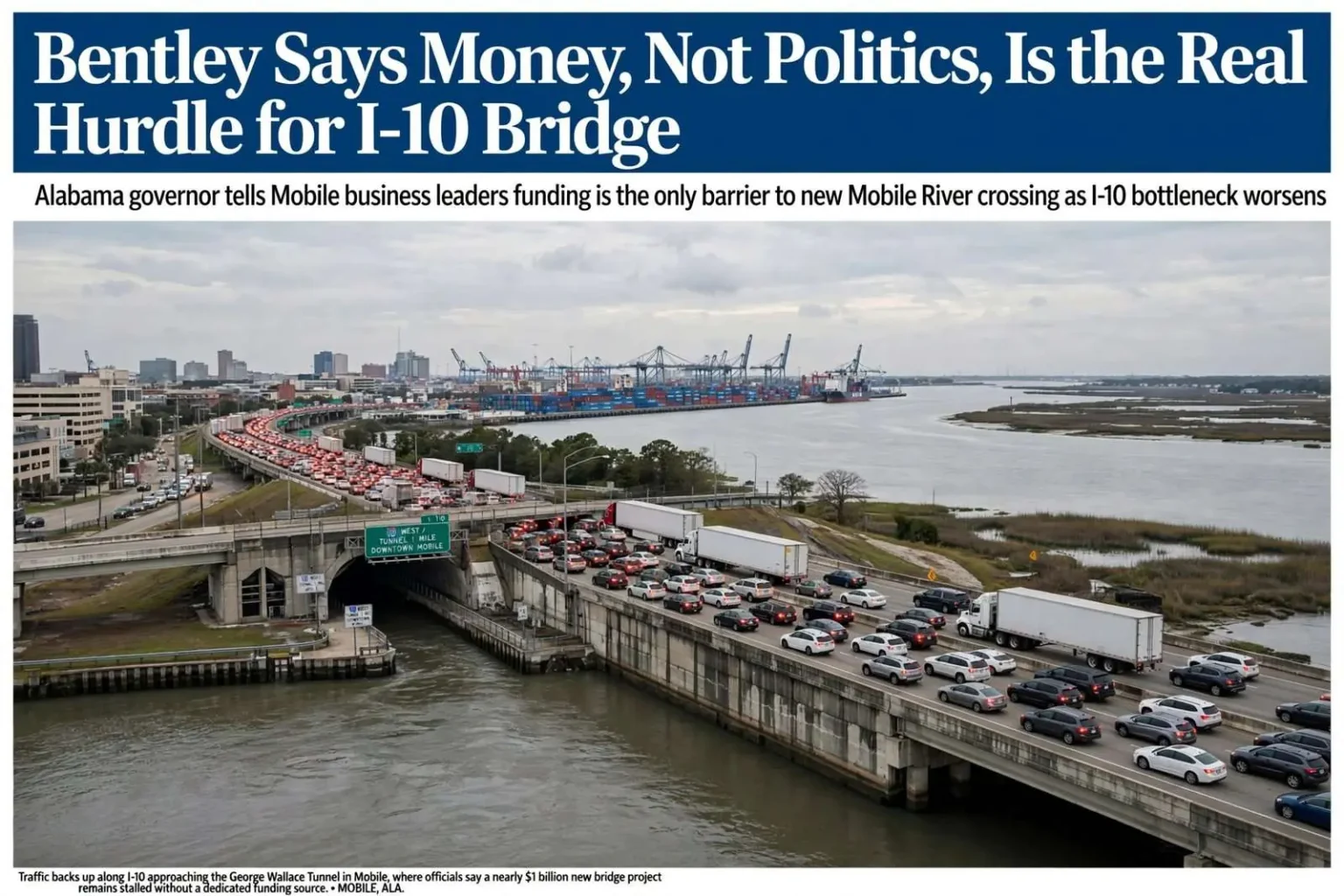
A new Interstate 10 bridge connecting Mobile and Baldwin counties has topped the wish list of local officials for well over a decade, and Alabama’s governor told a Mobile business audience this month that he intends to see it through before he leaves office. Speaking at a Mobile Area Chamber of Commerce luncheon downtown, Gov. Robert Bentley said the only thing standing between the region and a new bridge over the Mobile River would ultimately be money — not politics, not engineering, and not the regulatory process that has already consumed years of study.
“Before I leave office in four years, the only thing holding us back from doing the I-10 bridge will be money,” he told the crowd, echoing testimony he had given days earlier before a U.S. Senate committee in Washington. The double dose of advocacy — first before Congress, then before the home-state business community — marked the governor’s most direct public commitment yet to the project that local leaders have chased through successive administrations.
The luncheon crowd included many of the business and civic figures who have pressed for a new crossing since the early 2000s, when regional planning studies first identified the I-10 corridor through downtown Mobile as one of the worst bottlenecks on the Gulf Coast. For those in the room, the governor’s words offered the strongest signal to date that the state’s top officeholder shares their sense of urgency.
A Nearly Billion-Dollar Challenge
The scale of the challenge is significant. The proposed bridge has been estimated to cost nearly $1 billion, and even after clearing environmental and regulatory reviews, the project would still need a substantial state funding match to pair with whatever federal dollars materialize. No funding source — state, federal or local — has been identified that can cover the project’s full cost, which is precisely the problem Bentley’s Washington testimony was designed to address.
With the federal Highway Trust Fund running low nationally, Bentley argued that major regional projects like the Mobile River bridge should not have to compete against routine road and bridge maintenance for the same limited pool of state transportation dollars. The trust fund, financed by the federal gasoline tax, has been teetering toward insolvency for years as vehicles grow more efficient and the tax rate has remained flat, forcing Congress into repeated short-term patches that leave states unable to plan multi-year megaprojects with confidence.
Instead, Bentley floated the idea of a dedicated federal funding stream that states could apply for specifically to build projects of what he called “regional and national significance,” rather than drawing down each state’s standard transportation allocation. The concept would carve out a competitive category for spans like the Mobile River bridge — projects whose benefits reach beyond a single state’s routine network — and let them be judged on their merits rather than on a state’s share of formula funding.
He said he raised the concept directly with U.S. Sen. Barbara Boxer of California during his Senate testimony, telling her that Alabama would welcome having to compete for that kind of dedicated funding. Boxer, the senior senator from California and a key player in federal transportation legislation, had been working on the next long-term highway bill, giving Bentley’s proposal a receptive if uncertain audience. “We’re never afraid of competition,” he said he told her.
Bentley also said he wants federal transportation policy to preserve flexibility for states and avoid earmarks that lock funding to specific pet projects chosen in Washington rather than by state transportation officials. The governor’s position reflects a long-running tension in federal highway law between congressional earmarking and state-directed planning — a balance that shifted away from earmarks in recent reauthorization bills, even as overall funding has tightened.
Why the Crossing Matters So Much
For Mobile and Baldwin county leaders who have pushed for a new I-10 crossing for years to relieve congestion on the aging Bayway and George Wallace Tunnel, the governor’s comments offered a measure of reassurance that the project remains a state priority, even as the financing path forward stays uncertain. Daily traffic through the tunnels and across the Bayway has grown relentlessly with Baldwin County’s population boom, and the corridor’s design — dropping into tunnels beneath the Mobile River — leaves it unable to expand.
The George Wallace Tunnel, opened in the early 1970s, and the older Bankhead Tunnel funnel interstate traffic beneath the river in two-lane tubes that regularly back up for miles during peak hours and summer beach travel. Trucks hauling freight between the Port of Mobile and the beaches and suburbs of Baldwin County mix with commuter and tourist traffic in a corridor that engineers have long rated as functionally obsolete for an interstate mainline.
Regional business and elected officials have long argued that a new bridge is critical not just for local commuters but for freight traffic moving through the Port of Mobile and along the broader Gulf Coast corridor. I-10 is the principal east-west interstate linking Florida’s Panhandle, south Alabama, Mississippi and Louisiana, and Mobile’s river crossing is the only interstate link between Mobile and Baldwin counties — a choke point with no practical detour.
The Port of Mobile’s growth has raised the stakes further. Container terminals and bulk facilities along the river depend on trucks that must cross the bay to reach distribution centers, and port officials have warned that the tunnel bottleneck constrains the port’s ability to expand its share of Gulf shipping. A high-level bridge would allow larger vessels to pass beneath — a constraint the tunnels impose today — while clearing freight traffic from downtown streets.
Emergency planning adds another dimension. With the tunnels serving as the sole interstate evacuation route for Baldwin County’s beaches ahead of Gulf hurricanes, officials have long worried about a scenario in which the corridor’s limited capacity meets a full-scale evacuation. A new crossing would give the region redundancy it currently lacks for both everyday incidents and disaster response.
The Environmental Path and What Comes Next
Years of environmental study have already charted a preferred route for the new crossing — a bridge over the Mobile River north of downtown that would connect to rebuilt interchanges on both sides of the bay. The alignment would bypass the tunnels entirely, lifting the interstate over the working river and connecting with the Bayway approach toward the Eastern Shore. Completing the environmental review and permitting is a prerequisite for any federal construction dollars, and planners have stressed that the design work done so far positions the project to move quickly once funding is secured.
Still, Bentley acknowledged that the underlying problem for large infrastructure projects nationwide, including the Mobile River span, comes down to a shortage of new revenue for transportation funding overall. “Certainly, right now, any large project is in jeopardy because of funding,” he told reporters after his remarks — a blunt assessment of a federal program lurching from patch to patch and a state gas tax that has not been raised in more than two decades.
The governor stopped short of endorsing any specific state revenue proposal, and questions about Alabama’s own contribution to the project remain unresolved. Local officials have debated options ranging from tolling the new bridge to regional fuel taxes, but no consensus has emerged on a package that could satisfy both the funding need and a public wary of new charges on a route many commuters use daily.
Chamber leaders said the governor’s appearance helps keep the project visible at the state and federal level, which matters in a competitive funding environment. Megaprojects across the country — from Ohio River crossings to Gulf Coast corridors — are all chasing the same shrinking pool of discretionary dollars, and officials here believe that consistent advocacy from the governor’s office gives Alabama’s application a credibility it would otherwise lack.
For the residents who sit in tunnel traffic each morning and the truckers who move the Port of Mobile’s freight across the bay, the governor’s message was both encouraging and sobering: the political will is there, the engineering is well advanced, but the check has yet to be written. Bentley’s pledge that money will be the last remaining hurdle — rather than the first — gives project supporters a timeline to hold him to, and the region a reason to keep pushing for the dedicated federal stream he proposed in Washington.
History offers reason to think the persistence can pay off. Earlier generations of Mobile Bay crossings — from the Cochrane-Africatown bridge to the tunnels themselves — were each financed through combinations of state, federal and local effort that took years to assemble, and each was declared impossible until it was built. Project supporters say the Mobile River bridge now sits closer to construction than any previous attempt: a route has been chosen, environmental studies are far along, and for the first time the state’s governor is personally lobbying Congress for the funding mechanism that could finally get the span off the drawing board and into the water.