Daphne Council Tables Malbis Rezoning Request Amid Historic District Concerns
The Daphne City Council declined to vote on annexing and rezoning land near the historic Malbis district, citing the lack of a clear development plan.
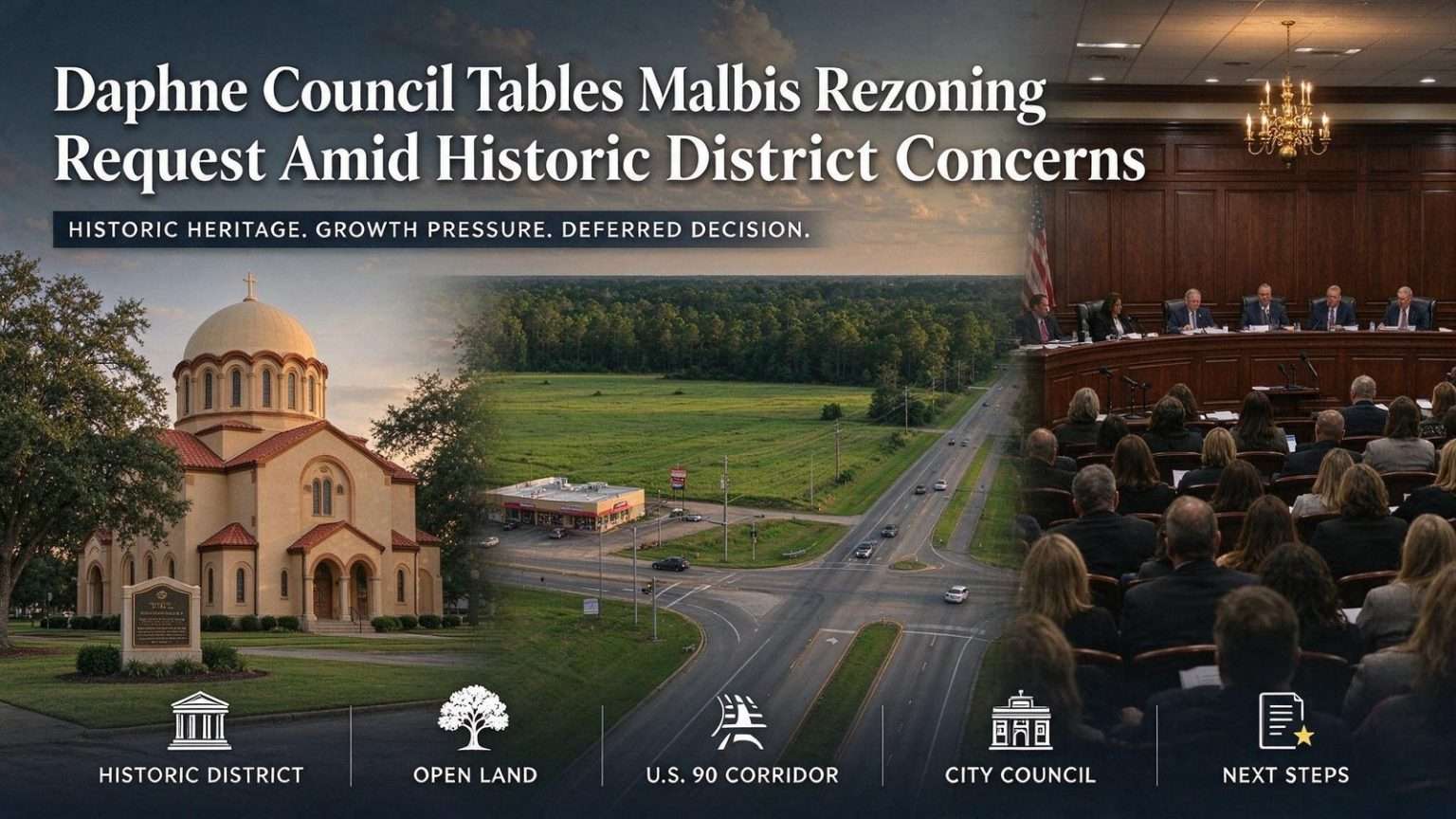
Weighing preservation of the historic Malbis district against the pressures of new development, the Daphne City Council opted not to vote on a request to annex and rezone roughly 18 acres of land near U.S. 90 and Alabama 181, effectively shelving the proposal for now. The decision, played out before a packed council chamber in the Eastern Shore city, captured a tension that has been building across Baldwin County for years: how to absorb the region’s explosive growth without erasing the historic communities that predate the subdivisions.
The request, brought by a Malbis landowner, sought to bring the vacant property from unincorporated Baldwin County into the city of Daphne and shift its zoning from single-family residential to a mix of high-density uses that would have allowed townhomes and general business development. Under Baldwin County’s zoning, the land could sit undeveloped as residential acreage; under Daphne’s commercial corridor zoning, it could become a strip of townhouse developments and retail frontage along one of the busiest crossings of the Eastern Shore.
Facing a lack of council support, the property owner’s attorney withdrew the request rather than force a vote. The withdrawal spared the council a formal defeat of the proposal but left every underlying question unanswered — and both sides acknowledged that the land’s fate, and the larger question of how Daphne treats historic Malbis, will return.
What the historic designation protects
The land currently sits within an 850-acre tract that Baldwin County commissioners designated a historic district several months earlier. That designation places any construction, demolition or major landscaping changes on the property under review by a county architectural preservation board — protections that would have disappeared had the land been annexed into Daphne without similar safeguards. The loophole at the heart of the dispute is a structural one: county historic districts do not follow property into municipalities, so an annexation can inadvertently strip away protection that took years to secure.
Preservation board review does not prohibit development; it shapes it. Proposals are examined for compatibility with the district’s historic character — scale, materials, setbacks and the treatment of old trees and landscape features — giving landowners a path to build while keeping the area’s identity intact. For the Malbis district, the review layer is the only formal protection its rural landscape and surviving historic structures have, and residents who fought for the designation made clear they do not intend to watch it evaporate parcel by parcel.
A Greek settlement’s legacy
The property traces back to the old Malbis Plantation, a roughly 10,000-acre Greek agricultural settlement established in the early 1900s that gradually declined after the Great Depression, with descendants eventually selling off much of the land. The colony’s founders built one of the most distinctive communities on the Gulf Coast — a self-contained agricultural enterprise centered on the Byzantine-style Holy Trinity church that still stands as a landmark along U.S. 90, its onion dome visible to thousands of commuters every day.
Portions of the original plantation now make up some of Baldwin County’s most recognizable developments, while roughly 3,000 acres remain under the plantation’s control. The surviving acreage is among the largest contiguous privately held tracts on the Eastern Shore, and what happens to it will shape the character of Daphne and its neighbors for decades. Every rezoning fight at its edges is, in effect, a preview of the decisions that will govern the whole tract when development pressure eventually reaches it in full.
The hearing that filled the chamber
Nearly a dozen residents spoke at Monday’s meeting, echoing concerns raised at an earlier public hearing in January. Neighbors along a road bordering the property argued the rezoning threatened the area’s character, describing a landscape of family parcels and wooded lanes where townhouse walls and parking lots would arrive as a shock. The landowner’s attorney contended the request aligned with the city’s long-range comprehensive plan for commercial growth along the U.S. 90 corridor, pointing to the parcel’s frontage on two major roadways as exactly the kind of land Daphne’s plan envisions for business use.
A longtime resident of the area urged the council to protect what she described as one of Baldwin County’s more distinctive communities, warning that approving piecemeal rezoning requests could erode the historic character shared by several small Baldwin County communities. Her argument extended beyond Malbis — to places like the French settlements and early turpentine towns scattered across the county — and it framed the council’s dilemma as one with precedent: whatever Daphne does at the edge of Malbis will be cited in the next annexation fight, wherever it comes.
Representatives of the plantation’s governing board told the council they are working on a long-sought master development plan covering the plantation’s remaining acreage, and said they intend to coordinate with the property owner, a nearby homeowners association and the city as that plan takes shape. The pledge was the meeting’s most consequential moment: it committed the county’s largest private landholder to a public planning process rather than a series of unannounced transactions, and it gave the city a seat at the table it has never fully occupied.
Council members said they were encouraged by that commitment and indicated they would begin drafting an ordinance aimed at better coordinating historic district protections between the county and city during future annexations, citing similar concerns in other historic Baldwin County communities. Such an ordinance would close, for Daphne at least, the annexation loophole at the center of this case — and it would signal to property owners across the historic district that coming into the city no longer means leaving preservation behind. Until that law is on the books, however, the 18 acres near U.S. 90 and Alabama 181 remain as they are: county land, county protection, and a question deferred.
How annexation works — and why it matters here
Annexation is routine machinery in Baldwin County, where municipalities extend their boundaries along highway corridors year after year, but it carries consequences that go well beyond whose police department answers the phone. When land moves into a city, it takes on that city’s zoning map, building codes, property tax rates and planning staff. For a landowner, annexation is often the first step in unlocking development the county would never approve; for neighbors, it can mean the rules that protected them are suddenly up for rewrite.
Daphne has been an aggressive annexer as it has grown into one of the Eastern Shore’s dominant cities, pushing its boundaries along U.S. 98 and the I-10 corridor while its population climbed past 25,000. The city’s comprehensive plan has long designated the U.S. 90 corridor for commercial growth, and planners have historically treated the highway frontage as Daphne’s natural retail spine. What the Malbis case adds is the historic district overlay — a variable the city’s annexation playbook has rarely had to accommodate.
Baldwin County’s own planning apparatus has strengthened in response to growth, and its architectural preservation board is among the tools counties in Alabama have adopted under the state’s enabling laws for historic preservation. The board’s review authority is limited to the districts the county commission creates, which is precisely why the boundary line in this case mattered more than the zoning line: one determined whose rules applied, the other what those rules said.
Growth pressure on the Eastern Shore
The dispute is a product of demographics as much as law. Baldwin County has been among the fastest-growing counties in Alabama and the broader Gulf Coast for two decades, drawing retirees, families and workers from Mobile across the bay, and the Eastern Shore communities of Daphne, Fairhope and Spanish Fort have absorbed much of that growth. Land that was farmland a generation ago now carries subdivisions, schools and shopping centers, and the remaining open tracts — Malbis’s 3,000 acres chief among them — have become the focus of intense speculation.
Developers look at the 18 acres near U.S. 90 and Alabama 181 and see frontage on two high-traffic routes in a city with strong schools and rising home prices. Preservationists look at the same land and see the edge of a community whose Greek heritage, historic church and agricultural grid exist nowhere else in the county. The council’s decision not to vote is not a resolution of that conflict but a deferral of it, and everyone in the chamber understood that the landowner is entitled to return with a new application the moment conditions change.
What to watch next
Two threads will determine how the story unfolds. The first is the ordinance the council plans to draft coordinating county and city historic protections during annexations — a relatively technical piece of legislation with large consequences, since it would remove the incentive to annex first and strip protections later. Similar coordination ordinances in other Southern cities have taken the form of automatic recognition of county historic districts or required planning commission review mirroring the preservation board’s standards.
The second is the plantation’s master development plan, which its governing board says it will share with the property owner, the homeowners association and the city as it takes shape. If the plan is genuine — a public framework for how thousands of acres develop over decades — it could transform the episodic, parcel-by-parcel fights that have characterized Malbis’s edges into a negotiated vision with room for both preservation and growth. If it slips, the piecemeal pressure will resume, and Daphne’s council will keep facing Monday-night choices like this one, one annexation request at a time.