Baldwin County Sheriff Calls Silverhill-Area Home ‘One of the Worst’ Hoarding Cases Seen
Baldwin County deputies arrested two adults after finding a mobile home filled with garbage, fecal matter and neglected animals near Silverhill.
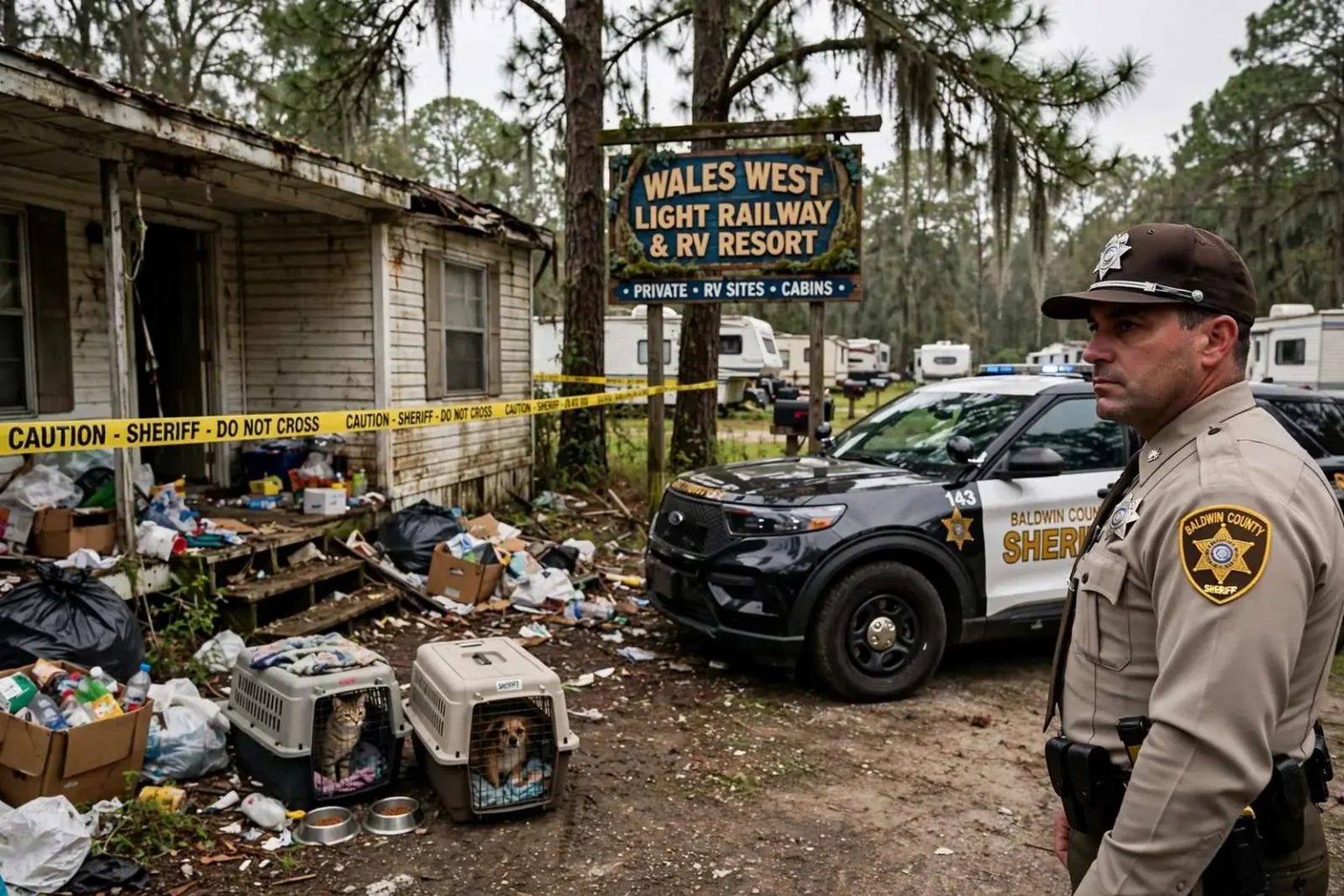
Baldwin County Sheriff’s deputies arrested two adults over the weekend after discovering what Sheriff Huey “Hoss” Mack described as one of the worst hoarding cases he has encountered in more than two decades in law enforcement, inside a mobile home near Silverhill.
Deputies found garbage and human or animal waste spread throughout the residence, located on a short side street within the Wales West Light Railway and RV Resort, a community south of Silverhill known for its mix of permanent mobile homes and seasonal RV sites popular with winter visitors. Authorities said all three people found living inside the home, including a teenage boy, had fecal matter on them when deputies arrived.
Tara Brooks and Gilmer Edwards, both 44, were booked into the Baldwin County Corrections Center on charges connected to maintaining an uninhabitable dwelling filled with garbage and waste. The jail, located in Robertsdale, serves as the county’s primary detention facility, and the charges the pair face carry potential penalties that grow with the severity of the conditions found and the welfare of any children involved.
Animals Found in Poor Condition
Investigators also found multiple animals inside the home in a malnourished state, including two dogs, a bird and more than ten cats, and said they were continuing to search the property in case additional animals were present.
The animals were removed from the residence for care, and their condition is likely to factor into the wider investigation. Baldwin County has grappled with animal neglect cases in both its rural stretches and its more densely settled communities, and the county’s animal services resources — stretched thin across a jurisdiction that spans more than 1,500 square miles — depend heavily on deputies and residents flagging trouble. Animal hoarding cases in particular tend to escalate quietly: a few pets become a dozen, waste accumulates faster than it can be managed, and the smell and noise that would alert neighbors in a city subdivision are muffled in semi-rural settings.
Sheriff Mack said the conditions inside amounted to more than a personal crisis, calling the home a community health risk given the presence of a minor alongside the accumulated waste and the number of neglected animals found on the property.
A Quiet Park, Stunned Neighbors
Neighbors in the surrounding resort community described a quiet, close-knit park where residents rarely lock their doors, and said they knew little about the couple beyond passing interactions. Several said the family largely kept to themselves despite living within easy walking distance of other homes in the park.
Wales West is one of the Eastern Shore’s more distinctive communities. Built around a Welsh-themed narrow-gauge railway that carries passengers through the woods south of Silverhill, the resort fills each winter with RV travelers — many of them retirees who migrate south along the Gulf Coast each season — alongside a smaller core of year-round residents in mobile homes. The park’s seasonal rhythm means its population swells and shrinks with the calendar, and permanent residents know one another well. That familiarity, several neighbors said, is part of what made the discovery so jarring: the family at the center of the case lived within sight of other homes, yet the severity of the conditions inside remained invisible until deputies walked through the door.
One relative who had visited the property periodically said she would sometimes encounter the teenager and his parents, who would occasionally ask for money or rides to a store, but had no indication of the severity of the conditions inside the home until deputies intervened over the weekend.
Sheriff’s officials have not released a detailed account of what prompted the weekend response, and charges in such cases can be amended or expanded as investigators complete their work. The two adults remained in custody pending initial court appearances, where bond amounts and conditions — including any restrictions on contact with the teenager or with animals — would be set by a district judge.
For the resort community around them, the arrests left questions that neighbors spent the following days discussing in the way small communities do. Park residents described seeing the family’s comings and goings over the years — the teenager growing up among them, the couple’s occasional requests for help — and expressed regret that no one had been able to reach the family before conditions deteriorated to the point that deputies had to be the ones to open the door.
Child welfare experts note that when minors are removed from hoarding environments, the recovery process is measured in months and years, not days: placement decisions, counseling, school continuity and medical care all become part of the case, handled quietly by the agencies involved. Officials declined to discuss specifics of the teenager’s situation, citing confidentiality laws that protect children in state care, and said only that his well-being would be addressed through the appropriate county agencies.
That experience, welfare advocates say, is one of the hardest truths of cases like this one. Family members and neighbors often sense that something is wrong but cannot see inside, and the shame that surrounds hoarding and self-neglect keeps those living in the conditions from asking for help. Social workers emphasize that hoarding is increasingly understood as a recognized mental health condition, and that intervention — whether through family, clergy, physicians or law enforcement — is usually the only way conditions reach the point of crisis before something worse happens.
Silverhill itself is a small town with deep roots in Baldwin County’s settlement history. Founded in the late nineteenth century and shaped by early Scandinavian and other Northern European settlers, the community spent most of a century as a quiet farming town before the county’s coastal growth wave reached it. Today it sits between Robertsdale and the booming Highway 181 corridor, its town limits small but its surroundings transformed by subdivisions, schools and the traffic that comes with them. In a town where the police department is modest and the volunteer network tight, the sheriff’s office carries most law enforcement responsibility — which is why a case of this scale in the town’s backyard lands squarely on county investigators’ desks.
The charges of maintaining an uninhabitable dwelling fall under Alabama law addressing premises kept in conditions dangerous to human life, and prosecutors weigh factors such as the presence of children, the extent of unsanitary conditions and the health of any animals when deciding how to proceed. Convictions can bring jail time, fines and court-ordered conditions, and in cases involving minors, family court proceedings can run alongside the criminal case.
Animal welfare workers who respond to hoarding cases describe a standard sequence: animals are documented and photographed for evidence, examined by a veterinarian, then transported to shelters or rescue partners where they can be nursed back to health while the criminal case proceeds. Malnourished cats and dogs from hoarding environments often recover fully with steady food and medical care, workers say, though the process can take weeks, and overcrowded county shelters rely on fosters and adopters to make room.
A Pattern Across the County
The case adds to a string of hoarding and unsafe-living-condition investigations that Baldwin County authorities have pursued in recent years, with officials continuing to stress the importance of neighbors and family members reporting signs of unsafe conditions, particularly when children may be involved.
Baldwin County’s rapid growth has reshaped how such cases surface. In the county’s small towns and rural communities — Silverhill, Summerdale, Loxley, Bay Minette and others — long-time residents once absorbed informal watchfulness over neighbors, checking on the elderly widow down the road or the family that kept to itself. As the county’s population has swelled and subdivisions have replaced farmland, that informal net has thinned, and sheriff’s officials have said repeatedly that deputy welfare checks and citizen reports now carry more of the load. Reports can be made to the sheriff’s office by phone, and officials have urged callers not to assume someone else has already called.
When a child is found in such conditions, the response moves quickly across agencies. Deputies document the scene, the county Department of Human Resources takes charge of the child’s immediate safety and placement, and health officials may become involved where sanitation is a concern. Prosecutors then review the evidence to determine what criminal charges the circumstances will support, and courts can order services, supervision or treatment as cases move forward.
Sheriff Mack has built his department’s public profile in part on urging residents to treat reporting as a civic duty rather than an intrusion, a message his office has repeated in cases involving elderly neglect, child welfare and animal cruelty alike. In a county of more than 230,000 residents spread from the Gulf beaches to the piney woods near the Florida line, deputies cannot see inside every home — and, officials note, they are rarely the first to know when something is wrong.
Further details on the investigation, including the well-being and placement of the minor found in the home, were expected to be handled through the appropriate county agencies following the arrests.