Prescribed Burn Near Oyster Bay Sends Smoke Over Gulf Shores
A planned wetland burn near Oyster Bay in Gulf Shores drew concerned calls from residents as smoke drifted over nearby subdivisions this weekend.
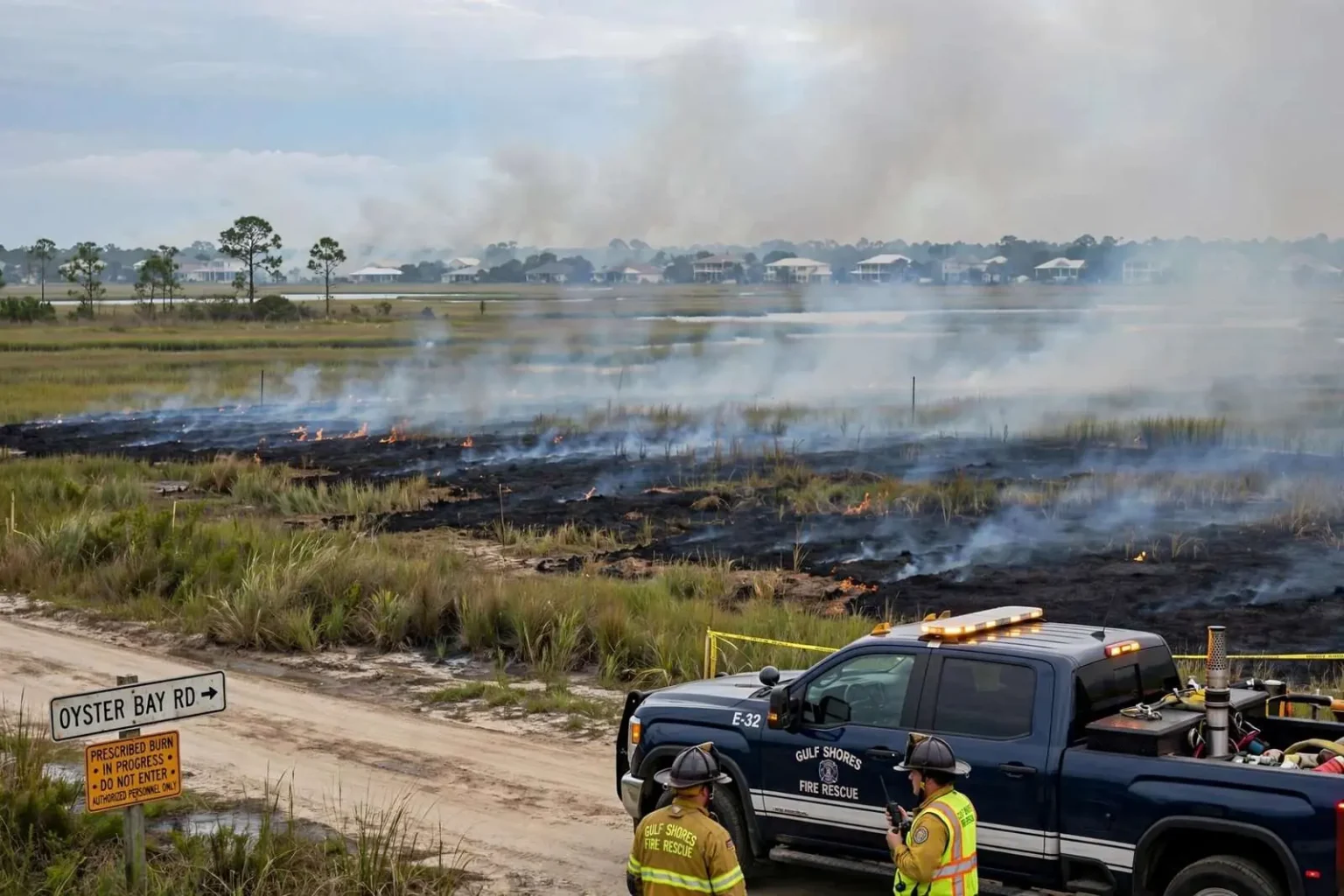
Residents across parts of Gulf Shores placed a flurry of calls to emergency dispatchers early Saturday after smoke from a planned wetland burn became visible near neighborhoods close to Oyster Bay. The controlled burn, carried out by a private land management contractor, targeted a roughly 400-acre tract of wetland north of Waterway Boulevard West and Oyster Bay Road, not far from County Road 6. Gulf Shores Fire Rescue confirmed the burn had been planned in advance and said crews were dispatched to monitor the site closely rather than to fight an unplanned fire.
The distinction between a prescribed burn and a wildfire matters greatly to fire officials, and it shaped the department’s response throughout the day. Rather than staging an aggressive attack on the flames, firefighters positioned themselves around the perimeter of the tract with a watching brief, ready to intervene only if the fire behaved in ways its planners had not anticipated. That posture reflects standard practice across coastal Alabama, where controlled burns are carried out under written plans that specify weather conditions, staffing, and equipment before a single acre is ignited.
Fire officials said the tract had been prepared ahead of time, with fire lines cut and maintained both within the burn area and around its perimeter, separating the site from the surrounding subdivisions. Fire lines are bare or closely mowed strips of ground that stop creeping flames at the edge of the burn unit, and keeping them clear is one of the most labor-intensive parts of any prescribed fire project. Even so, department officials acknowledged that neighbors bordering the property should expect to see and smell smoke, and that under certain wind conditions the flames themselves might be visible from nearby homes.
Advance notice and health precautions
Ahead of the burn, the city of Gulf Shores issued a public notice alerting residents to the planned activity, explaining that the work was intended to manage vegetation on the wetland tract and reduce the risk of larger, unplanned wildfires later in the year. Wetlands along Alabama’s coast accumulate dense growths of grasses, rushes and shrubs during wet years, and when dry spells arrive that accumulated vegetation becomes fuel. Removing it in small, supervised increments is widely regarded as far safer than allowing it to build until a summer lightning strike or stray spark touches it off.
City officials asked residents in the area to expect temporary smoke impacts and encouraged anyone with health conditions sensitive to smoke to take precautions, such as staying indoors and keeping windows closed during the most active burning periods. Smoke from prescribed burns is a particular concern for people with asthma, chronic obstructive pulmonary disease, heart conditions, and for the very young and the elderly. Public health guidance in such situations is consistent: close windows and doors, run air conditioning on recirculate if available, and avoid outdoor exertion until the smoke plume dissipates.
Fire Rescue crews remained stationed near the site throughout the day to watch for any shift in wind or unexpected spread beyond the prepared fire lines. Coastal wind patterns around Gulf Shores can shift noticeably between morning and afternoon as sea breezes develop, and burn managers typically time their ignition to take advantage of the most stable forecast conditions. Monitoring crews on the ground serve as the final safety check, able to halt operations if humidity drops, winds gust, or smoke begins to drift toward homes in an unplanned direction.
Officials said the burn was expected to be substantially completed by Sunday evening, though crews planned to continue monitoring for smoldering hot spots in the days that followed. Wetland soils and organic muck can hold heat deep underground long after visible flames disappear, and smoldering roots or stumps can reignite surface vegetation if winds pick up. That lingering phase is a routine feature of prescribed fire in wetland settings, and burn managers typically check the unit daily until they are satisfied the ground has cooled.
A routine tool on the Gulf Coast
Prescribed burns are a routine land-management tool used across coastal Alabama’s wetlands to clear undergrowth, encourage native plant regrowth and reduce the fuel available for accidental wildfires during drier months. Land managers in the region point out that many of the Gulf Coast’s signature natural communities, from longleaf pine savannas to wet prairie marshes, evolved alongside frequent natural fire and depend on periodic burning to stay healthy. Without it, woody brush crowds out the grasses and wildflowers that wildlife such as wading birds, marsh rabbits and pollinators rely on.
The practice also carries economic weight in Baldwin County and across south Alabama. Wildfires that start in overgrown vegetation near subdivisions can threaten dozens of homes at once, and fighting them costs far more than preventing them. Insurance and forestry officials have repeatedly emphasized that communities interspersed with wildland, sometimes called the wildland-urban interface, benefit directly from landowners who keep nearby tracts burned and maintained.
While prescribed burns are planned and supervised, sudden increases in visible smoke can still alarm nearby residents unfamiliar with the schedule, which is why local fire officials emphasize advance public notices before large burns take place. A tall column of smoke rising over a familiar marsh can look, from a distance, exactly like a structure fire or a wildfire, and dispatch centers in coastal Baldwin County routinely field calls asking whether a neighborhood is in danger. Public notices, road signs and social media alerts are the tools agencies use to cut down on those false alarms and free dispatchers for genuine emergencies.
Under Alabama law, landowners and contractors conducting prescribed burns must follow state standards covering notification, staffing and weather, and certified burn managers are trained to document conditions before, during and after each burn. The state framework is designed to make burning safer and more predictable while still allowing the practice that ecologists consider essential to the health of Southern landscapes. Violations can bring civil liability, which gives contractors a strong incentive to err on the side of caution.
Coordination kept the operation safe
No injuries or property damage were reported in connection with the burn, and Gulf Shores officials said the coordination between the county, the fire department and the private contractor allowed the operation to proceed safely despite its proximity to residential areas. The tract sits in a part of the city where residential subdivisions press close to undeveloped wetland, a layout common along Alabama’s coast, and that proximity is precisely why so much preparation went into the project.
Residents who noticed the smoke were reminded that questions about planned burns in Gulf Shores can be directed to city hall or Fire Rescue headquarters, and that callers who see smoke should report its location and any visible flames but need not assume an emergency when a burn has been publicly announced. Officials also asked neighbors to avoid drone flights or sightseeing near active burn areas, since low-flying aircraft and curious onlookers complicate the work of monitoring crews.
For the landowner, the weekend’s work leaves the tract in better ecological and fire-safety condition than it has been in years. Fresh growth on burned wetland typically emerges within weeks, green and dense, and the property will be safer in future dry seasons because of the fuel that went up in smoke over the weekend. For the surrounding neighborhoods, the sight and smell of smoke near Oyster Bay should now be familiar enough that the next scheduled burn draws curiosity instead of alarm, which is exactly the outcome fire officials said they hope repeated public notices will produce.
Smoke impacts from burns like this one depend heavily on atmospheric conditions on the day of ignition. Burn managers aim for what they call good dispersal, meaning enough wind movement to lift smoke away from homes rather than letting it settle in low areas overnight. Smoke that lingers in shaded, low-lying neighborhoods after sunset is one of the most common complaints associated with prescribed fire, and it is the reason many large burns near developed areas are wrapped up before late afternoon.
What residents can expect after a burn
In the days immediately following a wetland burn, residents may notice blackened ground, faint wisps of steam or thin smoke rising from the soil in the early morning, and an earthy smell after rain. Those are normal signs of a unit cooling down rather than signs of a new fire. Fire officials ask residents to report only active flames or heavy smoke, and to trust that monitoring crews are checking the site on a regular schedule until it is declared fully out.
Wildlife on the tract generally weathers the fire well. Wetland animals are adapted to move ahead of slow-moving ground fires, into burrows, open water or unburned pockets, and burns conducted in small units leave plenty of refuge habitat nearby. Within a single growing season, burned tracts typically show greener, denser regrowth than surrounding unburned land, which is one reason conservation groups in Baldwin County actively encourage the practice on private property.
The weekend operation near Oyster Bay serves as a reminder of how much behind-the-scenes work goes into keeping fire a safe tool along the coast. Between the contractor’s preparation, the city’s advance notice, and the around-the-clock presence of Gulf Shores Fire Rescue crews, a 400-acre burn beside residential streets came and went with nothing worse than a weekend of smoky skies and busy phone lines, and a wetland left healthier for the year ahead.