Monroeville Buzzes With Excitement Over Harper Lee’s Long-Awaited Second Novel
News that Harper Lee would publish a second novel sent her hometown of Monroeville into a flurry of excitement among shopkeepers and civic leaders.
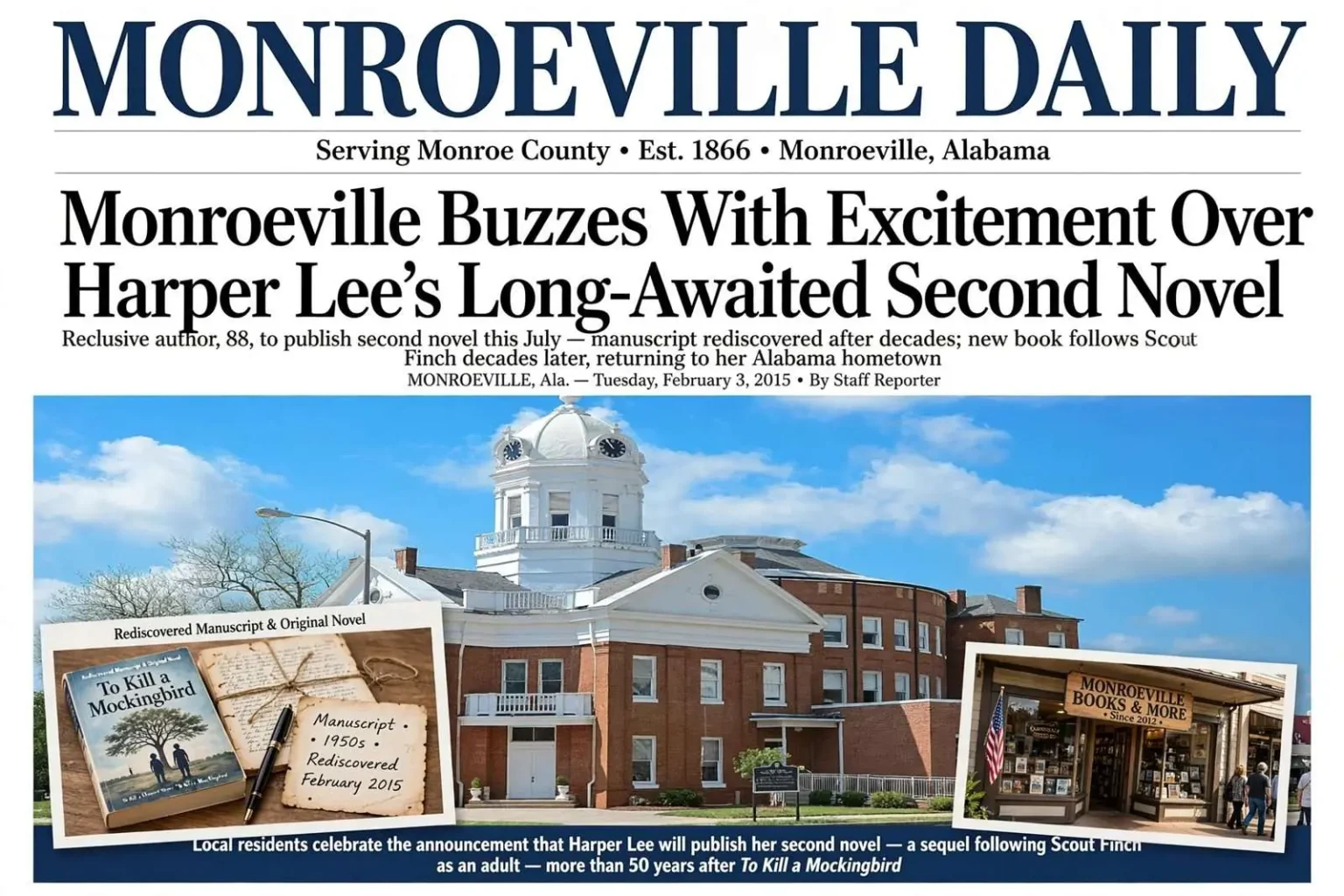
Word that reclusive author Harper Lee had written a second novel spread quickly through Monroeville on a Tuesday morning, turning an ordinary day in the small Monroe County town into a citywide celebration. Within hours of the announcement, the conversation in every shop, office and church hallway in Monroeville had turned to the same improbable news: the author whose only published book had stood alone for more than half a century was about to release another.
Lee, then 88 and known locally as “Miss Nelle,” released a statement through her publisher announcing that a new book, titled after a line from the Book of Isaiah, would arrive in bookstores that July. For a town that has long woven its identity around its most famous daughter, the announcement landed as both a publishing event and a personal one, with residents describing a mixture of astonishment and delight that the famously private writer had anything left to give the world.
The novel was written before her Pulitzer Prize-winning classic about a young girl growing up in a fictional Alabama town closely modeled on Monroeville, and until the announcement, that earlier book had remained her only published work in more than half a century. The revelation that the manuscript had survived all those years — presumed lost, then rediscovered — added a layer of literary wonder to the local excitement.
The original novel has sold tens of millions of copies worldwide and continues to move roughly a million copies a year, translated into dozens of languages. Few works of American fiction have maintained that kind of sustained audience, and few small towns anywhere can claim a book that has introduced readers on every continent to their streets, porches and courthouse square.
The newly announced book follows the same central character decades later, as she returns from New York to visit her aging father in the fictional town widely understood to be based on Monroeville. For local readers, that premise carried a particular charge: a story about coming home to Monroeville, written by the town’s most celebrated daughter, set in the very streets where they would queue to buy it.
Monroeville reacts
Local leaders reacted with a mix of surprise and pride. The head of the Monroeville/Monroe County Chamber of Commerce described the morning as a whirlwind, noting that Lee’s legacy already draws steady tourism to the small town and that a new book would likely deepen that interest. Monroeville has spent decades welcoming visitors who arrive on literary pilgrimage, and the prospect of a second book meant a second reason for them to come.
News of the announcement reached many residents informally, including the owner of a bookshop just off the town square who said her son called to tell her what he’d heard before it was confirmed publicly. That pattern — Monroeville learning its own news by phone and word of mouth — suited the story of a town where everyone seems connected by no more than a degree or two.
The store, which has operated since 2012, keeps copies of Lee’s classic in stock year-round and regularly welcomes visitors drawn by the annual stage adaptation performed in Monroeville. For local booksellers, the announcement promised the kind of season that merchants in a town of a few thousand residents rarely see: lines of customers, phones ringing with out-of-state orders and reporters seeking comment from anyone who ever crossed paths with the author.
Monroeville’s connection to its literary legacy is physical as well as sentimental. The Old Courthouse, with its iconic courtroom, draws readers year-round who want to stand in the space that inspired the novel’s most famous scenes, and the annual stage production fills seats each spring with audiences from across the country and beyond.
A private life in a famous hometown
Lee, who had lived for years splitting time between New York and Monroeville, was residing in an assisted living facility in her hometown at the time of the announcement. Her privacy was legendary — no interviews, no book tours, no public appearances — which made the statement released through her publisher all the more remarkable, and all the more closely parsed for what it revealed about her state of mind.
The news came several months after her older sister and longtime attorney, who had shielded Lee from unwanted attention for decades, passed away. Alice Lee, herself a lawyer of distinction in Monroeville, had handled her sister’s affairs and stood as the gatekeeper who kept the author’s world quiet, and her death had raised questions about who would protect that privacy going forward.
That history of protection shaped how the announcement was received. Readers who loved the first book had waited a lifetime for anything more from its author, and the sudden appearance of a full manuscript — written decades earlier, released as their author neared 90 — prompted both celebration and gentle debate among the town’s book clubs and porches about how the book had surfaced and what Lee herself wanted.
What the book means for the town’s future
For Monroeville, the practical implications reach across the local economy. The town has built a modest but steady tourism trade on its literary heritage — the courthouse museum, the play, the guided walks past Lee’s childhood homes and the homes of her childhood friend who became the model for the story’s most famous character. A second book doubles the story a visitor can come to see, and shop owners along the square understood immediately what that could mean for a town with few other industries drawing outsiders in.
Local educators also saw opportunity in the moment. Students in Monroe County grow up with the first novel on their classroom shelves, taught not just as American literature but as hometown history, and a second book promised a new chapter for that curriculum — a chance to study an author’s earliest work alongside her classic and to see how a writer’s vision of her town evolved over decades.
Booksellers nationwide anticipated the July release would become an event on the scale of the original publication, with first-printing copies destined to become keepsakes. In Monroeville, the local bookshop planned for a demand far beyond anything the square had seen, mindful that collectors, tourists and lifelong residents would all want the same thing: a copy of the town’s second novel, bought where the story was set.
For the author herself, the town’s hope was simple. Monroeville residents who know “Miss Nelle” as a neighbor rather than a legend expressed a wish, repeated across town that day: that the book would be good, that it would be hers, and that the world would read it with the same care it had shown her first — and only — one for all those years.
The story of the manuscript
The rediscovery of the manuscript added its own drama to the announcement. According to the account released alongside the news, the second novel was thought lost for decades until it surfaced in a secure location connected to the files for the original book, a find that stunned even longtime observers of the author’s affairs. When her publisher and representatives examined the pages, they found a complete novel, written in the author’s youth, telling the story readers had always wondered about: what became of Scout Finch after she grew up.
The decision to publish the book as written — without revising it into a contemporary style — shaped the conversation about the novel from the moment it was announced. Scholars noted that readers would be seeing the work of a young writer finding her voice, decades before the polish of the book that made her famous, and that the two novels together would form something rare in American letters: a before-and-after portrait of a masterpiece from the same hand.
For the character at the center of both books, the new novel meant a very different story than the one generations of readers knew. The beloved childhood world of the first book — a child’s summer, a mysterious neighbor, a trial that split a town — gives way in the second to the concerns of middle age: career, family obligation, the revisit of old assumptions, and a father seen through adult eyes rather than a child’s adoring ones.
A reading nation turns to Alabama
The announcement rippled far beyond Monroe County, dominating literary news across the country within hours. Book clubs, teachers and readers who had grown up on the first novel began revisiting it in anticipation, and Alabama’s own bookstores and libraries reported renewed interest in the author’s single, towering entry in the American canon.
In the state’s literary circles, the moment prompted reflection on Alabama’s place in American letters. The state that produced the century’s most beloved novel about conscience and childhood had, in the public imagination, produced it almost alone — one book, one author, one small town. The prospect of a second book promised to renew that legacy while raising its profile among readers too young to remember when the first one was news.
Back in Monroeville, the practical excitement of the morning — phones ringing, reporters arriving, plans forming — settled by afternoon into something quieter and more characteristic of the town: pride, protectiveness and patience. The town had waited more than fifty years once before. A few more months until July, residents agreed, was a wait they could manage.