A judge's gavel resting on a wooden bench in a courtroomA Clarke County circuit judge declined to postpone an arraignment in an attempted murder case.

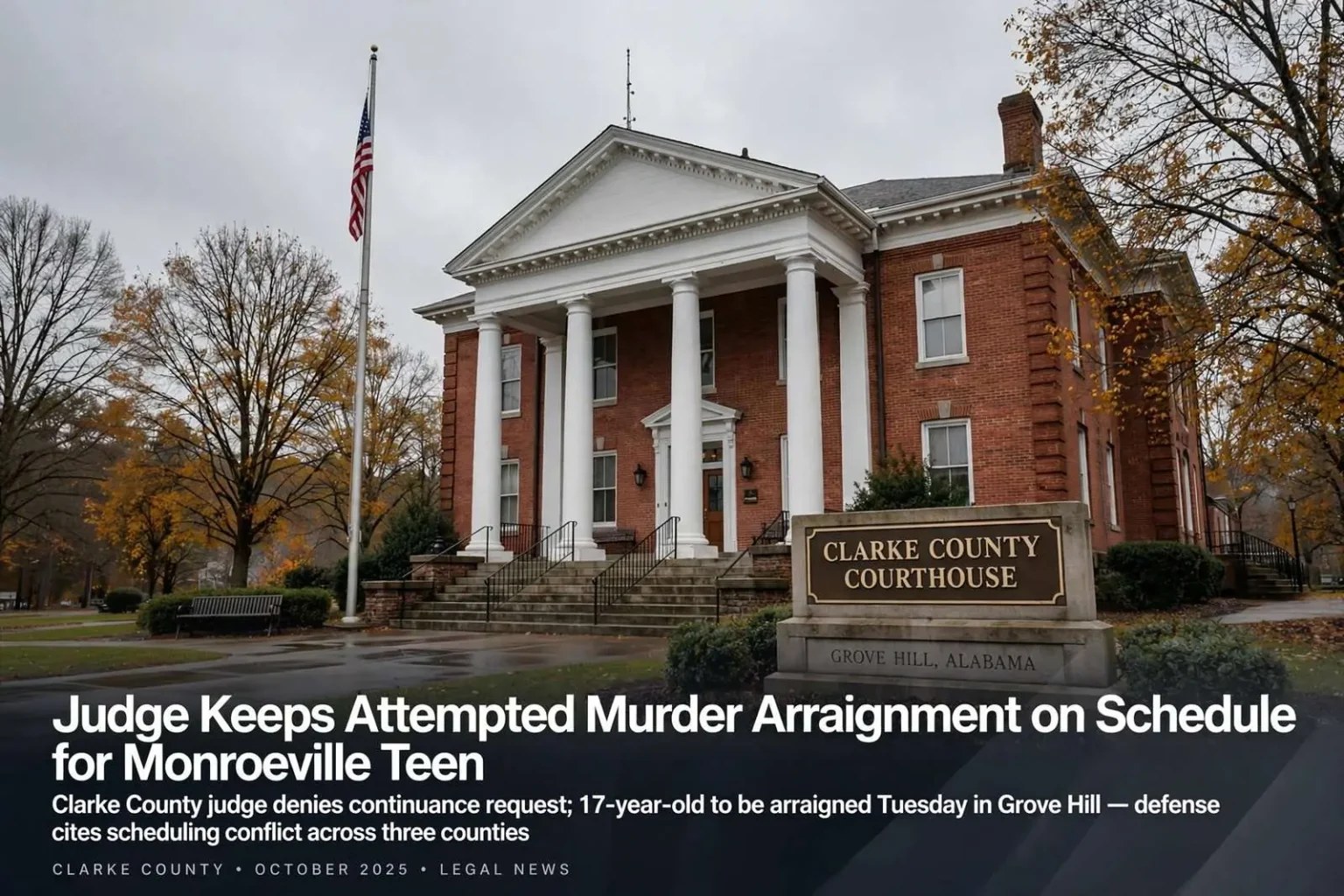
A Clarke County circuit judge has refused to push back the arraignment of a Monroeville teenager facing a serious slate of felony charges, keeping the case on its original schedule despite a defense attorney’s argument that he could not be in three counties at once. The Ruling Circuit Judge J. Perry Newton denied a motion filed by defense attorney W. Robert McMillan seeking to continue Tuesday’s arraignment of Calvin Fitzgerald Rankins III, 17, of Monroeville. The order was entered on a Sunday, and the arraignment remained on the calendar for Tuesday morning in Clarke County Circuit Court in Grove Hill.

McMillan told the court he faced an unavoidable scheduling conflict. He was set to appear at an election contest hearing in Wilcox County at 10:30 a.m. the same day, while also carrying multiple court settings at 9 a.m. in Monroe, Clarke and Conecuh counties. He argued that the continuance was necessary to provide effective representation and to avoid prejudice to his client, and stated plainly that the request was not made for purposes of delay.

Judge Newton was unpersuaded and denied the motion. The Charges Rankins was indicted by a Clarke County grand jury during its spring 2026 term. The indictments allege a series of offenses stemming from an incident in the fall of 2025.

The first indictment charges:

Attempted murder – prosecutors allege Rankins attempted to kill a juvenile victim, identified in court records only by the initials A.J., by shooting him with a firearm on Sept. 28, 2025. First-degree assault – alleging he caused serious physical injury to the victim with a .22-caliber rifle. Unlawful distribution of a controlled substance – alleging he unlawfully distributed marijuana to the same juvenile.

A separate indictment charges first-degree robbery, alleging that Rankins attempted to steal U.S. currency from the victim while armed with a .22-caliber rifle and caused serious physical injury in the course of the robbery.

All of these remain allegations. An indictment is not a finding of guilt; it is a grand jury’s determination that there is sufficient evidence to require a defendant to answer the charges in open court. Rankins is presumed innocent unless and until proven guilty. Custody Status Rankins is currently free on a $100,000 bond that carries a court-ordered cash component, and he is subject to electronic ankle monitoring while awaiting trial, according to court records.

Bond conditions of this kind reflect a court’s effort to balance the presumption of innocence against public safety and the risk of flight. A cash component means a defendant or family cannot satisfy the bond solely through a surety company’s pledge; real money must be posted. Electronic monitoring allows the court to track compliance with conditions such as curfews or exclusion zones. Understanding the Process An arraignment is the procedural hearing at which a defendant is formally advised of the charges and enters a plea. It is typically brief, but it sets the trial track in motion – scheduling orders, discovery deadlines and pretrial motions all flow from it. Delaying an arraignment therefore delays everything downstream, which is one reason judges scrutinize continuance requests carefully, particularly in violent-crime cases.

See also  Boardwalk Bistro and Studio Opens in Downtown Brewton

Scheduling conflicts of the sort described in McMillan’s motion are a genuine feature of rural legal practice in South Alabama. A single defense attorney may carry an active docket spanning several counties within the same judicial circuit and beyond, and Alabama’s circuit courts frequently hold competing settings on the same morning. Judges nonetheless retain broad discretion over their own calendars, and a conflict alone does not entitle a party to a delay. Charging a 17-Year-Old as an Adult That a 17-year-old was indicted by a grand jury and is appearing in circuit court rather than juvenile court reflects Alabama law, under which certain serious offenses committed by older juveniles – attempted murder and first-degree robbery among them – may be pursued in adult court. The consequences of conviction in circuit court are substantially more severe than any disposition available in the juvenile system.

Details of Tuesday’s arraignment hearing were not immediately available. The Regional Legal Landscape The setting of the case, in Clarke County Circuit Court at Grove Hill, reflects the way Alabama organizes its judiciary. Circuit courts handle felony prosecutions and major civil matters, and in much of south Alabama a single circuit spans multiple counties, with the court rotating among county seats. That structure is efficient for the state but, as the continuance motion illustrates, it can place heavy demands on the attorneys who must appear in different courthouses on the same day.

For residents of Monroe and Clarke counties, cases of this seriousness are rare enough to draw attention, yet the underlying legal mechanics – the grand jury, the arraignment, the bond, the presumption of innocence – are the same protections that apply in every Alabama felony prosecution. The judge’s decision to keep the arraignment on schedule is a routine exercise of judicial discretion, even when the underlying allegations are anything but routine. What the Public Should Keep in Mind Because the charges are serious and the defendant is a juvenile charged as an adult, the case will be watched closely in Monroeville and Grove Hill. It is important to recall at every stage that the indictments are allegations. The arraignment resolves none of the facts; it begins the formal process by which those facts will eventually be tested in court. Until a plea or a verdict, the presumption of innocence governs.

See also  State Report Card Grades Return for Alabama School Districts After Three-Year Pause

For the court system, the episode is a reminder of the logistical tightrope that rural Alabama practitioners navigate, and of the discretion judges exercise to keep cases moving without sacrificing a defendant’s right to meaningful representation. How those tensions resolve in this case will unfold in the months ahead, starting with the arraignment the judge refused to delay. The Stakes for the Community Beyond the procedural questions, the allegations in this case touch on concerns that weigh heavily on small communities: the safety of young people, the presence of firearms in disputes, and the distribution of controlled substances to minors. Residents of Monroeville and Grove Hill will follow the proceedings not as abstraction but as a local matter involving people and places they know. The court’s task, under the law, is to adjudicate the charges on the evidence presented, while the presumption of innocence ensures that no judgment is rendered until the process is complete. That balance between community concern and individual rights is the foundation on which the entire case will proceed.

Monroeville, the seat of Monroe County in southwest Alabama, is best known outside the region as the childhood home of novelist Harper Lee and the model for the fictional Maycomb in To Kill a Mockingbird. The town has a population of roughly 6,000 and serves as the commercial center for the surrounding agricultural county.

Monroe County Circuit Court, which handles serious felony cases in the county, sits in the Monroe County Courthouse, a building that became famous through the filming of the 1962 movie adaptation of To Kill a Mockingbird. The courthouse is still in active use, and the county’s court system continues to operate in much the same configuration it has for decades.

See also  Mobile Native Vivian Malone Jones Remembered as a Civil Rights Pioneer

Cases involving juveniles are typically handled through procedures that protect the minor’s identity. The arraignment stage is the first formal court appearance after charges are filed, and the judge at that stage decides whether the case will proceed, whether bond will be set and what conditions, if any, will be attached to the minor’s release.

Local governments and community partners are working through the implications of the situation, and several follow-up meetings have been scheduled for the coming weeks. Members of the public who want to weigh in on the matter can find the meeting dates on city and county websites, and written comments can be submitted through the standard channels used by the relevant agencies. Local news outlets will continue to cover the story as it develops.

Across south Alabama, similar issues are being addressed in other communities, and the lessons learned here are likely to inform how those communities approach their own challenges. Local officials have indicated they are in regular contact with counterparts in neighboring cities and counties, and they expect to share best practices as the situation continues to evolve.

The agencies involved in the matter have committed to keeping the public informed as the work progresses, and residents who want to receive updates directly can sign up for email or text alerts through the relevant city or county websites. Local community organizations have also agreed to share information as it becomes available, and several have scheduled public forums in the coming weeks to give residents a chance to ask questions of the officials involved.

For background, readers can consult the official websites of the relevant agencies, the local newspapers that have covered the story, and the public-meeting archives that document the prior deliberations on related topics. The combination of those resources should give residents a thorough understanding of how the current situation developed and how the agencies and elected officials are approaching the decisions that remain.