University of South Alabama Mobile
Mobile Bridge Backers Push ALDOT for Faster Timeline on I-10 Span
Mobile-area bridge supporters are pushing ALDOT and federal officials to speed up planning for the $850 million I-10 bridge project.
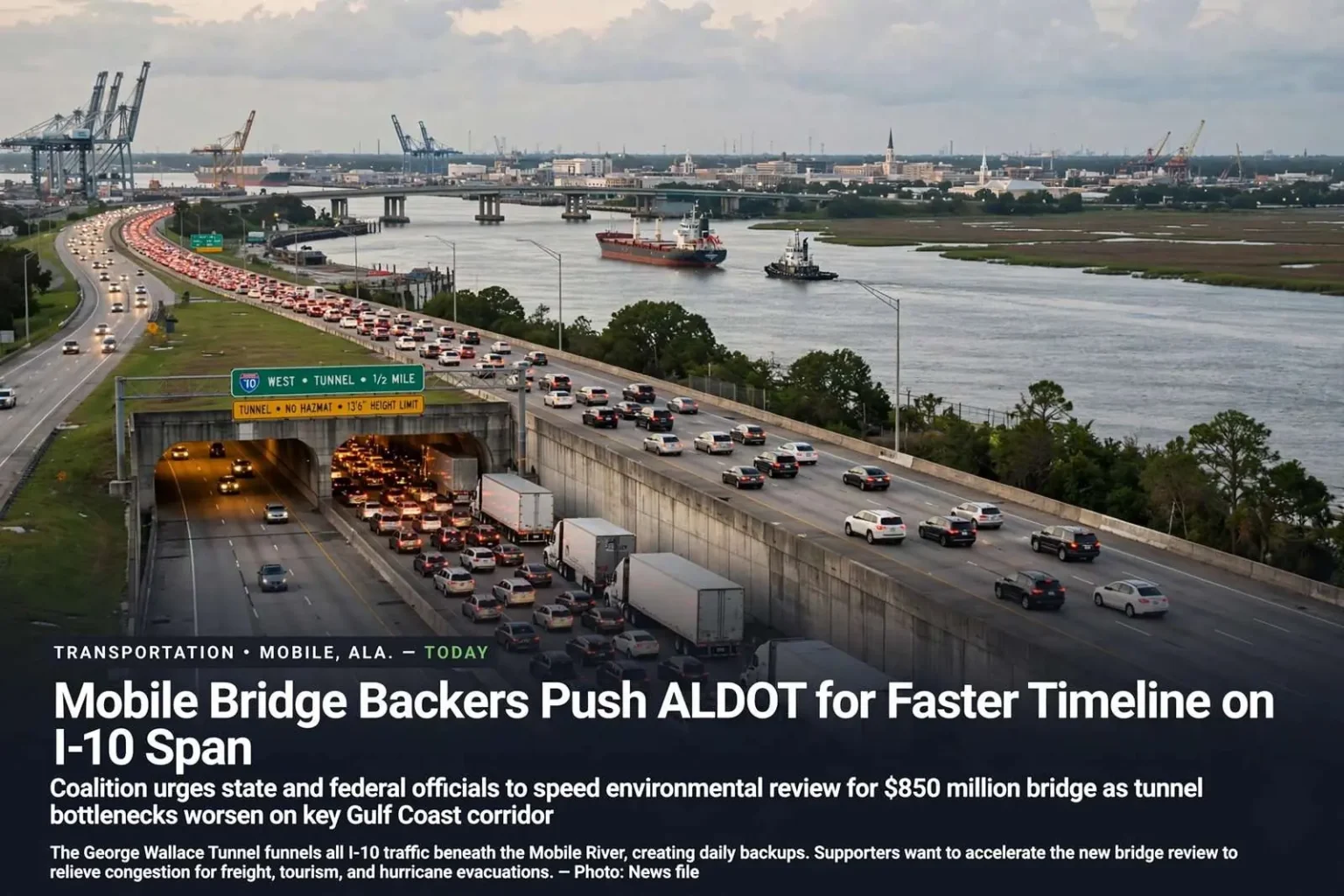
Supporters of a new Interstate 10 bridge over the Mobile River are pressing state and federal officials to speed up the planning process as the roughly $850 million project moves toward its design phase. Representatives from the Mobile Area Chamber of Commerce’s “Build the Bridge” Coalition and the Coastal Alabama Partnership say they are looking for ways around bureaucratic delays that could stretch out a project they consider a top regional priority. “We don’t have another 13 years to waste and we’ll be in a big bind here if we’re talking about it in 13 years,” said Wiley Blankenship, president and CEO of the Coastal Alabama Partnership. Mike Lee, the coalition’s chairman, echoed that urgency, saying the group’s focus is on “keeping the process moving.”
The urgency is rooted in one of the region’s most familiar frustrations. Interstate 10 — the primary east-west freight corridor along the Gulf Coast — crosses the Mobile River through the George Wallace Tunnel, a mid-century structure that bottlenecks thousands of vehicles a day, from beach-bound tourists to truck traffic serving the Port of Mobile. Backups through the tunnels are a daily fact of life in downtown Mobile, and planners have warned for years that the region’s growth makes the constraint worse with each passing season.
Their comments followed an analysis released by the Alabama Department of Transportation reviewing public comments on the preliminary environmental impact statement completed last summer by the Federal Highway Administration. That analysis estimated it could take one to two years to complete a final environmental impact statement, after which the FHWA would have 90 days to issue a formal Record of Decision affirming federal support for the project and its route. Only then would the project be positioned to move into final design and, eventually, construction.
The Timeline Concern
Bridge backers say the open-ended timeline is troubling, even as they acknowledge the process involves numerous regulatory steps. “To be given ranges like that is a little disconcerting,” Blankenship said, adding that he was not criticizing ALDOT but noting construction projects routinely take longer than hoped. The concern is arithmetic: every year consumed by review pushes the eventual construction period further into the future, while traffic volumes continue to climb through tunnels that cannot be meaningfully expanded.
Lee and Blankenship said federal highway officials indicated during a September trip to Washington that the final environmental review and the Record of Decision could potentially be issued together, shaving time off the process. Such a step would not shortcut the legal requirements of the environmental review, backers said, but would eliminate the waiting period between the two milestones — the kind of administrative efficiency the coalition has been advocating for as it lobbies state and federal agencies.
Vince Calametti, chief engineer for ALDOT’s Southwest Region, said the estimated timeline is reasonable given the scope of remaining work, which includes analysis of historical properties, a secondary archaeological survey, and other environmental studies that federal law requires before a project of this scale can advance. Engineers working through a National Environmental Policy Act review of an urban river crossing must document impacts on wetlands, historic districts, neighborhoods, and water quality, and respond to every substantive concern raised in public comments before a final statement can be issued.
Why the Bridge Matters to Mobile
The proposed crossing — a bridge over the Mobile River connecting the interstate corridors on the Mobile and Eastern Shore sides of the bay — has been discussed for decades and studied in earnest for years. The existing route funnels all interstate traffic through the twin tunnels beneath the river, structures built for a volume of traffic far below what today’s port activity, tourism, and regional growth deliver. Commercial vehicles face width and height restrictions in the tunnels, hazardous cargoes are restricted, and a single incident in a tunnel can paralyze interstate travel in both directions for hours.
Business groups argue the economic case is as strong as the traffic case. The Port of Mobile has been expanding, aerospace manufacturing has taken root at Brookley, and the Eastern Shore communities of Baldwin County continue to post some of the fastest growth in Alabama. All of that growth depends on a river crossing that planning studies have repeatedly identified as a constraint on the regional economy. The Build the Bridge Coalition, organized through the Mobile Area Chamber of Commerce, has united chambers, local governments, and business leaders on both sides of Mobile Bay behind the push, a level of consensus that regional projects rarely achieve.
The Environmental Review Gauntlet
The road to construction runs through the preliminary and final environmental impact statements required under federal law for major highway projects with significant impacts. The preliminary statement completed last summer described the proposed route and its effects and opened the formal public comment period; the review of those comments released by ALDOT sorts through what residents, agencies, and organizations had to say. Comments on projects of this kind typically address alignments, effects on historic neighborhoods, access changes, noise, wetlands, and how the project would be paid for, and each substantive issue must be addressed in the final document.
Only after the Federal Highway Administration signs the Record of Decision can the project proceed to right-of-way acquisition and final design. The 90-day window FHWA has for that decision after the final statement is standard, but bridge supporters note that the interval between the two documents — estimated at one to two years — is the part most susceptible to stretching. Their pitch to officials in Washington and Montgomery has been that anything that can be done concurrently rather than sequentially should be, without compromising the integrity of the review.
What Comes Next
ALDOT’s Southwest Region office continues its technical work on the studies Calametti outlined, and the state has committed to moving the project through the pipeline even as the broader funding picture for construction is sorted out. Major infrastructure projects of this size typically layer federal, state, and local funding, and decisions about how the bridge would be financed will shape the final schedule as much as the environmental reviews do. Project supporters say those decisions should be made with the same urgency the traffic studies demand.
For commuters, freight haulers, and tourists who sit in tunnel backups today, the debate in city offices and agency conference rooms can feel abstract. But the stakes are concrete: a project measured in hundreds of millions of dollars and years of construction, versus a crossing constraint that grows more expensive every year it goes unaddressed. Bridge backers say that trade-off is precisely why the region cannot afford to let the process drift — and why they plan to keep pressing until ground is broken.
The Tunnels That Started the Conversation
The George Wallace Tunnel, which carries Interstate 10 beneath the Mobile River, opened in the early 1970s and was paired with the older Bankhead Tunnel downtown, which handles Government Street traffic. The Wallace tunnel was built for an era when interstate travel through Mobile was a fraction of what it is today, and its four lanes now carry a daily mix of through-freight, local commuters, and seasonal beach traffic that regularly overwhelms the approach roads on both banks. When traffic backs up at the tunnel portals, the congestion spills into downtown Mobile’s street grid, compounding the problem for drivers who are not even using the interstate.
The constraint has consequences beyond daily commuting. I-10 is the primary hurricane evacuation route for the entire Gulf Coast between New Orleans and the Florida panhandle, and the tunnel’s capacity limits how quickly residents of Mobile and Baldwin counties can move inland when a storm threatens. Freight carriers serving the Port of Mobile — a facility whose recent growth has been one of the state’s economic bright spots — build extra time into schedules for the crossing. And emergency responders on both sides of the bay know that a tunnel incident closes the interstate with no nearby interstate alternative.
A Regional, Not Just Local, Project
Supporters stress that the bridge’s benefits would extend well past the city limits. Baldwin County’s population growth has made the Eastern Shore one of the fastest-developing areas in Alabama, and thousands of residents cross the bay daily for work in Mobile. Tourists driving to Gulf Shores and Orange Beach pass through the same choke point on summer weekends. Businesses in both counties rely on the corridor for suppliers, customers, and employees, which is why the coalition behind the project includes voices from throughout the two-county region rather than from Mobile alone.
The push for speed also reflects lessons from other Gulf Coast infrastructure efforts, where multi-year planning phases have tested public patience and, at times, public support. Coalition members argue that momentum matters: a project that advances steadily retains the backing of elected officials, funding partners, and the public, while one that drifts invites competing priorities to take its place in regional plans. Their message to ALDOT and federal reviewers has been consistent — the region has done its part, the studies are moving, and every avoidable month of delay is a month the existing crossing gets worse.
As the final environmental impact statement work proceeds, the Build the Bridge Coalition and the Coastal Alabama Partnership say they will continue tracking the project’s milestones, pressing for concurrent reviews where possible, and keeping the public informed about where the effort stands. The groups’ leaders say the goal is simple: a region that spends its energy on the future of its waterfront and its economy, rather than another 13 years of talking about a bridge everyone agrees it needs.