Mobile’s Magnolia Cemetery to Host Annual Confederate Generals’ Salute
An annual military salute honoring two Confederate generals and more than 1,100 Civil War dead is set for Mobile's historic Magnolia Cemetery.
Mobile’s Magnolia Cemetery will host its annual military salute this weekend, a longstanding local tradition honoring two Confederate generals and the more than 1,100 Civil War soldiers buried at the historic site.
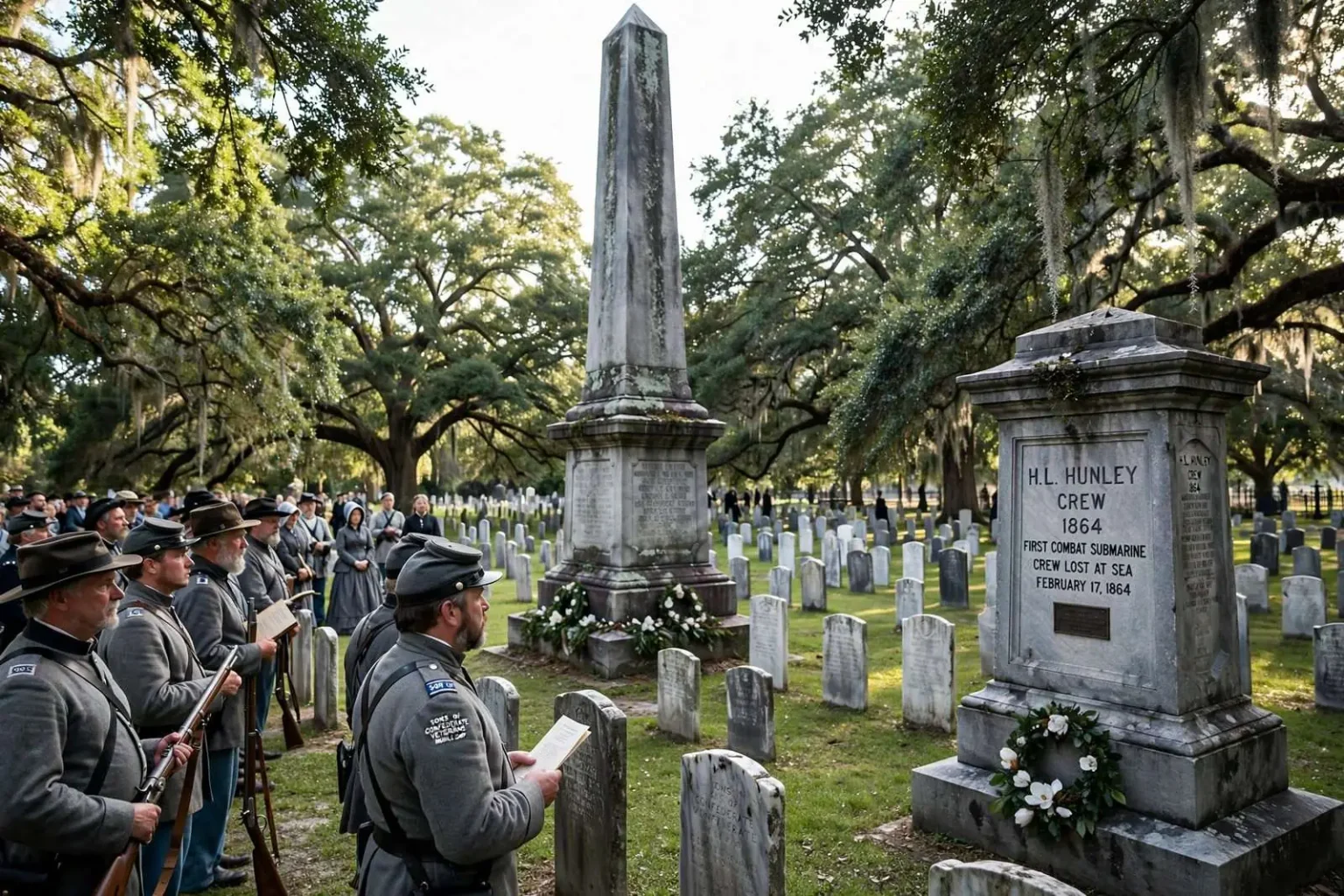
The ceremony takes place in the cemetery’s Confederate Rest section, an area within the roughly 1830s-era cemetery that was originally established as Soldiers’ Rest when it opened for use in 1862. The section is anchored by a large obelisk memorial surrounded by rows of marble gravestones, along with smaller monuments at each corner dedicated to specific military units and figures connected to the war, including the crew of the Confederate submarine H.L. Hunley and a general entombed at the site.
According to organizers, the event features period reenactors in historical dress along with era-appropriate weaponry on display, and includes a formal address commemorating each general’s military career. This year’s remarks are being delivered by an officer from a local Sons of Confederate Veterans camp.
A burial ground older than the war it remembers
Magnolia Cemetery ranks among the oldest burial grounds in the Mobile area, with its grounds reaching back to the 1830s, decades before the Civil War that gave the cemetery its best-known memorial section. When the conflict came, Mobile became a major wartime city, home to coastal defenses, shipbuilding and supply operations, and when soldiers died in the city’s hospitals, a place was needed to bury them. That place was laid out in 1862 as Soldiers’ Rest, the section now known as Confederate Rest.
The rows of marble headstones that fill the section record more than 1,100 soldiers, men who came from across the South and who died far from home in hospitals and camps around Mobile. For families of the era, a marked grave in a city cemetery was often the only tangible trace a lost soldier left behind, and the ordered rows of the section reflect the military discipline that organized the burials themselves.
At the center of the section rises the large obelisk, the kind of memorial column that became the standard form for Civil War commemoration across the South in the decades after the war. Around it, smaller monuments at each corner carry the names of specific units and figures, tying the ground to particular regiments and stories rather than to an undifferentiated mass of the fallen.
The Hunley connection
Among the corner monuments, one of the most historically striking honors the crew of the H.L. Hunley, the Confederate submarine that became the first combat submarine in history to sink an enemy warship. The hand-cranked vessel operated out of Mobile before being shipped by rail to Charleston, South Carolina, where it attacked the Union sloop-of-war Housatonic in February 1864 and then vanished with its crew.
Mobile’s ties to the Hunley run deep: the submarine was built in Mobile, and several members of its crew had connections to the city. When the wreck was raised from the ocean floor near Charleston more than a century later, the discovery drew international attention, and it gave Mobile’s memorial to the crew a renewed significance for visitors who come to the cemetery to trace that story to its origins.
The monument at Confederate Rest therefore serves double duty, marking men whose remains lie elsewhere while giving the cemetery a direct physical link to one of the most storied vessels in American naval history, built on the waterfront a few miles from the graves themselves.
A ceremony timed to the calendar
The salute is timed to fall on a Sunday near the birth date of one of the generals honored, a date that has been recognized as a state holiday in Alabama for more than a century. That timing places the ceremony within a broader calendar of commemorative observances that Alabama communities have kept since the postwar decades, when veterans’ organizations began holding annual rites at cemeteries across the state.
Period reenactors in historical dress and era-appropriate weaponry on display give the event its distinctive character, and the formal address commemorating each general’s military career provides the ceremony’s spoken centerpiece. This year’s remarks come from an officer of a local Sons of Confederate Veterans camp, continuing the long relationship between the heritage organization and the cemetery’s memorial traditions.
Memorial, not politics, say organizers
Organizers describe the annual salute as primarily a memorial and historical observance, intended to honor the more than 1,100 soldiers interred at the site rather than to make any broader political statement. That framing has guided the ceremony through changing decades in which the memory of the Civil War and its symbols have been the subject of intense public debate across the South.
The distinction the organizers draw is between commemoration of the dead, a function cemeteries have always performed, and advocacy of any kind. A graveside salute, in this reading, belongs to the same category as the wreath layings and rifle volleys that military and civic organizations perform at veterans’ graves of every era: an acknowledgment that the men buried there served and died, whatever posterity thinks of their cause.
The event is open to the public and typically draws local history enthusiasts, descendants of Confederate soldiers, and residents interested in the cemetery’s role as one of the older burial grounds in the Mobile area. Attendance has traditionally included a mix of the curious and the committed, with visitors often arriving early to walk the rows of marble markers and read the names before the ceremony begins.
Magnolia Cemetery’s place in Mobile history
Magnolia Cemetery itself spans a significant portion of Mobile’s historic district and includes the graves of numerous notable local figures beyond those honored specifically during the Confederate salute. Mayors, merchants, physicians, artists and generations of ordinary Mobilians lie within its grounds, which function as a cross-section of the city’s history from the antebellum decades through the modern era.
Cemeteries of this age serve as open-air archives. The inscriptions, stone styles and family plots of Magnolia record the epidemics, wars, yellow fever outbreaks and economic booms that shaped Mobile, and genealogists and historians have long relied on its records and monuments to document families and events that exist nowhere else in such detail.
The cemetery’s mature live oaks and quiet avenues also make it a place of daily use, not just occasional ceremony, for residents of the surrounding historic neighborhoods who walk its paths as they have for generations.
Preservation as an ongoing task
Preservation groups have worked over the years to maintain the cemetery’s older sections, including the memorial obelisks and headstones within Confederate Rest. Marble, the material of choice for mid-nineteenth century markers, weathers poorly along the Gulf Coast, where humidity, salt air, storms and simple time soften inscriptions and erode edges. Keeping more than 1,100 graves legible is therefore a continuous project rather than a completed one.
Volunteer efforts have included cleaning stones with conservation-appropriate methods, repairing monuments damaged by storms and age, and documenting the condition of markers so that deterioration can be tracked. Local historical and heritage organizations have supplied much of the labor and funding, supplemented by donations from descendants scattered far beyond Alabama.
The annual salute itself plays a role in that maintenance, drawing public attention to the section each year and reminding the community that the monuments depend on continued care. For the organizers, reenactors and families who gather there this weekend, the ceremony is at once a tribute to the soldiers of the 1860s and an investment in the ground that remembers them, ensuring that the obelisk, the corner monuments and the long rows of marble in Confederate Rest still stand for the generations that follow.
What visitors will find at the ceremony
Those who attend this weekend’s salute will find the section much as the war generation left it in its essentials: the tall obelisk at the center, the ordered rows of marble spreading out from its base, and the corner monuments holding the memory of particular commands and individuals. The reenactors’ presence, in the uniforms and dress of the 1860s, gives visitors a visual anchor for understanding the era the markers represent, and the displayed weaponry of the period draws its share of attention from attendees interested in the material history of the war.
The formal address will commemorate the military careers of the two generals honored by the ceremony, tracing their service in a war that touched every corner of the South. For attendees who are descendants of soldiers buried in the section, the spoken tribute carries a personal weight that goes beyond general historical interest; family research in the Mobile area frequently leads back to these same rows.
Because the event is open to the public, organizers have historically welcomed anyone with an interest in local history, and the weekend timing makes it accessible to families. Visitors are asked to treat the ground with the respect owed to any active burial place, a reminder that the graves belong not only to history but to the families who still tend them.
A tradition with deep local roots
Annual ceremonies at Confederate Rest trace their lineage to the commemorative culture that grew up across Alabama in the decades after Appomattox, when survivors’ associations and ladies’ memorial organizations took on the care of soldiers’ graves as their central work. Mobile was among the Southern cities where those organizations were most active, decorating graves each spring and holding public addresses that kept the memory of the fallen before the community.
Over time, that work passed to descendants’ organizations, most visibly the Sons of Confederate Veterans camps active in the Mobile area today, which have carried the memorial tradition forward. The involvement of a local camp officer as this year’s speaker continues an arrangement that has linked the cemetery’s observances to the heritage community for generations.
The observance’s endurance says something about Mobile’s relationship with its past. The city holds more layers of Gulf Coast history than almost any community in the region, from French colonial beginnings through antebellum cotton, two world wars of shipbuilding and the modern port, and Magnolia Cemetery sits at the heart of that layered memory. A ceremony there is as much about the continuity of the city as about the war itself.
Why the cemetery’s history matters beyond the weekend
For historians, Confederate Rest is one of the region’s most complete records of the war’s human cost on the central Gulf Coast. The more than 1,100 soldiers buried there died overwhelmingly in and around Mobile, in hospitals and camps rather than on famous battlefields, which makes the section a record of the war’s quieter toll: disease, wounds and hardship carried men off at rates that combat alone never matched.
The section also documents how Mobile itself functioned as a military city, defending the bay with forts at the entrance to the harbor and supporting the war effort through its foundries and workshops. The H.L. Hunley monument ties that story to the submarine built on the city’s waterfront, a piece of engineering history that has drawn worldwide attention since the vessel’s recovery.
This weekend’s salute, in the end, serves three audiences at once: the families and heritage groups who have kept the tradition alive for generations, the history-minded visitors who come to walk among the marble rows, and the preservationists whose work depends on the public attention the ceremony renews each year. Together they ensure that the obelisk and its 1,100 neighbors remain part of Mobile’s living landscape rather than fading into an unread past.