Baldwin County’s 29th Annual MLK Celebration Draws Hundreds to Daphne’s Main Street
About 300 people marched down Daphne's Main Street for Baldwin County's 29th annual Martin Luther King Jr. celebration honoring service and unity.
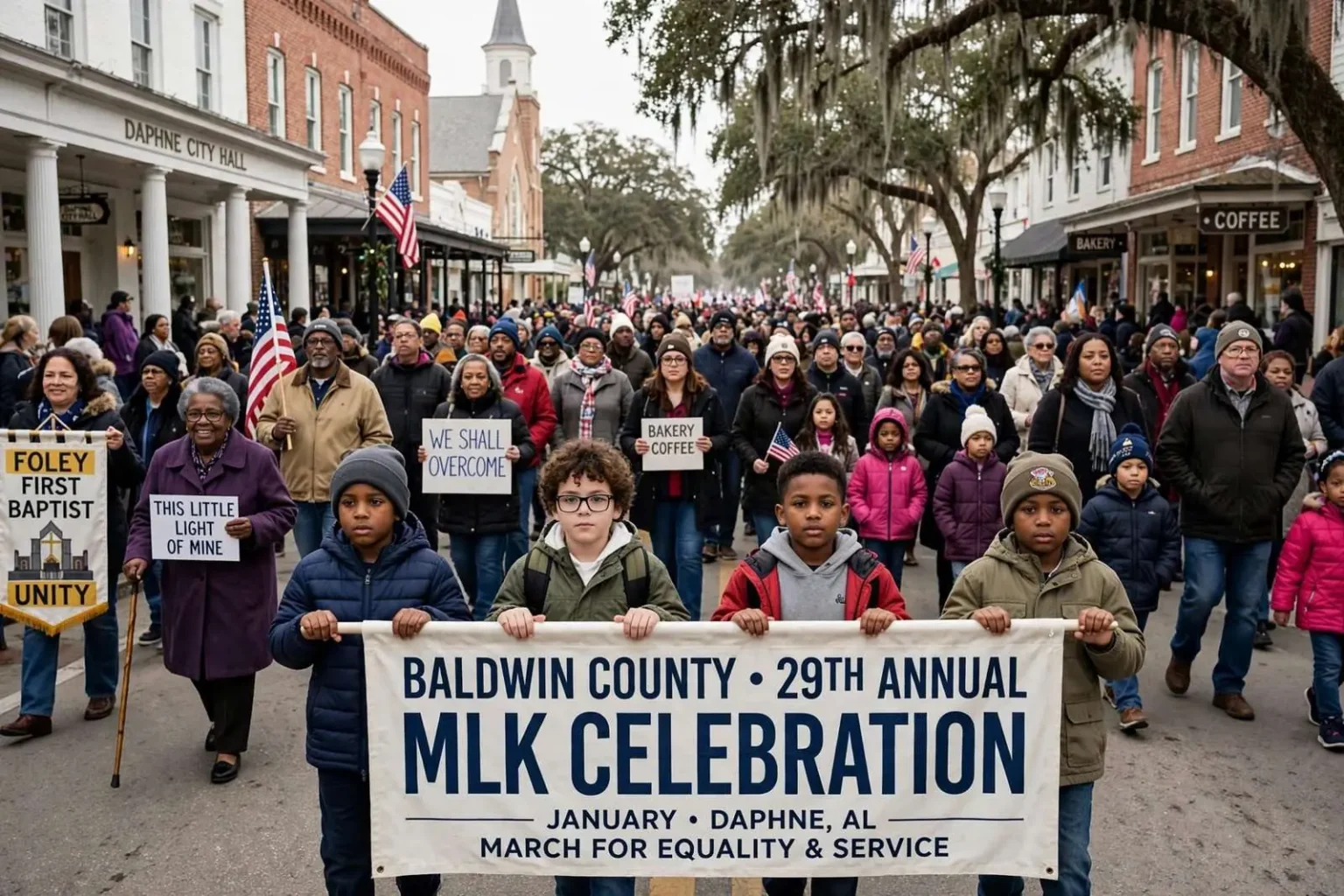
Roughly 300 people marched more than a mile down Main Street in Daphne on Martin Luther King Jr. Day, taking part in Baldwin County’s 29th annual celebration honoring the civil rights leader’s legacy. The procession stretched from Daphne City Hall to the Civic Center, where an afternoon program brought together elected officials, church groups and families from across the county. Daphne, perched on the eastern shore of Mobile Bay and known for its oak-lined streets and centuries-old history as one of the oldest towns in Alabama, provided a fitting stage for an event that has grown into one of Baldwin County’s most dependable January traditions.
The holiday itself, a federal observance since the 1980s, has long been marked across South Alabama with marches, church services and community programs. In Baldwin County — a fast-growing suburban and agricultural county of more than 200,000 residents stretching from Mobile Bay to the Florida line — the annual Daphne march has served for nearly three decades as the central commemoration, drawing participants from Bay Minette to Foley and Gulf Shores.
Daphne City Council President Tommie Conaway, who grew up in Montgomery and marched there as a child during the Civil Rights Movement, joined the walk and reflected on how far the observance has come since those early demonstrations. Her personal history linked the Baldwin County event directly to the city where King first rose to national prominence as a young pastor. She said the purpose of the Baldwin County event, held alongside similar marches that day in Mobile and Loxley, was to keep King’s message of equality and service alive for new generations.
Four young boys from Bay Minette, Fairhope and Daphne led the procession, carrying a banner marking the Baldwin County celebration, while marchers sang civil rights-era songs including This Little Light of Mine and We Shall Overcome. The choice of children to lead the walk was deliberate, organizers noted, a visual reminder that the commemoration is aimed as much at the future as at the past. The songs themselves carried their own history — anthems sung in churches and on protest lines across the South in the 1950s and 1960s, passed down to a generation of marchers for whom the struggles they accompanied are history rather than memory.
A family tradition across the county
Longtime participants said the annual walk has become a family tradition. One woman from Foley, marking her ninth year marching with her church, said the event exists mainly to teach younger generations about the past and inspire them toward the future. Churches from across Baldwin County organized groups for the walk, busing members in and joining the line as it moved down Main Street. For many families, the march is an annual appointment alongside holidays and reunions — a morning on the street followed by an afternoon indoors reflecting on what the day means.
The afternoon program featured a mix of youth performances and reflections from local leaders. A young Daphne girl recited an original poem about self-love before delivering a passage often associated with Nelson Mandela’s inaugural address, drawing a warm response from the crowd of roughly 200 gathered for the program. The pairing of the girl’s own writing with words famously spoken at Mandela’s 1994 inauguration tied the Baldwin County observance to the broader international story of the struggle for equality, a connection the crowd received with applause.
Bay Minette City Councilman Chris Norman served as guest speaker, tracing King’s path from his pastorship at Dexter Avenue Baptist Church in Montgomery through the Montgomery bus boycott and the founding of the Southern Christian Leadership Conference, before reminding the audience that King’s life of service ended at just 39 years old. Norman’s retelling walked the audience through the milestones that made King a national figure while he was still in his twenties: the 381-day boycott that began in December 1955 after Rosa Parks’s arrest, the founding of the SCLC in 1957, and the campaigns that followed across the South. King’s death in Memphis in 1968, at an age when most lives are still building, gave the audience its sharpest pause.
Foley City Councilman Vera Quaites, who emceed the program, challenged attendees to look beyond the ceremony itself and find ways to serve their neighbors year-round. Her charge echoed the modern framing of the King holiday as a day of service rather than simply a day off, and she pressed the point that the march’s meaning is measured in what participants do in the weeks and months that follow. Local officials in attendance used the moment to reinforce the same theme, noting that Baldwin County’s growth has brought prosperity alongside challenges of affordability, access and community cohesion.
Why the community keeps marching
Willie Williams, president of the Baldwin County Martin Luther King Celebration Committee that has organized the march for nearly three decades, said he’s often asked why the community continues to march each year. His answer, he said, is rooted in remembering the sacrifices of those who came before — people who could not vote or eat at the same restaurants as their neighbors, so that later generations could enjoy freedoms many now take for granted.
That history is not abstract in Alabama, where segregation laws once governed nearly every public accommodation and where the marches, boycotts and court battles of the 1950s and 1960s reshaped the state’s political life. Williams and the committee have made it their mission to keep that story in front of young people who grew up long after those battles were fought, arguing that memory is the first defense against forgetting.
The program’s attention to young people ran through nearly every element of the afternoon. Organizers have increasingly built the event around student participation — recitations, performances and speaking roles — on the theory that children who take an active part in the commemoration carry it forward. Teachers and church youth leaders spent the weeks before the holiday preparing participants, and the crowd’s response to the youngest performers reflected an audience that understood it was watching the tradition renew itself in real time.
The Daphne march also stands out for its route through the heart of one of Baldwin County’s oldest communities. Main Street’s storefronts and historic churches framed a procession that residents could watch from their own sidewalks, and bystanders joined in as the line passed. That accessibility has helped the march endure where larger, more formal commemorations have faded — no tickets, no admission, just a mile of street and an open invitation.
Baldwin County’s own civil rights history gave the day added resonance. The county’s Black communities — from the neighborhoods of Daphne and the county seat at Bay Minette to the farming settlements that dotted the county through the 20th century — lived through the era of segregation that King’s movement dismantled, and older marchers needed no history lesson to remember which doors were once closed to them. Speakers acknowledged that the freedoms exercised casually today, from voting without hindrance to sitting anywhere in a public restaurant, were won within living memory.
This year’s celebration carried the theme of unity drawn from a biblical passage, a choice consistent with the event’s church-centered roots. The organizing committee has long drawn its volunteers and its marchers primarily from Baldwin County’s congregations, and the program’s blend of scripture, song and civic reflection reflected that foundation. Speakers returned to the theme throughout the afternoon, framing unity not as an abstract ideal but as a practical obligation for a county whose population continues to diversify with each year of rapid growth.
The program also gave local elected officials a rare shared stage. Council members from Daphne, Bay Minette and Foley joined county-level leaders in the Civic Center, and several spoke of the value of an event that draws participants from every corner of Baldwin County rather than a single municipality. For the smaller delegations from towns like Loxley and Bay Minette, the Daphne march serves as the county’s common ground — the one observance that brings the whole community’s commemorations together under a single banner.
Organizers closed the event with a challenge for participants to bring friends and family to next year’s celebration in Bay Minette, continuing a tradition that has become a fixture of Baldwin County’s civic calendar each January. Rotating the host community keeps the observance connected to churches and neighborhoods across the county, and the announcement of the Bay Minette edition gave marchers a concrete reason to keep the momentum going. The committee’s leadership made clear that the march’s future depends on the same thing that has sustained it for 29 years: families deciding, each January, that the walk down Main Street is worth making together.
For the roughly 300 who walked and the 200 who filled the Civic Center, the day offered both remembrance and responsibility. The songs sung on Main Street, the history recounted from the podium and the poems recited by children all pointed to the same conclusion the committee has drawn for nearly three decades — that King’s legacy survives in Baldwin County not in monuments but in an annual procession that teaches, unites and, its organizers hope, inspires the next generation to serve.