Daphne-Born Algae Fuel Project Eyes Full-Scale Commercial Site on Mobile Bay
A Daphne pilot project turning wastewater and algae into drinking water and crude oil is scouting a large commercial site on Mobile Bay.
A unique wastewater-to-fuel experiment that began in Daphne is now searching for a full-scale commercial home, with company officials saying Mobile Bay remains a top contender for the expansion. The project, a partnership between Daphne Utilities and technology firm Algae Systems, backed by Japanese engineering giant IHI, has spent roughly two years proving out a process that turns algae and treated wastewater into both drinking water and crude oil. Company representatives say they are evaluating between 15 and 17 potential sites for the commercial-scale operation, with a decision expected within the next couple of months.
A company vice president told reporters he remains hopeful the commercial facility can be located on Mobile Bay itself, citing the region’s unique combination of water access, warm climate and community support as major assets for the technology. For Baldwin County, landing the plant would mean more than jobs at a single facility; it would position the eastern shore of Mobile Bay at the front of an emerging industry that treats sewage as a raw material rather than a disposal problem.
How the Process Works
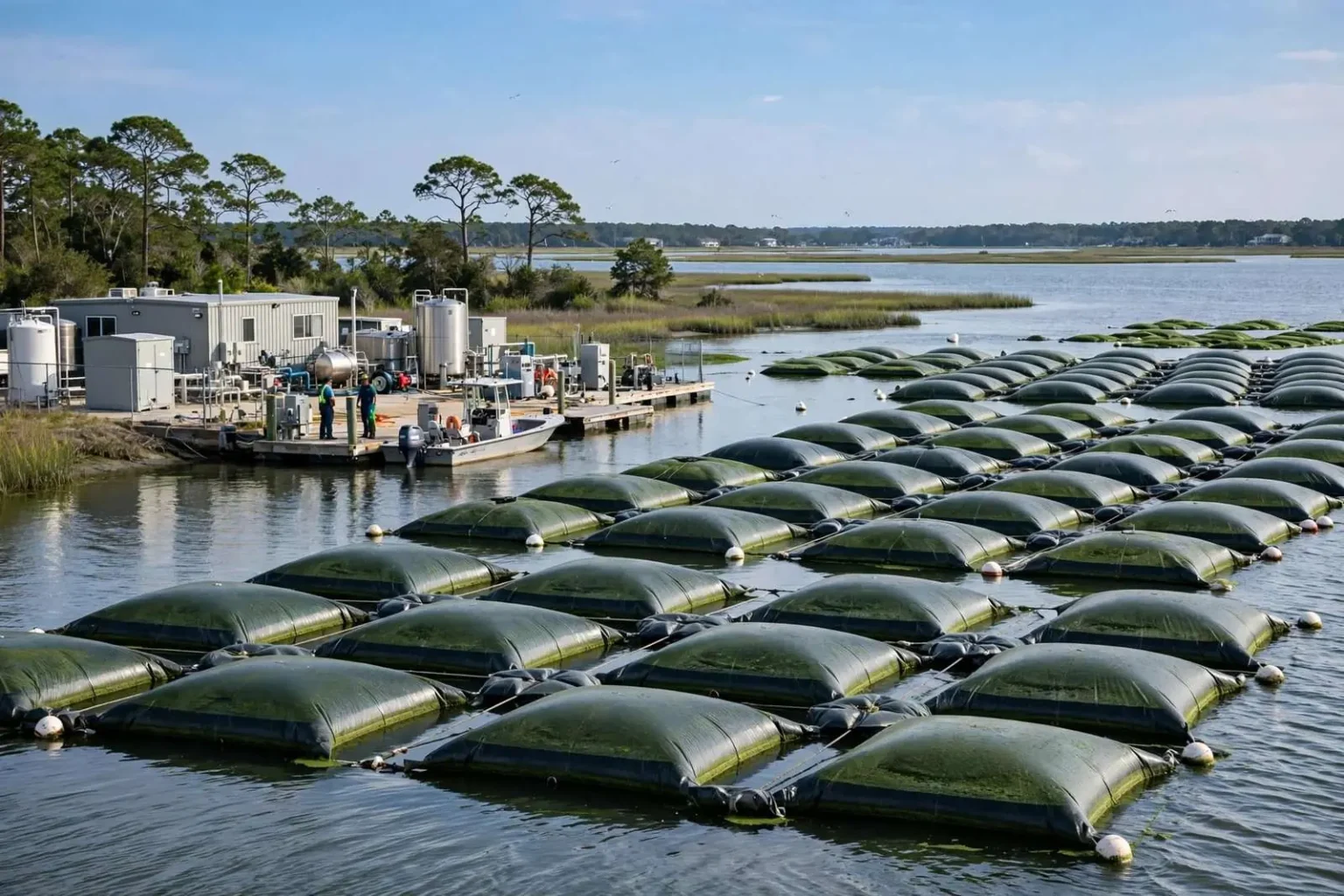
The process starts small, quite literally, with a single cell of locally sourced algae grown until it reaches sufficient volume. That algae is then mixed with disinfected wastewater inside large floating bags that sit directly on the surface of Mobile Bay, where sunlight and wave action do much of the work. Carbon dioxide scrubbed from the atmosphere is fed to the algae as it grows, a process company officials describe as producing the first carbon-negative fuel ever created.
After roughly four to six days, the algae stops growing and the mixture is pumped ashore, where the algae is separated from the water. The water can then be filtered down to drinking-water quality, while the concentrated algae, once it reaches about 10 percent of the mixture, is fed into a process called hydrothermal liquefaction. Heated to roughly 600 degrees Fahrenheit for just a few minutes, the mixture converts into crude oil that can be refined into standard fuel products.
The chemistry is the heart of the venture. Hydrothermal liquefaction mimics, in compressed time, the geological conditions that produced the world’s petroleum deposits over millions of years, using heat and pressure to break down organic material into a crude-like substance. Because the algae draws carbon dioxide out of the air as it grows, the fuel that results can offset the emissions released when it is burned, which is the basis for the company’s carbon-negative claim.
Company officials say the specialized bags used to hold the algae mixture, made using materials supplied by an athletic apparel manufacturer, are part of what sets the process apart from other algae-to-fuel efforts that have struggled with unfavorable economics. Algae cultivation on land requires tanks, pumps and nutrients that drive up costs; floating the crop on the bay lets the environment supply sunlight, mixing and cooling at essentially no charge.
From Pilot to Commercial Scale
The pilot facility currently operates on about half an acre of bags, handling roughly 40,000 gallons of wastewater treatment daily, and the company has already tested how the design scales up for larger volumes. That footprint is tiny by the standards of a municipal utility, but it has been enough to demonstrate each step of the process in sequence: growth, harvest, water recovery and oil conversion, all running on real wastewater rather than laboratory feedstock.
Company leaders say a full commercial installation could process a million gallons of wastewater per day or more, representing a significant leap from the pilot’s current scale. Reaching that volume would require a substantially larger field of floating bags, onshore processing buildings for the liquefaction step and infrastructure to move the mixture between them — the kind of industrial shoreline site that the company’s site search is now weighing across the region.
A Leadership Shuffle at Daphne Utilities
The project has also triggered a leadership shuffle at Daphne Utilities. The utility’s general manager is transitioning into a new role as Algae Systems’ vice president of operations and market development, while the assistant general manager is stepping up to lead the utility. The move places one of the pilot program’s most knowledgeable advocates on the commercial side of the venture, where the next phase of fundraising, permitting and construction will be decided.
For a mid-sized Baldwin County utility, taking a leading role in an experimental technology was an unusual path. Utilities are generally conservative operations, judged on reliability and rates rather than research. Daphne’s willingness to host a multi-year pilot reflects both the pressure the city faced in meeting wastewater treatment demands as it grows and the potential payoff: a technology that could eventually shrink treatment costs, add a revenue stream and reduce the environmental load on area waters.
Why Mobile Bay Fits
The region’s advantages for the technology are straightforward. The bay offers the shallow, calm waters the floating bags require, a warm climate that keeps the algae growing most of the year, and an existing network of utilities and industrial partners accustomed to marine construction. The presence of the Daphne pilot has also built local familiarity with the project, something company officials described as community support that other candidate sites cannot easily match.
Company representatives say they are evaluating between 15 and 17 potential sites, a list that presumably includes locations beyond the bay as the company weighs cost, permitting and market factors. A decision is expected within the next couple of months, and officials have been careful not to promise that the commercial plant will stay in Baldwin County. Still, the vice president’s public hope that the facility lands on Mobile Bay signals that the home site remains a serious contender rather than a sentimental favorite.
The Bigger Picture for Wastewater and Fuel
The appeal of the technology is that it attacks two problems at once. Wastewater treatment is a permanent, rising cost for every growing community, and discharge limits keep tightening. Conventional treatment consumes significant energy and chemicals. A process that simultaneously cleans water to drinking quality and yields sellable crude oil reframes the utility’s largest expense as a production input, and the drinking-water byproduct carries obvious significance in a coastal region where freshwater supply is a long-term concern.
The energy angle matters as well. Gulf Coast states have long been home to the petroleum industry’s refining and processing infrastructure, meaning a crude substitute produced from algae would find familiar buyers and handlers nearby. A commercial-scale facility on Mobile Bay would plug into an existing industrial ecosystem of pipelines, terminals and experienced process operators, reducing the friction that often accompanies first-of-a-kind plants.
What Comes Next
If Mobile Bay is ultimately chosen, the project could position Baldwin County as a hub for an emerging clean-energy technology that converts a persistent environmental challenge, wastewater treatment, into both drinking water and a renewable fuel source. Site selection would be followed by permitting, financing and construction, each step carrying its own timeline, but the two years of pilot data give the company something most algae-energy ventures never had: a documented, continuously operating proof of concept in the very environment where it hopes to build.
Local officials will be watching the decision closely. A commercial facility would bring construction jobs followed by a permanent operations workforce, and the plant’s visibility could attract related research and supplier activity to the area. It would also give Daphne, a city of modest size on the Eastern Shore, a claim to national attention in the energy and water technology space.
For now, the bags continue to float on the bay, the pilot continues to run and the company continues its site evaluation. Within a couple of months, the region should learn whether a experiment that began with a single cell of local algae will grow into a full-scale industry on the water where it started.
The project’s trajectory also illustrates how long the road from pilot to plant can be, even when the science works. Two years of operating data, a supportive host utility and a major industrial backer in IHI have carried the venture to the edge of commercialization, but the remaining steps — locking down a site, securing construction capital and navigating environmental permits for a first-of-a-kind facility — are the stages where many energy technologies stall. Company officials have been measured in their public statements for precisely that reason, emphasizing evaluation rather than announcement.
Residents of the Eastern Shore have followed the project with a mix of curiosity and pride. The image of floating bags growing fuel offshore is unlike anything else in the region’s industrial landscape, and school groups and civic organizations have taken an interest in the pilot as a hands-on example of how water, energy and environmental policy intersect. Should the commercial plant be built locally, that visibility would only grow, making the facility as much a landmark of the bay’s evolving economy as an industrial installation.