Mobile-Area Scout Troops Look for New Donors After Losing United Way Support
Boy Scouts and Girl Scouts councils serving Mobile, Washington and Clarke counties say United Way dollars no longer reach their programs.
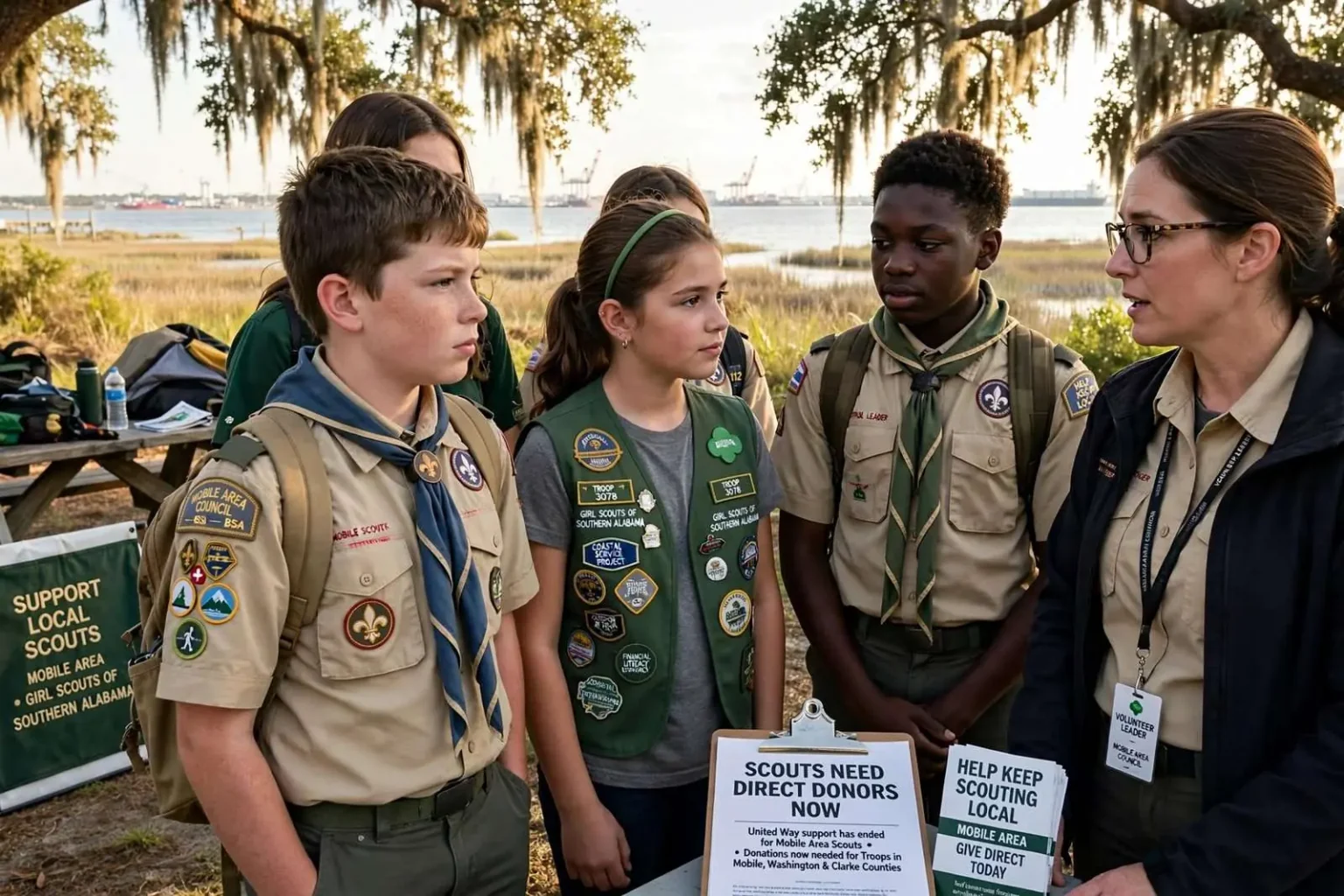
Scouting leaders across the Mobile area are asking residents to look closely at where their charitable dollars land this fall, after the region’s largest United Way chapter quietly stopped funneling money to local Boy Scout and Girl Scout councils.
The United Way of Southwest Alabama, which raises money for programs across Mobile, Washington and Clarke counties, shifted its giving model beginning in 2013, moving away from blanket support for large legacy agencies and toward funding specific programs instead. That change meant the Mobile Area Council of the Boy Scouts of America and the Girl Scouts of Southern Alabama lost financial backing that had flowed to them for years, even as many donors continued to assume their United Way gifts were still reaching the youth groups.
The funding-model shift that swept through United Way organizations nationwide has reshaped charitable giving in mid-sized communities across the country. Under the older model, workplace donors gave once and the United Way board divided the pool among partner agencies, which budgeted around that dependable stream. The newer model asks agencies to compete for grants tied to measurable outcomes, a change designed to demonstrate impact to donors — but one that inevitably leaves behind organizations whose work is broad, long-term and difficult to quantify in a single grant cycle.
The Confusion Is the Problem
Scouting officials say the confusion is the real problem. Many longtime supporters still check a box for the United Way campaign believing part of it automatically supports local troops, when in fact none of it has since the funding relationship ended. Council leaders are now working to correct that impression as the United Way’s annual fall campaign kicks off, hoping to redirect at least some of that goodwill into direct donations.
The confusion is understandable. For decades, Scouting appeared on United Way partner lists, and generations of donors built their giving habits around that pairing. Designations and payroll deductions change slowly, and many contributors never saw the announcement that the relationship had ended. From the councils’ perspective, every dollar still routed to the United Way in Scouting’s name is a dollar that quietly disappears from youth programming — not because anyone chose to cut it, but because the plumbing underneath the donation changed.
Workplace campaigns compound the issue. Employees who sign up for automatic payroll deductions often leave them in place for years, and the annual enrollment window offers only a brief chance to redirect. Council leaders say correcting that plumbing, giver by giver, is now one of their main development tasks.
What the Money Did
The dollar amounts at stake are significant for organizations that lean on community fundraising to keep dues low and equipment available for families who could not otherwise afford it. Scouting leaders estimate the combined loss to local Boy Scout and Girl Scout programming reached well into six figures once the transition fully took hold.
United Way support historically covered the unglamorous backbone of a Scouting council — the overhead that no individual donor wants to fund but every program requires. Office operations, insurance, staff time, training for volunteer leaders and financial aid for scouts whose families could not pay their way all drew on that institutional support. Replaceable in theory, that money is difficult to raise in practice, because individual givers prefer their gifts to buy visible things: a camping trip, a uniform, a badge.
So far, councils say they have avoided cutting programs or staff, but they acknowledge that could change if a new base of individual donors does not materialize. Both organizations operate on thin margins by design, with volunteer leadership and modest professional staffs, so a six-figure annual gap is large enough to force choices between program cuts, fee increases and reduced services for the scouts who can least afford them.
Family budgets are where those choices land first. Scouting dues cover only a fraction of what it costs to run a troop or a service unit, and councils use fundraising to hold fees where ordinary families can afford them. If the gap persists, the pressure toward higher camp fees, higher registration costs and thinner program calendars grows each year, and the first families priced out tend to be the ones Scouting exists to include.
The Baldwin County Exception
One bright spot for families in Baldwin County is that the separate United Way chapter serving that area has kept its Scouting funding in place, meaning troops on the eastern shore have not felt the same pinch as those chartered through the Mobile-based council.
The split illustrates how differently United Way affiliates can move even within a single metro area. Each chapter sets its own funding priorities with its own board, and the Baldwin chapter’s decision to maintain Scouting support has created a two-speed system: a troop meeting ten miles across Mobile Bay from another may face entirely different funding conditions. Council leaders have pointed to the contrast when explaining to Mobile-area donors that the shortfall is a specific, local funding-model decision — not a national Scouting or United Way policy.
The Direct-Ask Campaign
For now, Scouting leaders are leaning on direct outreach — phone calls, letters and word of mouth — to explain the funding gap and invite individual and corporate sponsors to step in where the United Way once did. They note that gifts of any size help offset the cost of camp fees, uniforms and merit badge programming for scouts across the three-county service area.
Direct outreach is slower and more expensive than a United Way check, but it carries advantages the old model never offered. Donors recruited one at a time tend to become volunteers as well as givers, they give year after year without a payroll window, and they can be shown exactly what their money does. Councils nationwide that lost United Way funding have followed this same path, trading a broad, shallow funding base for a narrower, deeper one built on personal relationships.
Corporate sponsors are a particular target for the councils’ fall push. Gulf Coast employers already back youth programs through scholarships and event sponsorships, and Scouting offers those businesses a workforce-development argument: the program’s emphasis on leadership, citizenship and outdoor skills reaches thousands of young people at precisely the ages when employers hope to shape their region’s future talent.
Community members interested in supporting either organization directly are encouraged to reach out to the local council offices rather than assuming a general United Way donation will reach Scouting programs, at least under the current funding structure.
What Local Scouting Looks Like on the Ground
The Mobile Area Council and the Girl Scouts of Southern Alabama serve a three-county footprint that includes some of the Gulf Coast’s most spread-out communities. Scouting in Mobile, Washington and Clarke counties runs through volunteer-led troops that meet in schools, churches and community buildings, with program calendars built around camping seasons, service projects and badge work that stretches from downtown Mobile to the small towns along the Tombigbee and Alabama rivers.
Volunteers are the system’s real engine. A council’s professional staff recruits leaders, secures facilities and manages the business of Scouting, but the weekly meetings, weekend campouts and badge clinics run on parents and community members who give their time. Every dollar of institutional funding multiplies that volunteer labor; every funding shortfall, conversely, threatens the support structure that keeps volunteers equipped, trained and returning year after year.
How Donors Can Direct Their Gifts
Council leaders emphasize that donors who want their money to reach Scouting have straightforward options. A direct gift to either council can be unrestricted or designated for a specific purpose — financial aid for camp, equipment for a particular troop, or program supplies. Donors who participate in workplace campaigns can also ask their employers about direct payroll designation to the councils, which some campaign platforms allow even outside United Way partner lists.
The councils’ guidance to supporters is deliberately practical: if Scouting matters to you, give in a way that lands there. A general United Way gift remains a valuable contribution to the region’s nonprofit network, which continues to fund health, education and income programs across the three counties, but it will not reach the scout troops under current funding arrangements.
A Season of Asking
Fall is the season when charitable organizations across the Gulf Coast make their annual appeals, and the councils enter this one with a clearer message than they have had since the funding change. The story they are telling is not one of crisis but of transition — programs intact, staff in place, and a gap that community support can close before it becomes one of either.
Whether that appeal succeeds will depend on converting decades of assumed support into decades of intentional support. The scout families, alumni and neighbors who kept the boxes checked through the United Way years represent a donor base most youth organizations would envy; the councils’ task this fall is simply to show them where the box is now.