Mobile’s Former Congressman Bonner Closed Out Campaign Fund With Gift to Alabama School of Math and Science
Records show Jo Bonner's Mobile-based campaign fund spent down over a year after he left Congress, ending with a gift to a local school.
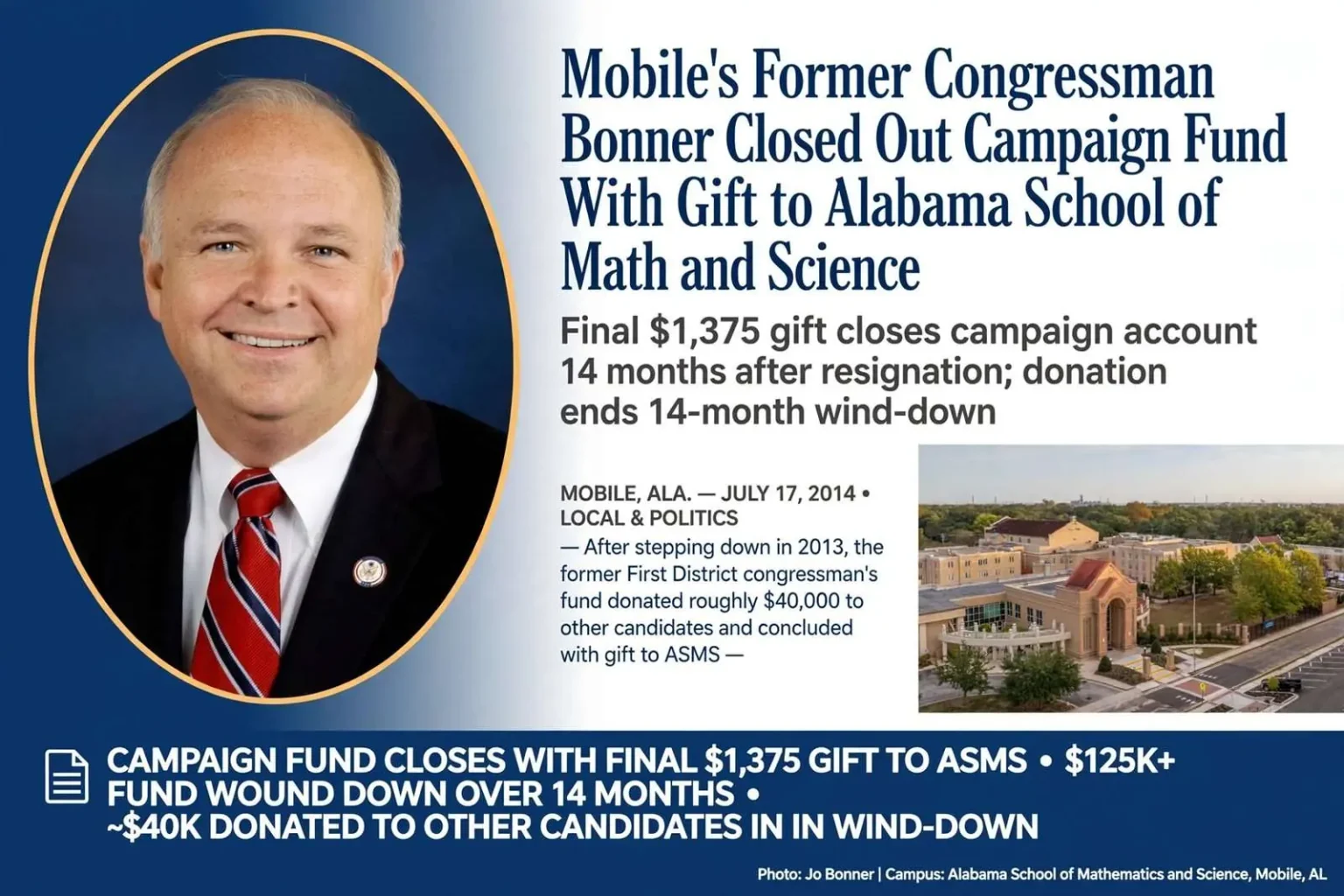
Nearly a year after Jo Bonner stepped down from Alabama’s First Congressional District seat to take a job with the University of Alabama System, his campaign committee was still writing checks.
Records show the Mobile Republican’s fund held more than $125,000 when he announced his resignation in the spring of 2013, and the account kept operating well into the following year before finally closing for good. Over that stretch, the campaign covered routine costs such as outstanding bills, travel, event tickets and meals, while also steering close to $40,000 in contributions to other candidates running for offices at the state, congressional and local level.
Bonner closed the account entirely in mid-July with a final gift of $1,375 to the Alabama School of Mathematics and Science, the selective public boarding school based in Mobile that had invited him to join its foundation board.
The closing gift bookended a political career that spanned more than a decade in Washington and gave the account’s remaining balance to an institution in the district he represented — a residential school that draws some of Alabama’s highest-achieving high school students to a campus in his hometown.
Why the Account Stayed Open So Long
Bonner, who now serves as vice chancellor for government relations and economic development within the University of Alabama System, said winding the fund down made more sense than converting it into a political action committee or banking it for a possible future campaign. He described the process as straightforward once his move from elected office to higher education was final, saying the campaign followed federal rules closely at every step.
The timeline reflects the practical realities of closing a congressional campaign committee. Outstanding obligations — vendor bills from the final campaign cycle, accounting and legal fees, storage and administrative costs — take months to resolve, and Federal Election Commission filings continue until the committee formally terminates. For a member who resigned mid-session rather than at the end of a term, the wind-down stretches even further, because the committee’s books must be squared while the former member transitions into new employment.
Contributions to other candidates during the wind-down are also common. Former members frequently use residual funds to pay down political debts of a different kind — supporting colleagues and party nominees — and the roughly $40,000 Bonner spread across state, congressional and local races functioned as a final act of political reciprocity before the account disappeared.
The Rules for Leftover Campaign Money
Federal law gives former members of Congress considerable freedom in how they dispose of leftover campaign money, so long as they do not convert it to personal use. Common outlets include donations to other candidates, gifts to charitable and civic groups, and expenses tied to shutting down a campaign operation.
The prohibition on personal use is the bright line. Campaign funds exist to support election activity, and converting them to salary, housing, vacations or other private benefit is barred outright — a rule enforced through FEC regulations and, in egregious cases, criminal referral. Within that boundary, though, a former member’s choices are broad: contributions to parties and candidates, donations to charities and universities, refunds to contributors, or any mix of the above.
Watchdog groups have called out other former lawmakers around the country for using leftover funds on lavish travel or club memberships, but nothing about Bonner’s spending drew that kind of scrutiny. His pattern — candidate contributions capped by contribution limits, routine wind-down costs, and a closing gift to a civic institution — tracked the conventional playbook that transparency groups describe as the appropriate use of residual funds.
A Career That Ended on His Own Terms
Bonner’s departure from Congress in 2013 was unusual in one respect: he left voluntarily, at the peak of his seniority, rather than facing defeat or resignation under pressure. First elected in 2002 to the seat representing southwest Alabama, he had risen through the House Republican ranks to become chairman of a subcommittee of the Appropriations Committee, a position that gave southwest Alabama a voice in federal spending decisions few districts of its size enjoy.
His move to the University of Alabama System placed him in a role that leveraged exactly the skills a longtime appropriator accumulates — navigating state and federal government on behalf of one of the state’s largest institutions. The university system’s government relations operation touches everything from legislative budgets to federal research funding, and Bonner’s Washington experience made him a natural fit for the vice chancellor’s post.
That career shift is also what made closing the committee the sensible path. A PAC funded with leftover congressional money would have kept Bonner active in electoral politics — endorsing, donating, possibly signaling interest in a comeback — at odds with a university role that demands nonpartisan relationships across the political spectrum.
The Final Gift
The choice of the Alabama School of Mathematics and Science as the account’s last beneficiary carried local meaning. The school, a public residential high school on Dauphin Street in Mobile, serves students from every county in the state, concentrating advanced coursework in math, science and technology that many home districts cannot offer. Inviting Bonner onto its foundation board tied him to the institution’s fundraising arm, and the $1,375 closing gift put his committee’s final dollars behind it.
For Mobile-area residents who followed Bonner’s more than a decade in Washington, the quiet wind-down of his campaign account offered a last look at the machinery of a political career — the bills, the contributions, the obligations that outlast the office itself, all settled by the book over fourteen months before the account closed for good in mid-July.
How Congressional Campaign Wind-Downs Work
For voters unfamiliar with the mechanics, a campaign committee is a separate legal entity from the candidate — it has its own bank account, its own treasurer and its own reporting obligations to the FEC, and it continues to exist until formally terminated regardless of whether the member remains in office.
Termination requires several steps. All debts must be paid, all assets disposed of, and a final report filed showing the committee ending with a zero balance. The process often takes longer than departing members expect, particularly for committees with years of accumulated records, vendor relationships and recurring obligations that only surface once the campaign’s regular activity stops.
During that window, the committee still operates under the same contribution limits and reporting rules that governed it while the member was in office. Contributions to other candidates remain capped per election, donations to charities are permissible within limits, and every disbursement lands on a public quarterly report that anyone — including journalists and watchdog groups — can examine.
That transparency is what allows comparisons between former members. When a departing lawmaker routes residual funds into personal-adjacent spending, the transactions appear in the public record, which is how watchdog groups catch the lavish travel and membership arrangements that have drawn criticism in other states. Bonner’s reports, by contrast, showed the standard categories: candidate contributions, administrative costs and charitable gifts.
The District Bonner Left Behind
Bonner’s resignation set in motion the special election process that ultimately decided who would fill the First District seat, an event that reshaped southwest Alabama’s congressional representation and drew national attention in a heavily Republican district. The campaign account’s long wind-down ran parallel to that transition — the old committee closing its books even as new campaigns for the seat opened theirs.
For the region, the episode was a small but instructive look at what happens after a congressman leaves. The office empties, the staff disperses, the issues move on — but the campaign committee, that enduring artifact of a political career, keeps filing reports and writing checks until every obligation is met and the last balance is given away.
Why It Matters to Voters
Stories like Bonner’s wind-down rarely make headlines precisely because they proceed as the rules intend, but they serve as a useful standard. Voters who follow the money after a member leaves office can see whether residual campaign funds — raised from donors who supported a candidacy — were treated as the public-facing political money they legally are, or converted into private benefit that the law forbids.
In Bonner’s case, the record shows a career’s worth of campaign money dispersed the way the FEC’s framework envisions: debts paid, colleagues supported, a charity and civic institution in his hometown chosen for the final gift, and the account closed cleanly in mid-July, more than a year after the congressman himself had already moved on.
The last check written, the last report filed and the account closed — and with it, the formal end of a political operation that began when Bonner first ran for the First District seat in 2002 and carried him through five general elections, the committee’s books finally balanced more than a year after he had walked out of a Capitol he had served for more than a decade.