Report Card: Grading Mobile’s Anonymous Election Prophets
With the June 2006 primary returns counted, the newspaper graded the anonymous insiders who had forecast the vote, handing out marks from A-minus to a blunt D in a lighthearted report card on the region's political prophets.
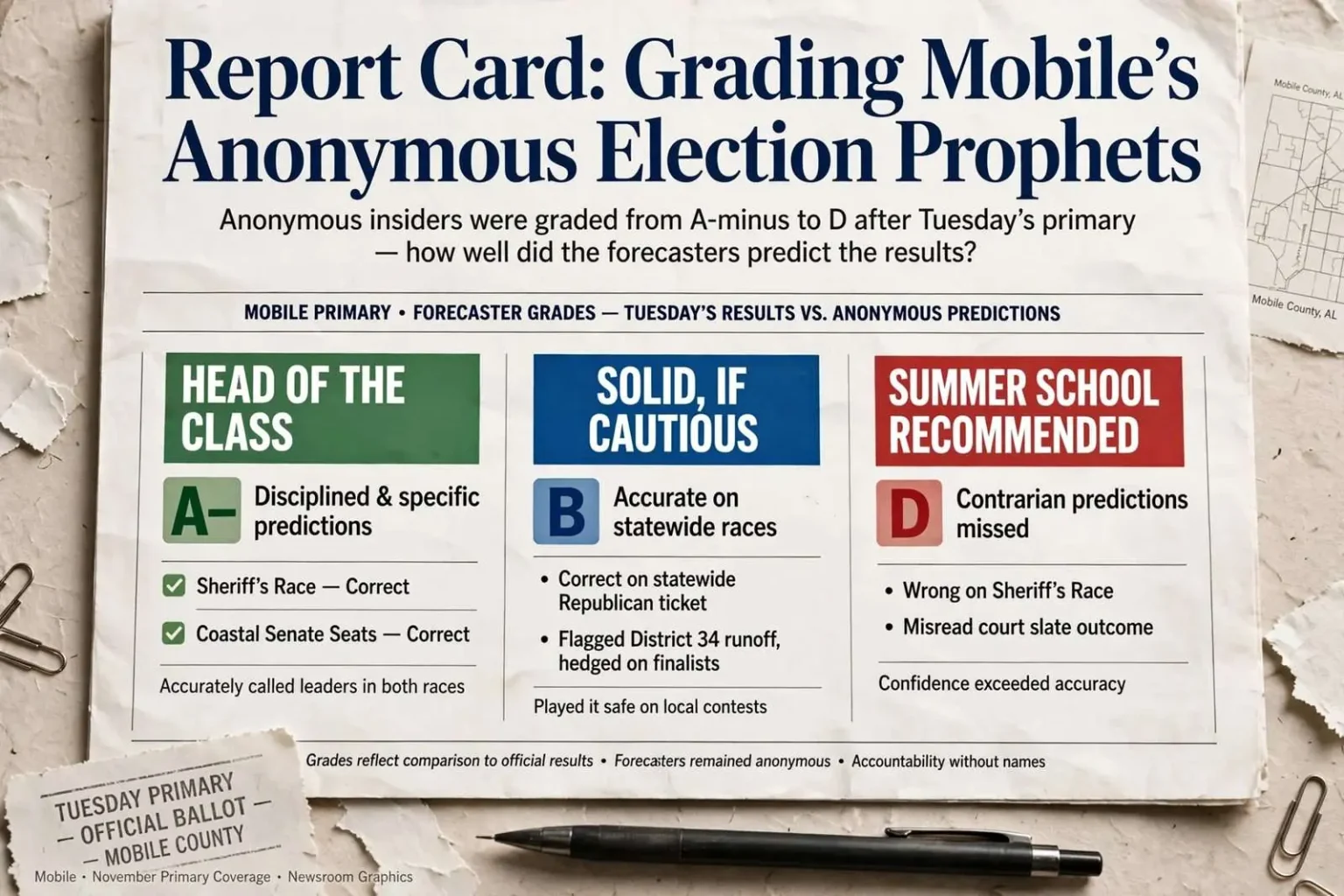
When the returns from Tuesday’s primary were finally counted, the newspaper turned the tables on the anonymous political insiders who had spent the closing days of the campaign handing out confident forecasts. Each was assigned a letter grade, from a gentleman’s A-minus down to a blunt D, and the report card offered a rare, lighthearted accounting of just how well the region’s self-styled experts actually read the electorate.
The exercise had begun before the vote, when a rotating group of operatives, attorneys and longtime office-watchers submitted their predictions on the condition of anonymity. With the results in hand, their calls could at last be measured against reality.
The setup was simple, and deliberately unforgiving. Forecasters were asked to commit in advance — not to hedge after the fact, not to reinterpret what they “really meant” once the numbers were in. In a business where being wrong is usually forgotten and being right is claimed loudly, the report card reversed the terms: the predictions were public, the prognosticators were not, and the grades would stand in print for anyone who cared to check the math.
The grades ran the full alphabet of pass and fail. A few earned near-perfect marks; a broad middle settled into the B range; and a stubborn handful drew D’s and a good-natured recommendation to consider summer school before the next election cycle.
Head of the Class
The top marks went to a pair of forecasters who had kept their predictions disciplined and specific. One, graded A-minus, had correctly identified the shape of the sheriff’s race and the appellate court contests without overreaching. Another earned high marks for a crisp, race-by-race rundown that named the likely leaders in the sheriff’s contest and both coastal state Senate seats.
Steady calls on Robert Smith in the circuit court race and on the Republican statewide ticket lifted their averages. What separated the top tier, the graders noted, was not luck but restraint: the best forecasters stuck to races they genuinely knew, named names, and resisted the temptation to bolt a surprise call onto an otherwise solid card in search of extra credit.
Both state Senate seats on the Gulf Coast drew particular attention during the campaign, since the districts run through growing suburban territory where turnover was plausible and the campaign spending was heavy. Calling the leaders in both — and being right — marked the difference between an observer who follows politics closely and one who merely talks about it.
Solid, If Cautious
A large middle band of panelists landed in the B range. Most had played it safe, forecasting Gov. Bob Riley and the other statewide favorites while hedging on the genuinely close local contests. The graders rewarded accuracy but docked points for vagueness, noting that a prediction with no losers attached to it is not much of a prediction.
Statewide favorites are easy calls, the graders observed, because the polling, the fundraising totals and the campaign travel all point the same way months before the vote. The real test of a political forecaster is the close local race — the judgeship decided by a few thousand votes, the legislative primary where two well-funded candidates split a party’s base — and it was exactly there that the middle of the class went quiet.
Several who correctly flagged a runoff in the District 34 Senate race but waffled on the finalists earned a respectable if unspectacular mark. Calling a runoff is useful; naming the two survivors is the payoff. The graders treated the distinction the way a teacher treats an essay that outlines a good argument but never quite makes it.
The B-range panelists shared another habit worth noting: most of them forecast the entire statewide Republican ticket correctly, which in a primary year was less clairvoyance than bookkeeping. Favorites with name recognition and funded campaigns win primaries the way they are expected to, and the graders declined to hand out high marks for reading what was already written on the wall.
Summer School Recommended
The lowest grades went to the boldest gamblers. One panelist, who framed his forecasts as a string of Las Vegas wagers, was handed a D with a note suggesting summer school; his contrarian bets against the consensus mostly missed. Another skeptic who doubted Sam Cochran’s strength in the sheriff’s race and expected the Moore-aligned court slate to outperform also finished near the bottom.
The graders were unsentimental: confidence, they observed, is no substitute for being right. In a field where everyone begins with the same public information — contribution reports, polling whispers, the mood at campaign stops — the differential is judgment, and the D’s went to forecasters whose judgment led them away from the evidence rather than toward it.
Contrarianism has its place in political handicapping, the graders acknowledged. Every now and then the consensus is wrong, and the analyst who spots it earns a reputation that lasts for years. But the odds reward the consensus far more often than they reward the longshot, and a report card that grades outcomes rather than rhetoric is unsentimental about the difference. Betting against an incumbent prosecutor or a well-funded judicial slate takes nerve; being wrong about it takes a D.
The sheriff’s race proved especially treacherous for the bottom of the class. It was the highest-profile local contest on the ballot, the subject of more armchair analysis than any other, and the one race where nearly every panelist had an opinion worth printing. That made it the natural anchor for the grades — and the place where the gap between the A-minus forecasters and the summer school candidates showed most clearly.
Part of the sport, the graders acknowledged, was the impossibility of a perfect score. Local contests turned on a few thousand votes, on turnout in a single beat, on the weather, and on a first-ever run with paper ballots that even the sharpest handicappers had struggled to factor in.
Each of those variables was real. Rain suppresses turnout unevenly across a county, and a few hundred votes lost in one precinct can flip a courthouse race. A first run with paper ballots raised the possibility of slow counts and counting errors that would keep campaigns — and prognosticators — guessing into the night. And turnout in a single beat, the old building block of Mobile County politics, has decided more than one local race when one candidate’s organization delivers while another’s fizzles.
A grade of B, more than one insider argued, was a respectable showing in a season that offered so many ways to be wrong.
The Value of Anonymity
If the report card stung, no one had to admit it. The whole point of the anonymous format was to let the insiders speak freely, and the grading kept that bargain intact: readers could see how the predictions fared without ever learning whose reputation had taken the hit.
Anonymity serves a real purpose in a political community the size of the Alabama Gulf Coast. The operatives and attorneys who watch campaigns closely are the same people who will stand in a courthouse hallway next to the winners a week later, negotiate with them professionally, or appear before them in court. Attaching names to a bad call would cost a forecaster more than pride — and the pool of willing participants along with it.
The format also changed what forecasters were willing to say. Insiders who might soften a public assessment for professional reasons will, under a promise of anonymity, name the race they actually expect to see upset and the candidate they privately believe is sinking. The result is a more candid — if unattributable — read on a campaign than the polite on-the-record quotes that cluster around a well-managed race.
For readers, the report card offered something rarer still: accountability without scandal. Political predictions usually evaporate the morning after the election, unpunished and unrecorded, and the profession of pontificating survives on that amnesia. Grading the forecasters — even anonymously, even playfully — reminded the audience that punditry is a claim about the future that can be checked, and that being confidently wrong carries a cost, however small.
There was also an unintended civic lesson buried in the exercise. The variables the graders listed — weather, turnout in a single beat, a first experiment with paper ballots — are the same forces that make election night genuinely uncertain no matter how much the experts know. The report card quietly documented the limits of insider knowledge, and by extension the value of the only poll that counts: the one taken on election day.
The panelists, for their part, could nurse their bruises in private and, presumably, sharpen their pencils for the fall general election, when the same crowd would surely be asked to do it all again.
The primary’s top forecasters had earned the right to keep going; the summer school candidates had a semester to figure out what the electorate was telling them. Between the two extremes stretched the dependable middle — the insiders who know a favorite when they see one, hedge on the close races, and collect their B’s. In Alabama politics, where a few thousand votes and one rainy Tuesday can redraw the map, that may be as close to expertise as anyone gets.