Sam Cochran to Take the Oath as Mobile County’s Interim Sheriff
Sam Cochran, the retired Mobile police chief and new Republican nominee for sheriff, was set to be sworn in Friday as interim Mobile County sheriff, taking over a department left unsettled by Jack Tillman's departure.
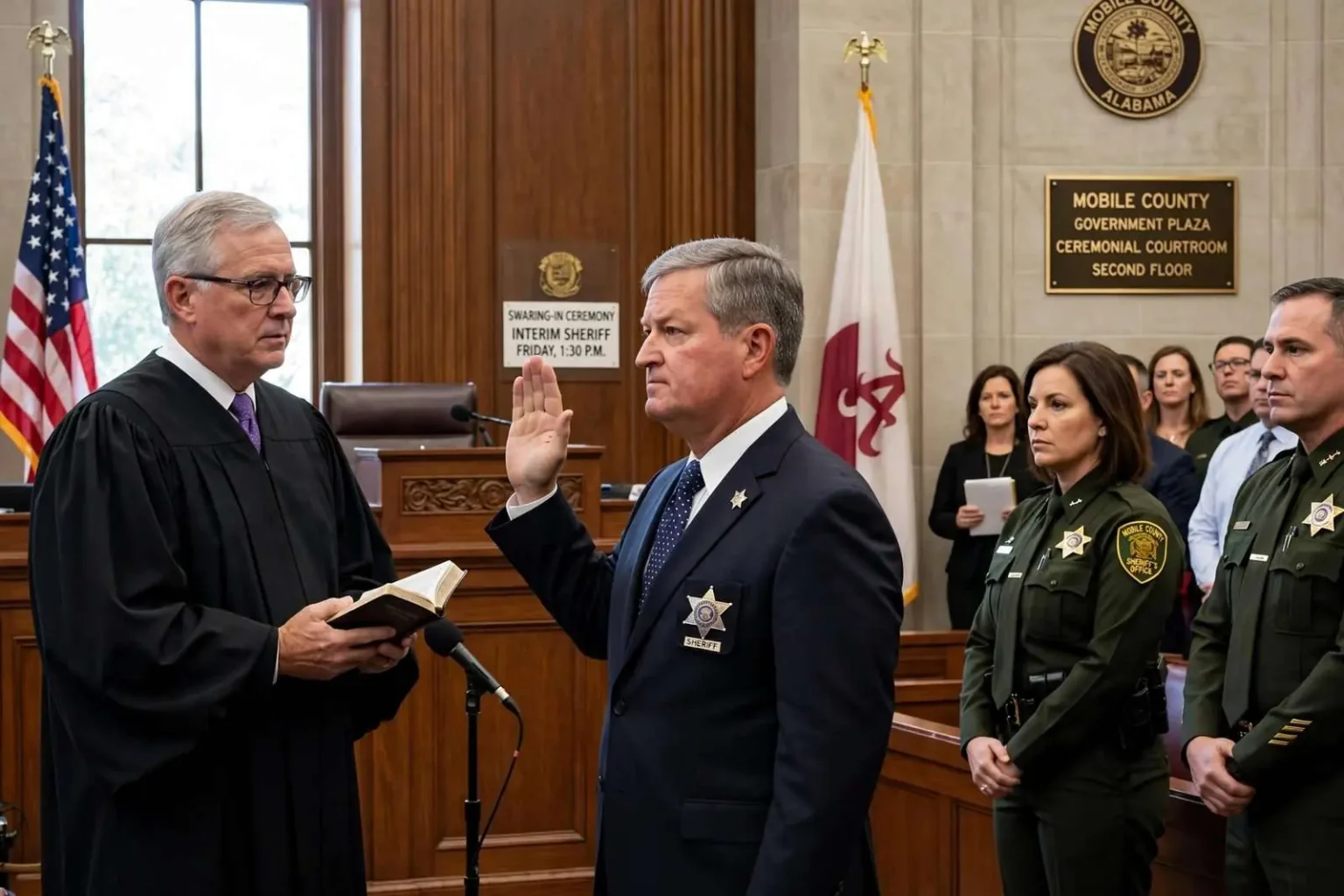
Sam Cochran, the newly minted Republican nominee for Mobile County sheriff, was set to be sworn in as interim sheriff on Friday afternoon, taking the reins of a department that had passed through turbulent hands over the preceding months. The ceremony was scheduled for 1:30 p.m. in the ceremonial courtroom on the second floor of the courthouse section of Government Plaza, and the public was invited to what officials expected to be a brief occasion.
Cochran, 51, who had recently retired as chief of the Mobile Police Department, won the GOP nomination for sheriff by claiming 55 percent of the vote against four other candidates, enough to avoid a runoff and take the nomination outright.
An Outright Win in a Crowded Field
Outright victories are far from guaranteed in crowded primaries, where a large field often splits the vote and forces the top two finishers into a runoff. Cochran’s ability to clear a majority against four opponents spared his campaign the expense and uncertainty of a second round and let him turn immediately to the general election and, now, to the interim duties of the office he hoped to hold in his own right.
The mathematics of a five-candidate race reward whoever holds a firm base. With four rivals dividing the remainder of the electorate, a candidate who crosses 50 percent on the first ballot has typically consolidated support across more than one constituency — in Cochran’s case, a law enforcement résumé that resonated with the department’s own personnel and with the party’s regular voters alike. Avoiding a runoff also mattered strategically in a compressed calendar: a second round would have consumed six more weeks of fundraising and campaigning while the sheriff’s office sat in interim hands.
The primary result carried double weight because of the vacancy it addressed. Under the sequence Alabama parties followed in such cases, the nominee would assume the office in an acting capacity as soon as the party’s choice was settled — which meant Cochran’s primary victory did not merely position him for November. It handed him the department immediately.
Filling a Vacancy
The interim appointment made Cochran the successor to David Evans, whom Gov. Bob Riley had tapped weeks earlier to fill the post temporarily. The office had come open when former Sheriff Jack Tillman left under a plea bargain with the district attorney’s office.
Tillman’s departure closed a chapter that had shadowed the department for years. The longtime sheriff resigned after pleading guilty to misdemeanor charges stemming from a wide-ranging investigation, ending his tenure in a courthouse rather than at the polls and leaving the county’s top law enforcement office in the hands of an appointee with no mandate beyond the governor’s selection. Evans, serving in that bridge role, was understood from the outset to be a caretaker — a steady presence who would keep the department running until the political process produced a successor.
The arrangement is a familiar feature of Alabama government. Sheriffs hold constitutional office in the state, and when one departs midterm the seat does not pass to an automatic successor; instead, the governor appoints a temporary holder, with the expectation that the party apparatus and the electorate will resolve the question at the next election. In a county the size of Mobile — home to the state’s largest sheriff’s office operations, including the county jail and enforcement across the county’s unincorporated stretches — the interim period is watched closely, because the department’s daily business does not pause for politics.
From the outset, it was understood that Evans would serve only until the Republican Party settled on its nominee for the fall general election, a role Cochran secured with his primary victory. Interim appointments of this kind are common when an elected office falls vacant between elections, bridging the gap until voters or, as here, a party can settle the succession.
For the deputies and staff of the sheriff’s department, the arrangement offered a clear chain of command after a stretch in which the top job had changed hands more than once. Continuity matters in a uniformed service: budgets, jail operations, patrol shifts and court security all run on schedules that a leadership vacuum disrupts, and each transition of command ripples down through the ranks. Cochran’s swearing-in gave the department a leader with an expiration date measured in elections rather than in appointments, which is as close to permanence as an interim office allows.
A Fall Contest Still Ahead
The swearing-in did not end the political questions surrounding the sheriff’s office. Democratic opposition was anticipated in the November general election, though there was some dispute over who would carry the party’s banner. DaVon Grey had won the Democratic primary, but his victory faced a challenge over his campaign’s failure to file financial disclosures as the rules required. Bail bondsman Clint Ulmer had finished a distant second to Grey in that primary.
The dispute placed the Democratic nomination in procedural limbo. Campaign finance rules exist to give the public a view of who is funding a candidate, and a failure to file — unlike a question of vote counting — is typically resolved by party committees or the courts rather than by ballots. Depending on how the challenge was resolved, the general election could proceed with Grey as the nominee, with Ulmer substituted in his place, or with the party’s slate otherwise adjusted, each outcome carrying its own implications for a race in which the Republican nominee was already in office.
That asymmetry defined the fall campaign’s terrain. Cochran would run as an incumbent with months of actual command behind him; his Democratic opponent would run against a record that was still being written. Interim tenures cut both ways in this respect — they give voters a preview, but they also expose every misstep to the same scrutiny an elected sheriff would face.
From Police Chief to Sheriff
For Cochran, the interim post amounted to a return to the top of county law enforcement, capping a career that had carried him through the ranks of the Mobile Police Department to its chief’s office. His allies pointed to that experience as an asset, while the interim tenure would give voters a look at how he ran the sheriff’s department before they rendered their verdict at the polls in the fall.
The two offices are related but distinct. A police chief answers to a mayor and administers a city department organized around patrol, investigations and the specialized units a major city requires. A county sheriff in Alabama answers directly to the voters, and the office bundles responsibilities no city department combines: operating the county jail, serving the courts, executing warrants and civil process, and providing law enforcement to unincorporated communities that have no police department of their own. The management challenge is broader and the political accountability more direct.
Cochran’s decades inside the Mobile Police Department gave him name recognition across the county and credibility with the uniformed services whose cooperation the sheriff’s office depends on. Retiring as chief and immediately seeking the sheriff’s office followed a well-worn path in Alabama politics, where experienced police executives frequently translate their service records into countywide runs.
The transition also carried practical benefits for the department’s workforce. A new sheriff arriving with four decades of street-level and command experience does not need months to learn the organization’s rhythms, and deputies knew going in that the incoming chief officer understood the job from the inside — a reassurance of sorts after an interim period in which the office’s leadership had been, by design, temporary.
A Brief Ceremony With Practical Effect
The ceremony itself promised little pomp. Its practical effect was simply that, as of Friday afternoon, the badge of Mobile County sheriff would rest with Cochran, offering a measure of stability to a department that had seen more than its share of upheaval.
Swearing-ins for interim officeholders are typically working occasions rather than celebrations, and the 1:30 p.m. slot in the ceremonial courtroom reflected that. Government Plaza — the shared downtown home of Mobile’s city and county governments — houses the courtrooms where such oaths are administered, and the choice of a public venue meant deputies, department staff and ordinary citizens could witness the transfer of authority in person rather than read about it afterward.
The formality matters more than its brevity suggests. An oath of office converts a political victory into legal authority: until the words are administered, a nominee has a title in waiting but no command. From the moment the oath was complete, Cochran’s orders carried the weight of the office, and the department’s chain of command — disrupted since Tillman’s departure — ran through a single, settled line again.
For the county’s judges, prosecutors and municipal police chiefs, the settling of the office also restored an institutional counterpart. The sheriff sits on the county’s emergency management and public safety structures, signs off on interagency agreements, and answers to the public in ways that affect every jurisdiction in the county. Months of caretaker leadership had kept those functions alive; a nominee-in-office could begin making decisions with a longer horizon.
What Came Next
Cochran’s immediate agenda was effectively set for him. He would run the department through the remainder of the term, prepare it for whatever the general election’s outcome brought, and present himself to the county’s voters over the summer and fall not as a candidate describing what he would do, but as an officeholder demonstrating what he had done.
The residual legal and political questions — the challenge to the Democratic nomination foremost among them — would resolve on their own calendars, independent of the department’s operations. Either way, November would deliver the verdict that interim arrangements defer: an election in which the office finally passed to someone holding it by vote rather than by appointment or party designation.
Until then, the county had what it had lacked since the investigation and resignation that opened the vacancy — a sheriff with a mandate of his own, even if that mandate came from a primary ballot rather than a general one, and a department whose top job had, for the first time in months, a foreseeable future.
The turbulence that preceded the afternoon was not forgotten. But the ceremony’s brevity was itself the point: a department does not need theater to recover its footing, only a leader whose authority no one in the building has to ask about. As of Friday afternoon, Mobile County had one.