Shelby Pressed the Case Against the Estate Tax, Calling It a Threat to Family Farms and Small Business
In June 2006, Sen. Richard Shelby argued that the federal estate tax, scheduled to return in 2011, threatened family farms and small businesses, and pressed for permanent repeal after a Senate defeat.
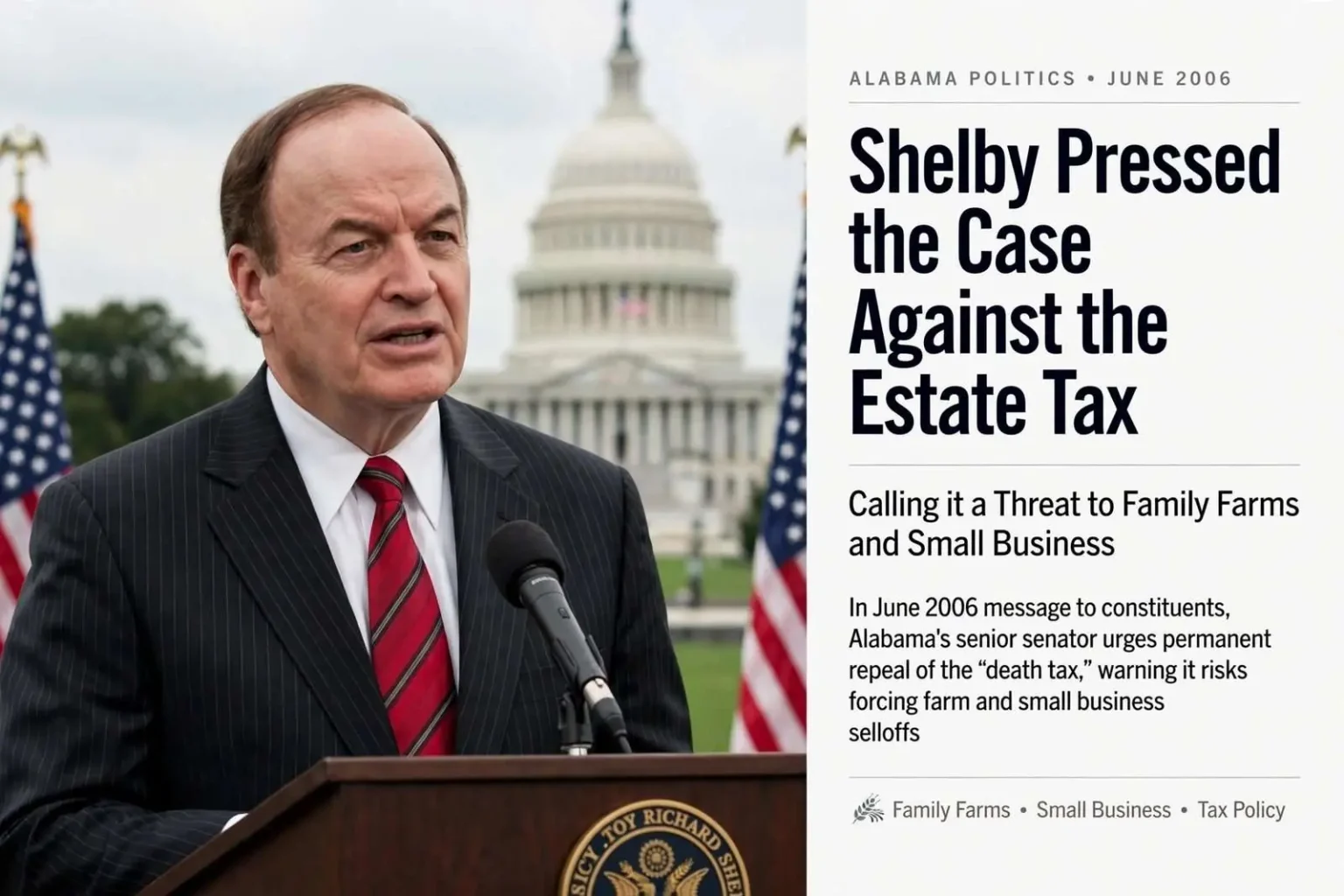
U.S. Sen. Richard Shelby, R-Ala., used a June 2006 message to constituents to press one of the central tax fights of the decade, arguing that the federal estate tax — which he called, as its critics long had, the “death tax” — posed a direct threat to family farms and small businesses and should be permanently repealed. Shelby, Alabama’s senior senator and at the time chairman of the Senate Committee on Banking, Housing and Urban Affairs, had spent years arguing that the tax punished families for the act of building something worth passing on, and he treated the issue as one of the defining economic questions facing Washington that decade.
The occasion was a defeat. The Senate had recently taken up a House-passed measure, H.R. 8, the Death Tax Repeal Permanency Act of 2005, which sought to make repeal permanent. It did not pass. Shelby made clear he considered that a failure of the chamber, and his message to Alabamians read as both an explanation of what had gone wrong and a promise to keep pushing for the outcome he wanted.
The Sunset Problem
The heart of Shelby’s argument was a quirk of legislative drafting. In 2001, Congress passed a law gradually phasing out the estate tax, with complete elimination arriving in 2010. But the same bill carried a sunset provision that would reinstate the tax just one year later, in 2011. Absent congressional action, Shelby warned, all of that progress would be reversed.
The sunset clause was not an oversight. The 2001 tax bill had moved through the Senate under budget reconciliation rules, which allowed passage with a simple majority but capped the measure’s effect on federal deficits. Drafters wrote the expiration date to fit within the budget window, leaving the final stage of the phase-out — full repeal in 2010 — followed by the return of the pre-2001 law the very next year. The result was what critics on both sides called a legislative cliff: a single year without the tax, then its full reinstatement unless Congress acted again.
Before the 2001 tax cuts, he noted, family farms, small businesses and other holdings passed on to family members faced a rate he described as a crippling 55 percent upon the owner’s death. Without a permanent fix, that rate would return. Under the old schedule, the top rate applied only to the largest estates, but the statutory top rate itself was the number that stuck in the minds of farm and business owners — and in the speeches of the tax’s opponents.
“The death tax places an undue burden on our nation’s family-owned farms and small businesses,” Shelby wrote. “These individuals work tirelessly day in and day out to make their own way, to contribute to society and the economy only to be told their loved ones will be punished when they die.”
The practical problem, as he presented it, was one of liquidity. A family might be wealthy on paper — in acreage, in equipment, in a fleet of boats or a busy practice — while holding little actual cash. When the tax bill came due nine months after death, the only ready source of money could be the sale of the assets themselves: a stand of timber cut early, a farm subdivided, a shop liquidated. That was the scenario the 55 percent rate made concrete, and the one his constituents feared most.
The Argument He Made
Shelby’s case rested on several linked claims, each aimed at a different way the tax could reach into a family’s affairs.
The first was forced sales. He said he too often heard of sons and daughters forced to sell part, if not all, of a legacy their parents had built simply to pay estate taxes. For families whose holdings had taken a lifetime — or several lifetimes — to assemble, the prospect of dismantling them to satisfy a tax bill was the emotional core of the issue, and the one that animated repeal advocates across the South and the Midwest.
Then came the character of the businesses involved. Whether a construction company, a cattle farm or a medical practice, he argued, such enterprises require significant investment in land, equipment and materials that quickly exceed the exemption threshold. Those investments, he wrote, are not part of the business — they are the business. An excavator, a herd, an examination room: these were not luxuries that could be trimmed to raise cash, but the operating assets without which the enterprise stopped functioning.
Next was double taxation. He described the estate tax as a second bite at the apple, taxing assets that had already been taxed as income. A farmer’s profits had been taxed when earned; the land bought with them had been taxed through property levies; and now, at death, the whole holding faced taxation a third time. In his telling, the tax reached money that had never enjoyed a free ride through the code in the first place.
Closely related were the effects on saving. Punitive taxes, in his telling — including the estate tax, the capital gains tax, the dividend tax and the gift tax — discouraged the saving and investment that drive economic growth. Shelby grouped the estate tax with the rest of the code’s taxes on accumulated wealth, arguing that each one weakened the incentives of the people most likely to reinvest, expand and hire.
Finally, there was complexity. He called the estate tax one of the more complicated taxes to comply with in what he described as a bloated code. Valuing a working farm meant appraising timber, crops, livestock and equipment; valuing a small company meant dividing interests in a business that might have no ready market; and estates that straddled the line of liability often spent years in back-and-forth with the Internal Revenue Service over figures that could swing the outcome by hundreds of thousands of dollars. Compliance costs, he argued, fell on precisely the families the tax’s defenders said it was designed to spare.
One Step in a Larger Project
Shelby framed all of it as one step in a larger project. He said he remained a strong advocate for a simplified tax code that treats all taxpayers fairly, and that until there was consensus to overhaul the code entirely, he would push legislation that reduced the burden incrementally. Estate tax repeal, in that framing, was not an isolated cause but part of a broader program: lower and simpler taxes on the people who saved, invested and passed on working assets.
Why It Landed in South Alabama
The argument had particular resonance in the region Shelby’s state sends to Washington from its southern counties. Southwest Alabama’s economy has long rested on exactly the kinds of assets Shelby described: timberland in Washington, Clarke and Monroe counties, held in families for generations; farms across Baldwin and Escambia counties; shrimp boats and seafood houses in Bayou La Batre and Coden; small construction firms, marine businesses and independent medical practices across the region.
Timber in particular is Alabama’s story. Much of the state’s rural economy grows on privately owned forestland, and a large share of that land is held by families rather than corporations — tracts passed down through wills and family agreements, occasionally sold in parcels when a generation turns over. Along the coast, the shrimp fleet of Bayou La Batre and Coden represents boats, licenses and processing houses assembled over decades, often within a single family. These are enterprises whose value sits in land, boats, timber and equipment rather than in cash, which is precisely what makes an estate tax bill difficult to pay without selling something.
Whether the tax in practice hit as many family farms as its opponents claimed was, and remains, a matter of genuine dispute among economists, since exemption levels shielded most estates from any liability at all. By the mid-2000s, the federal exemption had climbed far enough that only estates above roughly $2 million — doubled in later years — owed any tax, and studies of actual returns found that very few working farms or businesses paid it. Critics of repeal argued the horror stories were rare exceptions; supporters answered that the threat alone distorted planning, forcing families into life insurance, trusts and gifting schemes to protect assets they should have been free to pass on.
But the political potency of the argument in a region of land-rich, cash-poor family businesses was never in doubt. In counties where a family’s net worth might be almost entirely woodland or waterfront, the abstract question of who actually owed the tax mattered less than the plain-sounding claim that the government would take half of what a parent built when the parent died. Shelby’s message was written for exactly that audience.
What Happened Next
The repeal Shelby sought never became permanent in the form he described. Congress ultimately allowed the 2010 repeal to take effect for a single year — and then, at the end of 2010, restored the estate tax at a lower rate with a substantially higher exemption. The year-end legislation set the top rate at 35 percent and the exempted amount at $5 million per person, figures that replaced the 55 percent top rate and far smaller exemptions Shelby had warned about in his message.
Subsequent legislation raised the exemption further still, leaving the tax on the books but reaching a far smaller number of estates than the 2001-era rules would have. Later changes made the law permanent rather than subject to another sunset, raised the rate modestly, and indexed the exempted amount to inflation — so that each year a larger share of family estates, even sizable ones, passed without federal estate tax liability.
For Alabama, the practical effect was that the full 55 percent rate Shelby had warned about never returned. Families planning inheritances after 2010 faced a tax that arrived at a lower rate, above a higher threshold, with more room to plan around it — a landscape far removed from the pre-2001 rules that had shaped the repeal movement’s rhetoric. At the same time, the tax never disappeared, so the argument over it never quite ended either; each proposal to raise or lower the exemption rekindled the same dispute about land-rich enterprises and forced sales.
A Snapshot of a Fight in Progress
Read from the present day, the June 2006 message is a snapshot of a fight in progress, delivered by a senior appropriator to constituents in a state where the phrase “family farm” still describes a real thing. It captures the debate at the moment the 2001 law’s temporary architecture was beginning to look untenable — with full repeal one Congress away on the calendar, but no agreement in sight on making it stick.
Shelby’s constituents in south and southwest Alabama would go on reading versions of that argument for years: in messages about the one-year repeal, about the 2010 compromise, and about every later attempt to raise the exemption or abolish the tax outright. The core claims did not change. That heirs should not be forced to sell the family place to pay the government; that a business made of land, boats, timber and machines is more than an accounting entry; that a tax collected at death is unlike any other the federal government levies.
What changed was the arithmetic underneath. The exemptions grew, the top rate fell from 55 percent to figures in the high 30s, and the estates actually subject to the tax dwindled to a small fraction of those in existence. The political argument, meanwhile, survived on its own terms — less as a description of what most families faced than as a statement of principle about what the government ought to demand of them at the moment of loss.
Shelby, who would remain in the Senate for another decade and a half after that message, kept his position throughout. For the farms of Baldwin and Escambia counties, the timber tracts of Washington, Clarke and Monroe, and the seafood houses of Bayou La Batre, the June 2006 message remains a record of where their senior senator stood when the outcome was still genuinely in doubt — and of the argument he made, in plain terms, to the people who elected him.