Judge-Elect’s Law License in Jeopardy After Supreme Court Rejects Discipline as Too Lenient
Circuit Judge-elect Stuart DuBose faced renewed bar discipline in late 2006 after the Alabama Supreme Court rejected a suspension timed to begin the day after the election as too lenient.
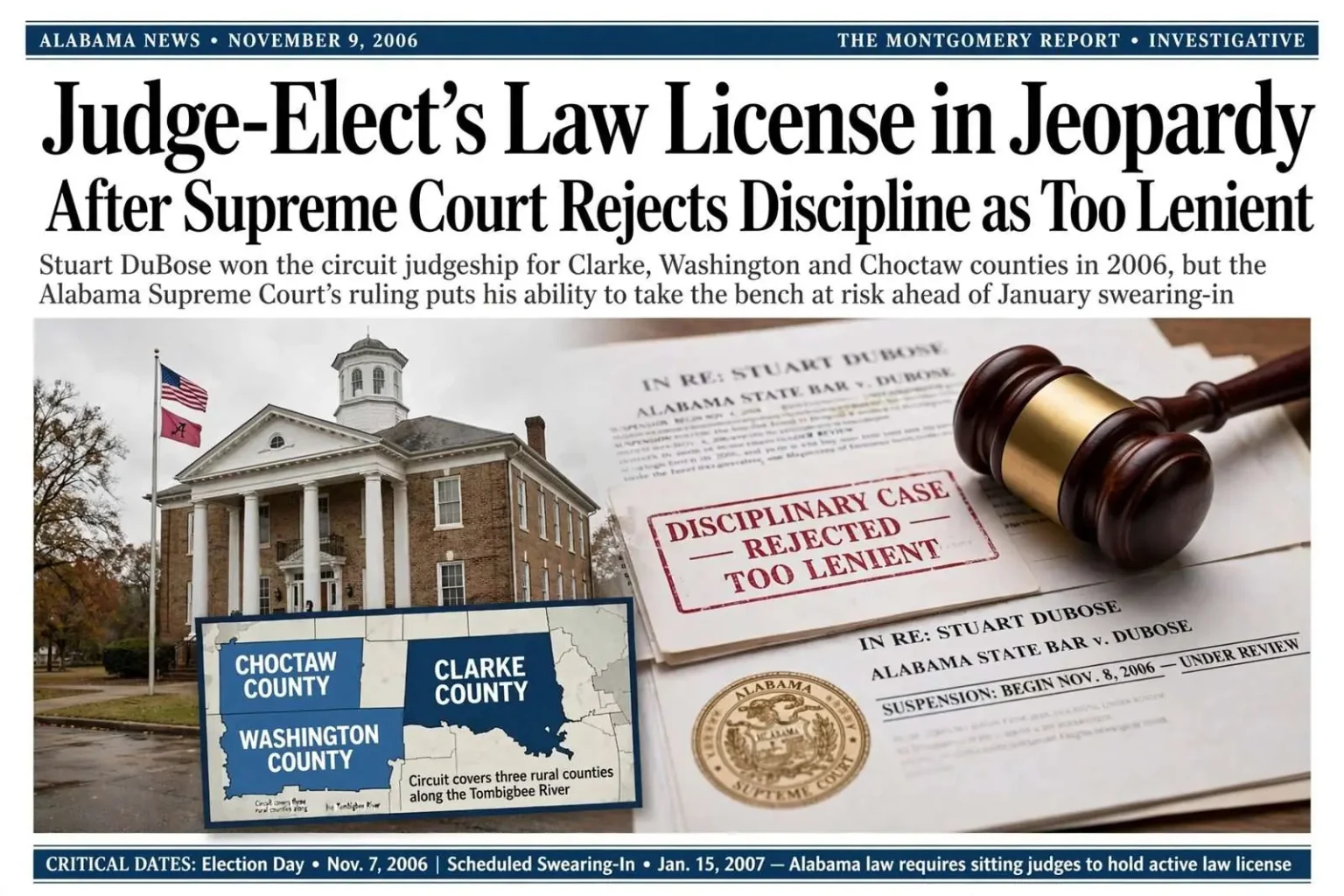
Stuart DuBose won a circuit judgeship serving Clarke, Washington and Choctaw counties in 2006, but as the general election approached his ability to take the seat was thrown into doubt by a disciplinary case that the Alabama Supreme Court refused to let quietly resolve itself.
The episode placed a rare question in front of the state’s courts: what happens when the voters elect a judge whose own law license is under suspension at the moment he is supposed to take the bench? Alabama law links judicial eligibility to holding a law license, and the answer in a case like DuBose’s would determine whether an election already decided by the public could be undone by the state’s disciplinary machinery.
The estate case
DuBose had been sued in connection with his handling of a will. The complaint accused him of failing to exercise the proper standard of care in safeguarding his client’s interests. He had claimed a 40 percent fee, or $1.2 million, for defending a will he had himself prepared for a dying man he had never met.
The combination of roles at the center of the complaint — drafter of the will, defender of the will, and claimant to a fee measured in seven figures — was what gave the case its notoriety in courthouse conversations. Estate disputes can turn on obscure documents and strained families, but the underlying question was a plain one: whether an attorney who wrote the instrument, then charged against the estate to protect it, had acted within the standard of care the profession requires. The dollar figures made the dispute impossible to ignore in the small counties where it would be heard.
The civil case, arising from a 2003 estate dispute, was settled. The Alabama State Bar Association’s disciplinary committee also resolved the complaint over DuBose’s conduct. With both tracks apparently closed, the matter might have ended there — a costly episode, a settlement, and a bar complaint resolved without public sanction. The Alabama Supreme Court had other ideas.
Separately, and to the considerable amusement of the courthouse bar, DuBose had appeared as a plaintiff in another lawsuit in which he argued that he was completely disabled as a result of a malfunctioning La-Z-Boy recliner. The recliner case traveled through the region’s legal circles as a running joke, the kind of filing that lawyers retell at the courthouse coffee pot for years. Its presence in the public record did DuBose no favors among colleagues, even as it had no formal bearing on the disciplinary question before the court.
The timing of the suspension
The bar’s disciplinary committee suspended DuBose from the practice of law beginning Nov. 8, 2006, the day after the general election. That date was not incidental. Alabama law requires a judicial candidate to hold a law license on Election Day. A suspension beginning Nov. 8 left DuBose licensed on Nov. 7, precisely satisfying the requirement while still imposing a sanction.
The construction was elegant and, to critics, transparent. A suspension timed to begin the day after Election Day preserved every legal requirement a candidate must meet while imposing discipline that would never touch the day that mattered. Whether the arrangement reflected careful lawyering, accommodation between the committee and the candidate, or simply an agreed schedule, its effect was plain: DuBose could be elected with his license intact, then suspended from practice before ever taking office.
The Alabama Supreme Court was not persuaded. It rejected the punishment as too lenient, a ruling that reopened the entire question and put in jeopardy DuBose’s ability to claim the seat to which voters had elected him. The court’s intervention transformed what had looked like a settled arrangement into a live constitutional problem, and it sent the case back to the disciplinary process with the stakes now attached to a judgeship rather than merely to a law practice.
Two dates that mattered
DuBose was required to face the bar association’s disciplinary body again. The stakes were precise and mechanical. If he were found guilty of the complaints and given a suspension of his law license that overlapped either of two dates, the Alabama Constitution would disqualify him from serving as judge: Election Day, Tuesday, Nov. 7, 2006, and his scheduled swearing-in, Jan. 15, 2007.
Absent a setback before the bar, DuBose was scheduled to take office on that January date. The constitutional test thus bracketed the entire transition: a suspension spanning the first date would erase the qualification under which he had run, and one spanning the second would bar him from the oath itself. Between those dates stood only the disciplinary process, which the Supreme Court had already shown it would not treat as a formality.
Popular with voters, less so with lawyers
DuBose had won a hard-fought Democratic primary over Chris Bailey by 93 votes to claim the party’s nomination for the circuit judgeship covering Clarke, Washington and Choctaw counties. No one sought the Republican nomination, which meant the primary was effectively the election. A margin of ninety-three votes across three counties is the sort of result that invites recount talk, but it also demonstrated something a wider margin might not: the race was genuinely contested, and the voters who turned out for DuBose did so against an opponent with real support of his own.
In rural Alabama circuits, races for the bench often draw modest attention from the general public but intense interest among the local bar. Party primaries decide most judicial seats because one party fields no candidate in the general election, leaving the courthouse’s future to a summer electorate. That structure puts enormous weight on name recognition, family ties and community standing — the qualities that decide small-town elections — rather than on the professional reputation a candidate holds among fellow lawyers.
The campaign demonstrated at least one thing clearly: DuBose was considerably more popular with the general voting public than with his colleagues at the bar.
A deposition taken in preparation for the civil trial in the estate case may help explain the gap. Asked about a written statement in which he had said he expected from the beginning that there was no legitimate basis for attacking the validity of the will, DuBose was questioned about whether that statement had been untrue. He answered that it was, describing it as “an intentional misrepresentation” made to opposing counsel in order to discourage him.
Asked whether he routinely sent letters to other lawyers containing misrepresentations, DuBose replied: “Yes, sir, I probably do.”
The exchange became the case’s defining moment, quoted in courthouse conversation and eventually in coverage of his election. Candor toward opposing counsel is among the profession’s baseline obligations, and an attorney’s own sworn acknowledgment that misrepresentation was routine cut directly against the standard the disciplinary process exists to enforce. DuBose’s attorney noted that it was his client’s position that he was obligated to present his client’s case in the best light possible — an advocacy rationale that many lawyers would accept in the abstract but that few would stretch to cover statements described as intentional misrepresentations.
The tension between those two accounts captured the gap the election had exposed. Voters in the river counties knew DuBose as a familiar local figure, a lawyer with deep roots and a name they recognized on the ballot. Lawyers who had dealt with him knew the deposition, the fee claim and the recliner suit. The Alabama Supreme Court’s willingness to reject the negotiated suspension meant that, for once, the second audience’s judgment carried formal consequences.
Why it mattered in the river counties
Clarke, Washington and Choctaw counties form a rural stretch of southwest Alabama where the circuit court is one of the most consequential institutions in daily life, handling everything from timber disputes and estates to criminal dockets. The judge who presides there wields real authority over a population with few alternatives and little insulation from the outcome.
The counties’ economies and their court dockets are intertwined. Timberland holdings change hands in transactions measured in decades, family estates pass through probate in courthouses in Grove Hill, Chatom and Butler, and criminal cases arrive from sheriff’s offices stretched across territory that takes hours to patrol. A circuit judge in such a place decides questions — titles, inheritances, sentences — that families carry for generations, and appellate review is a rare corrective rather than a routine check.
That a judge-elect might be barred from taking office by his own professional discipline was, accordingly, more than a curiosity. It raised the practical question of what would happen to a seat that voters had already filled, and the larger one of what standard of candor the citizens of Grove Hill, Chatom and Butler were entitled to expect from the person on the bench.
The practical machinery behind that question was not simple. If a judge-elect were disqualified, the seat’s fate would fall to gubernatorial appointment or special election under state law, meaning the public’s choice could be replaced by a selection made in Montgomery. Voters who had turned out in a contested primary to choose their judge would find the decision taken out of their hands by a suspension schedule — the precise outcome the Alabama Constitution’s license requirement exists to prevent, but one that leaves the electorate’s role hollow. The DuBose case forced the river counties to watch that collision play out in real time, between an election already held and a disciplinary process the Supreme Court had refused to let serve as a rubber stamp.