A Washington County High School Graduate Just Got Honored by the Flying Bricks Community Band for Years of Service
Hayden Chafin, a recent Washington County High School graduate, was honored by the Flying Bricks Community Band for his service to the group alongside fellow member Chris Beverly.
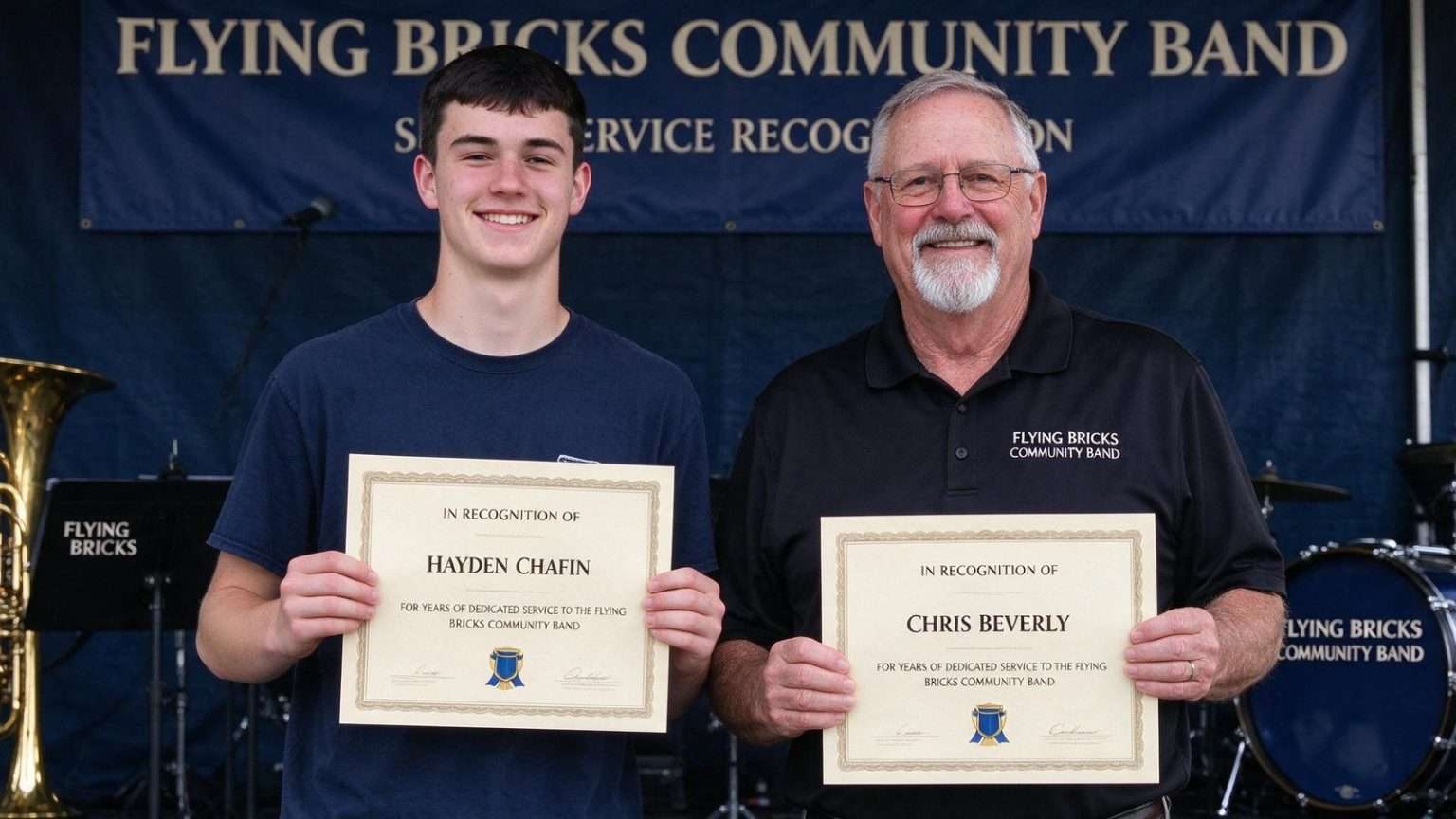
Hayden Chafin, a recent graduate of Washington County High School, was recognized by the Flying Bricks Community Band for his service to the group, a small but longstanding piece of Washington County’s local music scene. The recognition placed Chafin among the community musicians whose quiet, year-in and year-out commitment keeps rural Alabama’s volunteer bands alive, and it came at a moment of transition in his own life as he moves from high school into whatever comes next.
Chafin was honored alongside fellow band member Chris Beverly in recognition of his contributions to the community band, according to the Clarke County Democrat and Thomasville Times, which both featured the recognition this week. Community newspapers in the region have long served as the primary record for these kinds of honors — the recognitions that never make larger outlets but that matter a great deal in small towns, where the people being celebrated are neighbors and the organizations being supported are fixtures of civic life.
The Flying Bricks Community Band occupies a role that larger communities rarely have to think about. In Washington County, where the population is spread across small communities like Chatom, McIntosh, Millry and Leroy, there is no professional orchestra, no municipal concert series and no standing institution for instrumental music outside the schools. The community band fills that space, giving musicians of all ages a place to play and giving residents a local live music tradition they can count on.
The Role of Community Bands in Rural Alabama
Community bands like the Flying Bricks have long served as one of the few consistent outlets for amateur and semi-professional musicians in rural South Alabama counties. They offer performance opportunities that don’t require the infrastructure of a school program or a professional orchestra — no conservatory credentials, no auditions by mail, no travel to a distant city. A player brings an instrument, shows up for rehearsal and earns a seat. For adults who played in school and never stopped, and for students who want more music than the school calendar provides, that accessibility is the whole point.
The tradition runs deep in the region. Across Alabama’s rural counties, community bands, church music programs and family ensembles have carried instrumental music through generations, often with no dedicated facility and limited budgets. Rehearsals happen wherever space can be found, concerts happen in school gyms, community centers and town events, and the organizations survive on the willingness of members to keep showing up. Bands that last for decades do so because someone is always willing to organize the next performance.
Recognitions like Chafin’s tend to mark not just individual achievement but the ongoing survival of these small, volunteer-driven musical groups in towns too small to support a full-time performing arts organization. When a community band honors a member, it is also telling its own story: that the group is still active, still valued, and still investing in its people. Honors like this one function as a public thank-you and as a signal to younger musicians that their service is noticed.
Washington County and Its Music
Washington County sits in Alabama’s southwestern corner, bordering Mississippi, and its communities have historically sustained music through schools and churches. The county’s school music programs carry a heavy load in a place where few other structured musical outlets exist, and graduates who keep playing after high school typically do so through community groups. The Flying Bricks Community Band represents that continuation — the place where a school musician’s playing life does not have to end at graduation.
Chafin’s recognition comes as he transitions out of high school, a common moment for community band members in rural counties, where membership often shifts as young musicians graduate and move on to college, work or military service elsewhere. The pattern shapes these organizations profoundly. Each spring brings departures; each year depends on finding players willing to fill the chairs. Bands that survive learn to value every member’s tenure, however long or short, which is why service recognitions are woven into the culture of groups like the Flying Bricks.
For a recent graduate, the honor also marks a crossing point. School band membership is structured — directors, schedules, graded expectations. Community band membership is chosen. The players who join after high school do it for the music and the company, on their own time, and those who make real contributions while still students are often the ones who set the example for the classes behind them. That is the kind of service a community band notices and, in Chafin’s case, formally recognized.
Why Local Recognition Matters
In small towns, recognition travels differently than it does in cities. The Clarke County Democrat and the Thomasville Times reaching their readers with Chafin’s story means the honor was witnessed by the community that benefits from it — the families who attend concerts, the neighbors who know the band members by name, and the students deciding whether to keep playing after graduation. Local newspapers remain the connective tissue of civic life in rural counties, and features like this one do quiet work: they tell young people that showing up matters, and they tell volunteers that their hours are seen.
The same dynamic applies to the honored musicians’ futures. Whether Chafin stays in Washington County or moves away for school and work, the experience of being counted on by a community organization travels with him. Rural Alabama’s out-migration is a persistent reality — young people leave for education and employment — and community organizations like the Flying Bricks live with the resulting churn. The groups that persist are the ones that keep extending the invitation to every new class of graduates.
Chris Beverly’s recognition alongside Chafin underscores the same point from the other direction. Community bands are mixtures of ages and tenures — longtime players who anchor the sound, newer members who keep it young — and honoring two members together reflects that blend. The health of such an organization is measured less by any single performance than by whether it continues to generate the kind of commitment that earned these two musicians their recognition.
The Broader Picture for Rural Arts
Stories like this one illustrate how the arts survive in places without cultural institutions. There is no grant office in a town the size of Chatom, no arts council budget keeping a band alive. The Flying Bricks Community Band persists the way rural organizations always have: through volunteers, local support and the simple habit of playing. Every recognition ceremony, every newspaper feature and every concert strengthens the habit.
For Washington County, the honor given to Hayden Chafin and Chris Beverly is a small event with a larger meaning — proof that the county’s musical tradition has a next generation, and that the community notices when its young people invest in it. The band’s work goes on, the rehearsals continue, and the chairs that graduating seniors leave behind wait for the next players willing to fill them.
How Community Bands Work
For readers unfamiliar with the format, a community band operates on a model that has changed little over the past century. Membership is open — typically to anyone who plays a band instrument at a functional level — and the repertoire draws from marches, concert standards, pops arrangements and patriotic fare suited to civic events. Rehearsals run weekly or near-weekly, often in borrowed space, and the performance calendar follows the community’s rhythms: holiday concerts, summer programs, festivals and hometown celebrations. No one is paid at the scale of a professional; the reward is the playing itself and the role the band plays in town life.
That simplicity is also the band’s vulnerability. A community band has no institutional safety net. If a director moves away, the group must find another from within its own ranks. If the percussion section graduates, someone must recruit. If attendance at concerts drops, the band keeps playing anyway and hopes the audience returns. Organizations like the Flying Bricks persist through exactly the kind of member dedication that the recent recognition celebrated, and their longevity is measured in the accumulated service of players like Chafin and Beverly.
The educational function of these groups deserves mention as well. In rural counties, a community band is often where a young musician first plays mature repertoire, sits next to an experienced adult player and learns the habits of ensemble musicianship beyond the school room. The intergenerational makeup — students beside veterans, beginners beside players with decades of experience — is something school programs cannot replicate and professional ensembles never attempt. It is one of the quiet strengths of the community band tradition, and it is why transitions like graduation matter so much to the groups’ continuity.
The Year Ahead for Chafin and the Band
For Hayden Chafin, the honor arrives at the threshold moment every Washington County High graduate faces: decisions about college, work and military service that determine whether he remains a local musician or carries his playing somewhere else. Either way, the recognition stands as a record of what he gave the group while he was in it, and it joins the long list of small civic honors — baseball team photos, 4-H awards, church recognitions — that make up the public memory of a rural community.
For the Flying Bricks Community Band, the celebration is both a pause and a continuation. The band will keep its rehearsal schedule, prepare its next program and recruit the players who will fill the seats as members move on. The Washington County music scene it anchors is not the kind that generates headlines, but it is the kind that endures — one graduate, one recognition, one concert at a time. The Clarke County Democrat and Thomasville Times did their part by telling the story; the band does its part by continuing to play; and musicians like Chafin and Beverly have done theirs by showing what commitment to a small-town institution looks like.
The lesson of the recognition extends beyond Washington County. Every rural county in South Alabama has an organization like the Flying Bricks — underfunded, overcommitted and essential — and each depends on the same renewable asset, namely young musicians willing to keep playing after the school year ends. The Flying Bricks have recognized theirs. The hope, as always in community music, is that the next generation is watching.