Cassanova’s Rendezvous Cafe: Chatom’s First and Only Bar
Cassanova's Rendezvous Cafe opened in 2009 as Chatom's first bar after the Washington County town went wet, drawing an unexpected cross-section of locals.
Chatom, the seat of Washington County, spent most of its history as a dry town where anyone wanting a drink had to leave town to get one. That changed when Cassanova’s Rendezvous Cafe opened its doors in 2009, becoming the first bar in town after local voters brought Chatom in line with state standards for alcohol sales roughly a year and a half earlier. For a courthouse town of about 1,200 people tucked into the piney woods near the Mississippi line, the arrival of a legal drinking establishment marked a genuine cultural turning point.
Washington County had long been among Alabama’s driest corners, one of the counties that held onto prohibition-era restrictions decades after the state began loosening them. The change did not come all at once, and it did not come without resistance. Even after the vote that made alcohol sales legal, old attitudes persisted in a county where church attendance remains high and where, for generations, the only answer to a Sunday dinner question about drinking was a firm no.
A bar hidden behind a storefront
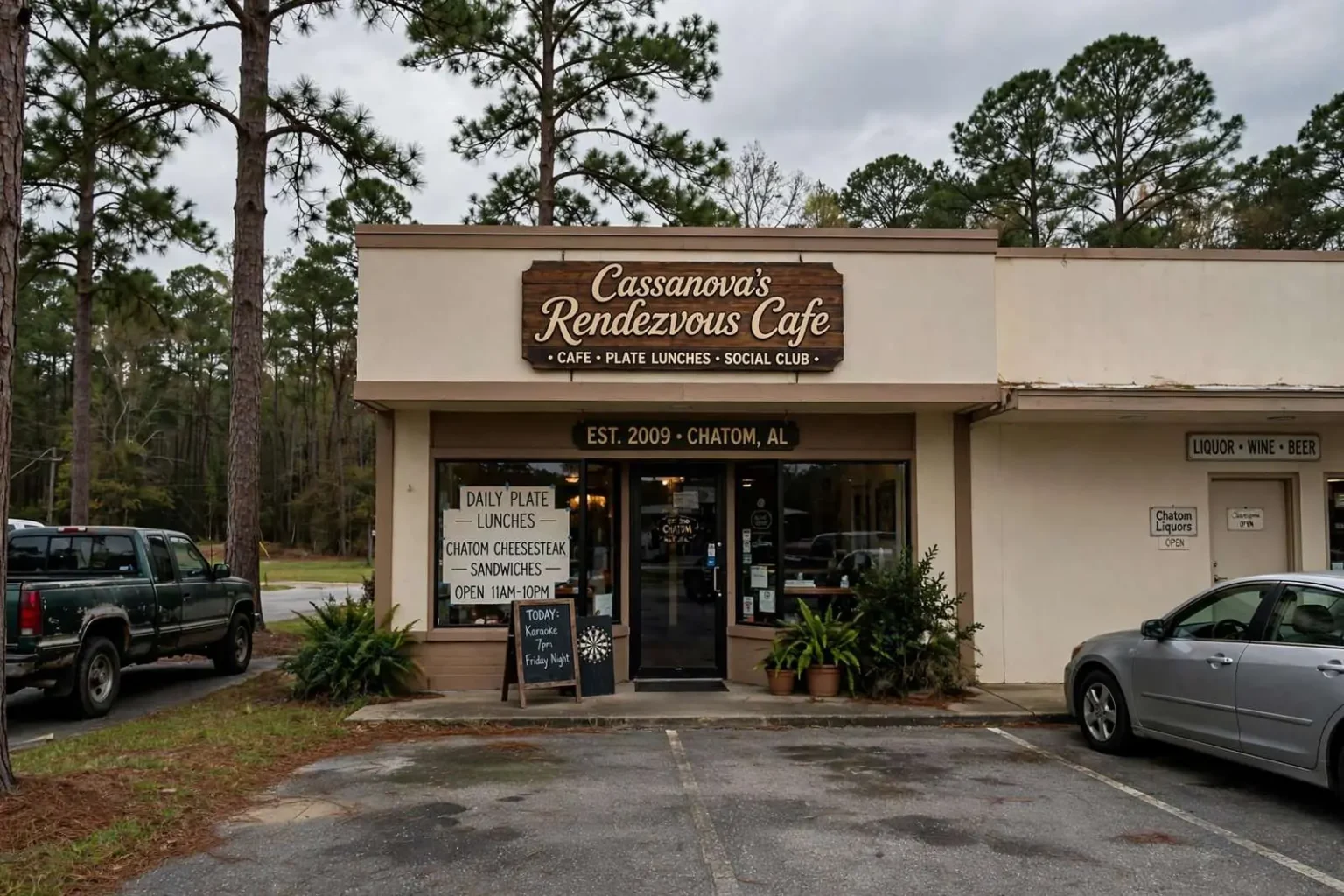
From the street, the business looks like an ordinary cafe in a strip mall on the edge of downtown. Diners pass through a small restaurant front before following a long hallway back to a single-room bar the owners call the social club. Inside, the room is fitted with dartboards, billiards tables, a handful of seating areas and a full bar along one wall, with a painted seaside veranda scene covering the back wall. A projector sometimes runs sitcoms over the bar on slow weeknights, giving regulars something to watch between games of pool.
The kitchen serves sandwiches and plate lunches — the house Chatom cheesesteak is a point of local pride — while the bar keeps a surprisingly respectable beer selection for a town of roughly 1,200 people. A separate party room hosts touring bands and karaoke nights on busier evenings, pulling in crowds from across Washington County and from neighboring communities in Clarke, Choctaw and Mobile counties that sit within an easy drive.
The layout itself says a lot about the town it serves. The cafe front lets a customer stop in for a plate lunch without ever walking past the bar, an accommodation to a community where some residents were ready for wet status and others were decidedly not. The long hallway in between functions almost literally as a buffer between old Chatom and new Chatom.
An unlikely cross-section of town
Owner Frankie Beech has built a clientele that cuts across the community’s usual lines. On a typical Thursday night the bar draws everyone from the town’s head librarian to its newly hired economic developer and the mayor’s son — a generation of Washington County leadership far more comfortable with the town’s wet status than their parents were. What might once have been a source of gossip in a small courthouse town has become an ordinary part of the social calendar.
Next door sits another first: Chatom’s first liquor store, which opened alongside the bar. Even so, old habits die hard in the deeply church-going county; longtime residents say plenty of prominent families still drive to Mobile County to buy their beer and liquor rather than be seen carrying a bag out of the local store. The roughly hour-long round trip to the bigger markets to the south is, for some, still preferable to a familiar face at the counter at home.
Chatom and Washington County context
Chatom serves as the governmental center of Washington County, a largely rural county of about 15,000 people along the Mississippi border where timber, small farming and commuting jobs in Mobile dominate the economy. The town sits at the junction of U.S. Highway 56 and Alabama Highway 17, and its courthouse square anchors a compact downtown surrounded by modest residential streets. Like many south Alabama county seats, Chatom has watched younger residents move toward Mobile and Baldwin counties for work, leaving behind a tight-knit community where nearly everyone knows everyone else — and where a new business of any kind is news.
That familiarity shapes how a bar operates. In a metro-area establishment, anonymity is part of the appeal. In Chatom, the social club model — a single room where the whole town runs into itself — is the appeal. Regulars describe a place where loggers, school employees, retirees and the occasional visiting professional end up around the same pool table, and where disagreements tend to get settled with dart games rather than drama.
A late-opening chapter for a century-old town
Cassanova’s Rendezvous Cafe closes at 10 p.m. on weeknights. For a rural south Alabama town that went more than a century without a legal bar, the modest hours are another sign of how carefully the transition has been handled. The business has settled into a rhythm that fits its market: lunch service from the cafe side, weekday evenings for the regular crowd, and live music or karaoke on weekends when the party room fills up.
The story of Chatom’s first bar is part of a broader pattern that has played out across rural Alabama over the past two decades, as one-time dry counties and dry municipalities held local-option votes and slowly legalized alcohol sales. Counties across the state — from rural wiregrass communities to north Alabama towns — have made similar shifts, often driven by a mix of practical economics and generational change. Local governments increasingly see legal alcohol sales as a way to keep dining and entertainment dollars at home rather than losing them to neighboring wet jurisdictions, and restaurant owners frequently cite the ability to serve beer and wine as a factor in whether a small-town eatery can survive at all.
In Chatom’s case, the economics were straightforward: before the vote, anyone in town who wanted a drink with dinner or a beer while watching a ballgame drove to the state line or down to Mobile County, spending money that might otherwise have stayed in Washington County. After the vote, that spending had somewhere local to land — first at the liquor store next door, then at the bar behind the cafe storefront on the edge of downtown.
What the future holds
Whether Cassanova’s Rendezvous Cafe remains Chatom’s only bar is an open question that depends less on demand than on the town’s size. A community of 1,200 people supports exactly so much nightlife, and the owners have anchored their business to the daytime cafe trade as much as the evening crowd. For now, the establishment holds two titles at once — the town’s first bar and, next door, its first liquor store — and it has done what pioneers usually do in small-town Alabama: it has made the unusual feel routine. A town that once enforced its dry status with a straight face now hosts karaoke on Friday nights, and the sky has notably failed to fall. The generation coming up in Washington County politics treats that as progress; their grandparents’ generation treats it as a remarkable thing to have lived to see.
Small-town Alabama and the local-option era
Alabama’s patchwork of wet and dry territory is a legacy of prohibition that outlived national repeal by decades. Even after the 21st Amendment ended national prohibition in 1933, Alabama law allowed counties and municipalities to decide alcohol questions for themselves through local-option elections, producing a map where wet and dry towns sometimes sat a few miles apart. That map shaped commerce for generations: residents of dry communities planned shopping trips around liquor store runs, and entrepreneurs in newly wet towns occasionally found themselves first in line for an entire market.
That is essentially what happened in Chatom. When voters aligned the town with state standards for alcohol sales, the field was wide open, and Cassanova’s Rendezvous Cafe claimed it — first as a bar, then with the liquor store next door. In larger cities such openings barely register; in a county seat like Chatom, they mark an era. The bar and store together gave the town its first legal alcohol trade in its history as an incorporated municipality.
The social club formula in rural Alabama
The single-room “social club” behind the cafe reflects a model that has long worked in rural Alabama communities, where full-scale nightlife districts cannot survive but a gathering place with games, music and a kitchen can. Dartboards and billiards tables cost little to maintain, plate lunches bring in a weekday crowd, and a party room large enough for a touring band turns slow weekends into events. The painted seaside veranda mural and the occasional sitcom projector add the kind of character that chain establishments cannot replicate, and that small-town regulars come to consider their own.
The kitchen’s menu leans on south Alabama staples: sandwiches, plate lunches and the local favorite cheesesteak that gives the place a signature dish. Combining a working cafe with a hidden bar has proved durable — the daytime trade keeps revenue flowing regardless of how busy the social club gets at night, and the lunch crowd becomes the pool crowd as the day goes on.
Nearly a decade and a half after it opened, the establishment has outlasted the skepticism that greeted its arrival. The town’s leading citizens, once the most likely to object, now count themselves among the regulars, and the drive to Mobile County for a six-pack has become a habit of the older generation rather than a necessity. For Chatom, the little bar behind an ordinary-looking cafe has become what its owners named it all along: a social club, in the fullest small-town sense of the phrase.