Washington County Approves 5% Pay Increase for Newman’s Ambulance Service
Washington County's Emergency Medical Rescue Board approved a 5% pay increase for Newman's Ambulance Service, raising its monthly contract payment to $17,020.
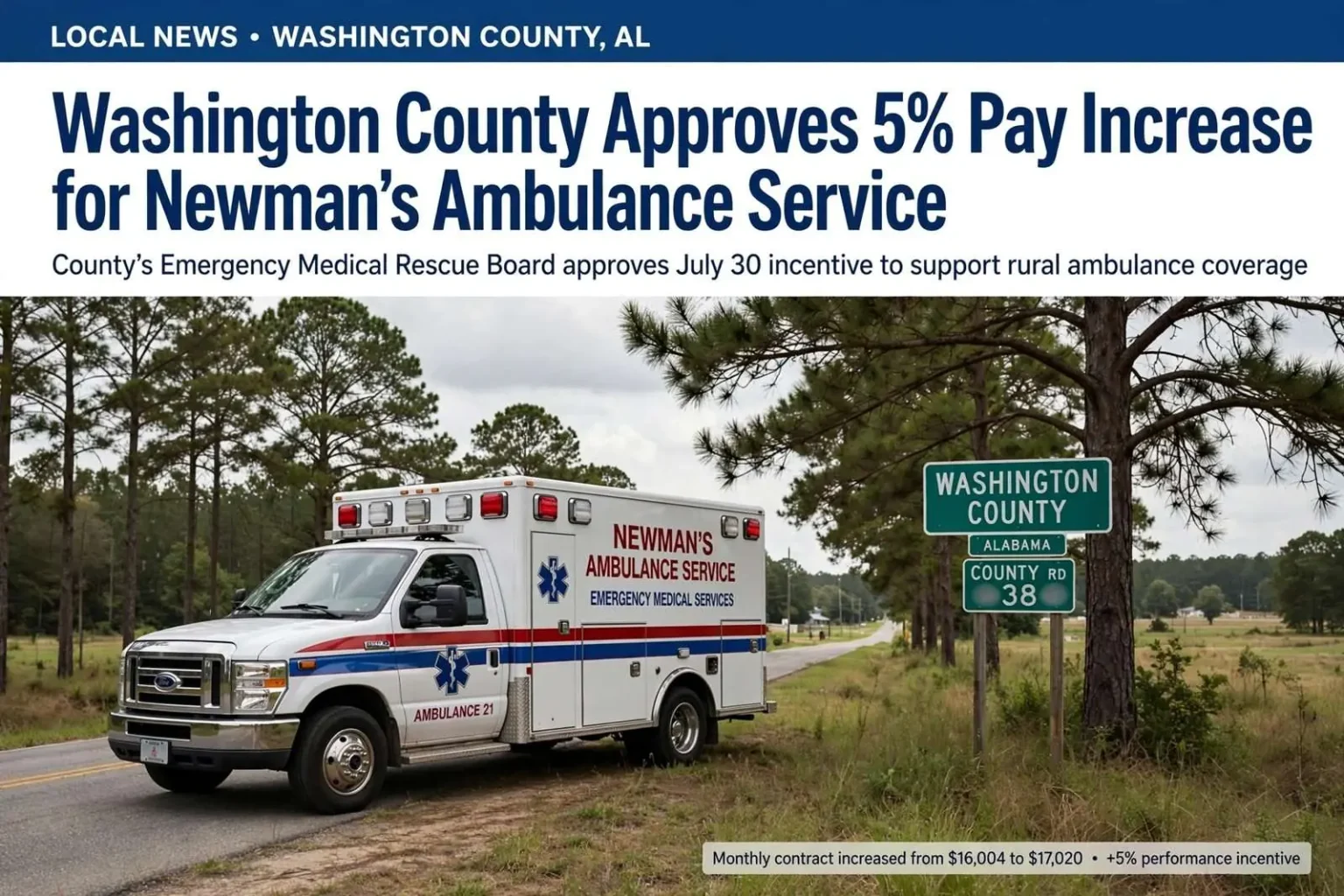
Newman’s Ambulance Service is getting a pay bump for its work serving Washington County, after the county’s Emergency Medical Rescue Board approved a 5 percent performance incentive on July 30. The increase raises the company’s monthly contract payment from $16,004 to $17,020, adding just over a thousand dollars a month to the public subsidy that supports ambulance coverage across one of Alabama’s most rural counties. The vote was described by board leadership as a routine application of the contract’s own terms rather than a new decision reached in response to a problem.
Emergency Medical Rescue Board President Jack Busby said the raise was built into the company’s original contract as a performance incentive, and wasn’t a surprise decision. Under that structure, the additional 5 percent becomes available when the provider meets the performance standards the county set when the agreement was signed — the mechanism by which the board rewards reliable service without renegotiating the contract from scratch. Busby said the additional funding also helps offset rising operating costs, including fuel and other expenses, while recognizing Newman’s continued performance under its agreement with the county.
The distinction matters for how the increase should be understood. A performance incentive written into a contract is not an emergency bailout or a mid-term concession; it is compensation the provider earns by doing the job it promised to do. Rural ambulance contracts across Alabama increasingly include such provisions precisely because fixed monthly payments can fall behind the actual cost of running an ambulance service, and boards that want to keep a provider in place build in ways for the pay to rise with performance and with costs.
Why rural ambulance service is expensive to run
Washington County sits in southwest Alabama along the Mississippi line, a county of small communities — Chatom, Millry, McIntosh, Vinegar Bend, Saint Stephens, Leroy and others — spread across a wide rural landscape with long distances between addresses and a volunteer-based fire tradition. Covering that territory with ambulance service means long transport runs to hospitals in Chatom, Jackson, Mobile, or across the state line, plenty of miles on every unit, and response areas that can take a crew far from its station on any given call. Every mile is fuel, maintenance, tires, and payroll time, which is why operating costs weigh so heavily on providers working rural contracts.
The economics of rural EMS are unforgiving in other ways as well. Reimbursement for ambulance transports, which comes largely through Medicare and Medicaid for the patients rural services carry most often, frequently covers less than the full cost of the run — particularly for long-distance transports from isolated communities to hospitals outside the county. A contract payment from the county or a rescue board bridges that gap, making it possible for a company like Newman’s to keep units staffed and available around the clock in a service area that private market forces alone would struggle to justify.
Fuel is only the most visible of the rising costs. Ambulance services face the same pressures as any fleet operator — vehicle prices, parts availability, insurance premiums — along with the persistent challenge of staffing, since paramedics and EMTs are in demand across the region and can often earn more in urban services or hospital settings. When those pressures mount faster than a fixed contract payment grows, providers can be pushed toward cutting service or leaving a county altogether, outcomes that rural boards work hard to avoid.
How the Emergency Medical Rescue Board fits in
The Emergency Medical Rescue Board is the public body charged with overseeing ambulance service for Washington County, administering the contract that defines what residents are entitled to expect from their EMS coverage. The board’s job is a balancing act familiar to rural governments across the state: hold the provider accountable for response times and staffing, while paying enough to keep qualified crews on the road. When the board sets performance incentives into a contract, it is building accountability and financial viability into the same document — the provider earns more only by continuing to perform, and the county gets a service it does not have to rebuild every few years.
Board President Jack Busby’s explanation of the July 30 vote emphasized that continuity. The 5 percent incentive had been part of the original agreement with Newman’s, and its approval was the contract working as designed rather than a response to a shortfall or a dispute. That kind of predictability is valuable on both sides of the table: the provider can plan around the payment it has earned, and the board avoids the disruptions that come when an ambulance company walks away from an unsustainable contract mid-term, an outcome that has played out in other rural Alabama counties in recent years.
The numbers involved illustrate the scale of the public commitment. A monthly payment of $16,004 comes to roughly $192,000 a year before the incentive; at $17,020, the annual figure approaches $205,000. For a small rural county, that is serious money, and it reflects the reality that ambulance service cannot pay for itself out of transport fees in a county with Washington’s population density and travel distances. The extra $12,000 or so a year that the incentive adds is the price of keeping a proven provider whole as its costs rise.
What reliable ambulance coverage means for residents
For the people who live in Washington County, the contract details translate into a simple question: when someone dials 911, how long until help arrives? In a county where a drive from a far corner to the hospital in Chatom or on to Jackson can take the better part of an hour, having a staffed ambulance positioned and ready is the difference between a medical emergency with options and one without. Rural residents — often older on average than the state as a whole, and living farther from hospitals — depend on that readiness for cardiac events, strokes, wrecks on rural highways, and the farm and timber accidents that remain part of life in the region.
Keeping the same provider under a stable, incentivized contract also preserves institutional knowledge. Crews who work a county for years learn the back roads, the long driveways, the volunteer fire departments they coordinate with, and the quickest routes to the right hospital — knowledge that resets to zero whenever a county has to change providers. Continuity, in other words, is itself a performance value, and the board’s structure rewards the company for maintaining it.
With the incentive approved on July 30, Newman’s Ambulance Service continues as Washington County’s contract EMS provider at the higher monthly rate of $17,020, with the increase serving both as recognition of performance already delivered and as support against the fuel and operating costs that keep climbing. For the county’s residents, the vote is one more step in the unglamorous but essential work of keeping an ambulance close enough to matter.
The broader picture for rural EMS in Alabama
Washington County’s approach reflects a wider pattern. Across rural Alabama, counties and rescue boards have spent recent years wrestling with how to keep ambulance coverage in place as providers consolidate, fuel prices swing, and workforce shortages deepen. Some counties have raised contract payments, others have taken a direct role in funding EMS through ambulance fees or allocations, and many have adopted the same tool Washington County used: performance-based incentives that let the pay rise only when the service holds up its end of the deal.
The stakes of getting it wrong are well documented. When rural ambulance services fold or withdraw, counties can be left scrambling for coverage, with neighboring services stretched thin and response times climbing to lengths that put patients at risk. Preventing that outcome is far cheaper than repairing it, which is why boards like Washington County’s treat a modest, contract-defined increase not as an expense to be resisted but as maintenance on a system residents depend on daily.
For now, the July 30 decision stands as a working example of that philosophy: a 5 percent performance incentive, applied as the contract intended, lifting the monthly payment from $16,004 to $17,020 and keeping Newman’s Ambulance Service — its crews, its units, and its institutional knowledge of the county — right where Washington County needs it.
Residents who want to follow the board’s work can watch for its regular meetings, where contract performance, coverage levels, and the finances of county EMS are discussed in public. Those sessions are where decisions like the July 30 incentive are weighed, and they offer a window into the ongoing effort to balance cost with capability in a county where geography makes every ambulance run a long one.
The July 30 approval also underscores how county governments measure value in rural EMS contracts. The additional funding was justified not by a crisis but by the steady, documented performance of a provider meeting its obligations month after month, combined with the cost pressures any fleet operator faces. That combination — performance on one side, rising fuel and operating expenses on the other — is exactly the situation performance incentives are designed to address, and the board’s vote reflected the terms written into the agreement rather than a new negotiation.