State Awards $3.6 Million in Road Grants, Including Projects in Robertsdale and Washington County
Governor Kay Ivey announced $3.6 million in state road grants for 11 projects statewide, including a Robertsdale culvert replacement and a Washington County paving project.
Governor Kay Ivey announced this week that more than $3.6 million in state funding is being awarded to cities and counties across Alabama for 11 road projects, part of a recurring grant program aimed at shoring up local transportation infrastructure.
The awards represent the second round of funding distributed this year under the Alabama Department of Transportation’s Annual Grant Program, which was created under the Rebuild Alabama Act. That law, passed by the Legislature and signed by Ivey in 2019, requires ALDOT to set aside at least $10 million each year from the state’s share of gas tax revenue specifically for local road projects. Additional funding is expected to be awarded later this year.
“Strong, safe and reliable infrastructure is one of the reasons our state attracts record-breaking investments and jobs,” Ivey said in announcing the grants. “Rebuild Alabama is delivering lasting improvements, ensuring we have the strong transportation network needed to support our growing economy and those who drive our roads and bridges. We are keeping our foot on the gas and will continue to invest in infrastructure that serves every corner of Alabama.”
Local governments are not simply receiving free money — cities and counties receiving grants in this round also contributed more than $1.5 million of their own toward the projects, and all awarded projects must break ground within one year of receiving funding. Since the Rebuild Alabama Act passed, ALDOT’s Annual Grant Program has now awarded more than $81.8 million in state transportation funding for local projects statewide.
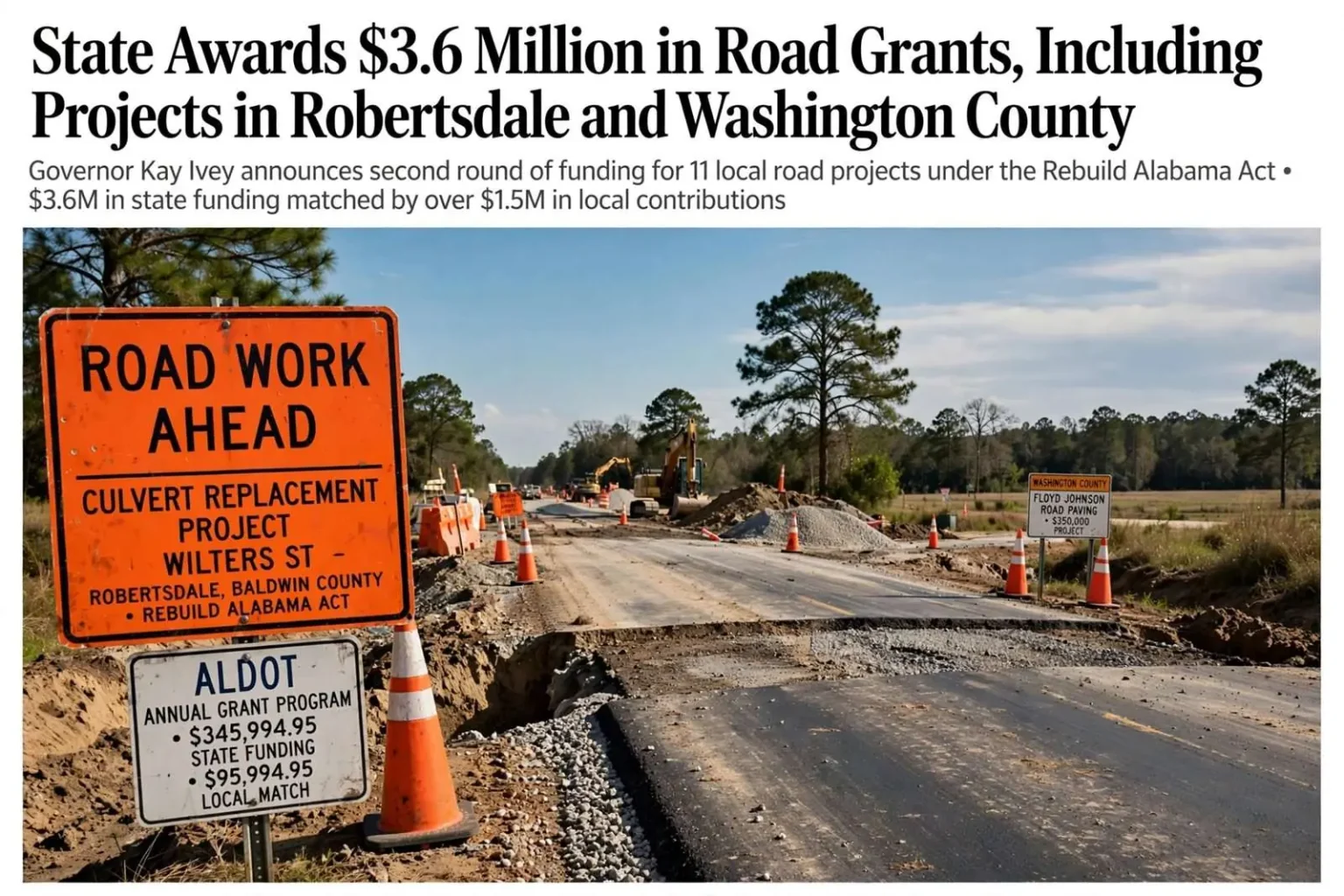
Two of the projects included in this round directly affect South Alabama. In Robertsdale, in Baldwin County, the state is funding a culvert replacement on Wilters Street, with $345,994.95 in state money paired with $95,994.95 in local matching funds for a total project cost of $441,989.90. In Washington County, the grant program is funding full-depth asphalt paving of Floyd Johnson Road, backed by $350,000 in state funds and $141,310 in local matching funds, for a total of $491,310.
Where the Money Comes From
The Rebuild Alabama Act raised the state’s fuel tax by 10 cents a gallon, phased in over three years beginning in September 2019, with the rate afterward adjusted periodically to track road-construction costs. Revenue from the increase is dedicated to road and bridge work and is split among the state, counties and cities, with the Annual Grant Program set aside specifically for local projects.